-
We detected your language preference as English. Would you like to switch to the English version for a better experience?
Switch to English
Stay here


Formulators seeking smooth, tangle-free hair and silky skin feel consistently turn to one ingredient family: the polyquaterniums. These synthetic and semi-synthetic cationic polymers — designated by INCI names such as Polyquaternium-6, Polyquaternium-7, Polyquaternium-10, and Polyquaternium-11 — carry a permanent positive charge that makes them highly substantive to the negatively charged surfaces of hair and skin. The result is measurable wet- and dry-combing improvement, reduced static and flyaway, and a soft conditioning film that transforms sensory perception. Yet selecting the wrong polyquaternium, or mishandling it in an anionic surfactant base, can cause haze, precipitation, limp hair, or stubborn buildup. This guide breaks down the chemistry, the families, the comparative performance, formulation best practices, and the global regulatory status of polyquaternium conditioning polymers.
| Function | Target Applications | Key Specifications | Compliance Status |
|---|---|---|---|
| Cationic conditioning, anti-static, film-forming, viscosity contribution, deposition aid for silicones and actives | Rinse-off and leave-on hair care (shampoos, conditioners, masks, styling), body wash, facial cleansers, moisturizers, shave gels | Supplied as aqueous solutions (8–40% solids) or powders; cationic charge density from ~0.5 to ~6 meq/g; molecular weights from ~105 to >106 Da | CIR-reviewed as safe as used in present practices; listed in the EU CosIng database with no Annex II/III restrictions for common grades; listed in China IECIC |
| Wet-comb force reduction, surface lubricity, sebum control films, clear-gel conditioning | Clear shampoos, 2-in-1 cleansers, color-protection lines, sulfate-free systems, bar cleansers, wipes | Typical use levels 0.05–2.0% active; stable pH 4–9 for most grades; compatible with anionic/amphoteric surfactant systems depending on charge density | US: MoCRA (2022) ingredient listing framework; EU: Regulation (EC) No 1223/2009 compliant; Japan: positive list systems; safety supported by SCCS review principles |
The polyquaterniums are not a single chemistry but a numbered INCI series of quaternary ammonium polymers. The most important industrial routes include:
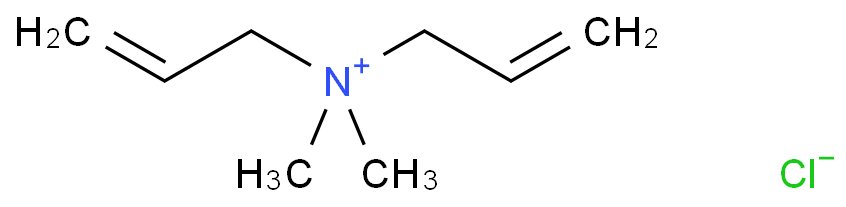
Polyquaternium-6 (CAS 26062-79-3) is produced by free-radical cyclopolymerization of diallyldimethylammonium chloride (DADMAC), yielding a homopolymer in which the quaternary ammonium group sits inside a pyrrolidinium ring within the backbone:
Polyquaternium-7 (CAS 26590-05-6) is a copolymer of DADMAC with nonionic acrylamide. The acrylamide dilutes the cationic charge along the chain, which is why PQ-7 tolerates anionic surfactant systems far better than PQ-6. Commercial PQ-7 is typically sold as an 8–10% aqueous solution. For sourcing, the Polyquaternium-7 supply listing covers major producers and grades.
Polyquaternium-10 (CAS 68610-92-4) is a cationic cellulose ether: hydroxyethyl cellulose is etherified with the quaternizing reagent 3-chloro-2-hydroxypropyltrimethylammonium chloride (the same reagent used to cationize guar), grafting trimethylammonium side groups onto the polysaccharide:
Polyquaternium-11 (CAS 53633-54-8) is the quaternized copolymer of vinylpyrrolidone and dimethylaminoethyl methacrylate, giving a film-forming polymer favored in mousses, gels, and styling sprays.
The conditioning effect is fundamentally electrostatic. Human hair has an isoelectric point near pH 3.7, so at typical cosmetic pH (4.5–6.5) the cuticle surface carries a net negative charge. Quaternary ammonium groups are permanently ionized — independent of pH — so polyquaternium chains adsorb strongly and often irreversibly onto the fiber surface. This adsorbed polymer layer:
• Lubricates the cuticle, lowering the friction coefficient and cutting wet-combing forces dramatically — the key instrumental proof of conditioning performance.
• Neutralizes static charge, suppressing flyaway after towel-drying and brushing.
• Forms a flexible film that smooths lifted cuticle scales, improving shine and alignment.
• Acts as a deposition aid: in 2-in-1 shampoos, dilution-induced coacervation between the cationic polymer and anionic surfactant (e.g., sodium laureth sulfate) forms a viscous phase that deposits onto hair during rinsing, carrying silicones and oils with it.
Charge density and molecular weight govern substantivity: high-charge, high-molecular-weight polymers deposit more strongly but risk buildup and over-conditioning, while low-charge copolymers give a lighter, cleaner feel. On skin, the same adsorption produces a perceptible silky, "slip" film used in body washes, shave products, and moisturizers — a cornerstone of hair conditioning agents and skin-feel modification generally. Biodegradability varies: cellulosic and guar-based cationics break down more readily than highly substituted vinyl homopolymers such as PQ-6.
With more than 100 numbered INCI entries, the polyquaternium family is best understood as three structural classes, each with distinct handling and performance trade-offs.
These petrochemical-derived polymers are built by free-radical polymerization of quaternized vinyl or allyl monomers. Polyquaternium-6, the DADMAC homopolymer, has the highest charge density of the common grades and delivers powerful conditioning and even some preservative potentiation — but it forms insoluble complexes with anionic surfactants and is therefore largely restricted to conditioners and treatments. PQ-7, the DADMAC/acrylamide copolymer, is the workhorse of the class: low charge, excellent anionic compatibility, and a light skin feel at low cost. Its limitations are modest conditioning at low doses and a slightly tacky feel at high doses. These vinyl polymers are inexpensive and robust, but their biodegradability is limited.
Polyquaternium-10 and the related Polyquaternium-4 attach quaternary groups to a hydroxyethyl cellulose backbone, combining polysaccharide substantivity with a clean, non-tacky after-feel. PQ-10 is the most widely used cationic in clear shampoos because it is compatible with anionic surfactants at typical use levels and even contributes mild thickening. Trade-offs: higher cost than PQ-7, sensitivity to high salt levels, and lower humidity resistance than cationic silicone systems. PQ-4 offers higher charge for deeper conditioning in treatments.
Guar gum, a galactomannan from the guar bean, is cationized with the same trimethylammonium epoxide reagent used for PQ-10. Guar hydroxypropyltrimonium chloride delivers efficient wet-conditioning in clear shampoos, cold-processes easily, and carries a strong sustainability narrative — a natural-based backbone with better biodegradability than vinyl polymers. Limitations include supply variability, haze risk at high use levels in some surfactant systems, and a heavier deposition feel than PQ-10. It is often paired with PQ-7 or PQ-10 in hybrid conditioning systems.
| INCI Name / CAS | Charge Density | Anionic Surfactant Compatibility | Feel / Sensory | Best Applications |
|---|---|---|---|---|
| Polyquaternium-6 (26062-79-3) | Very high (~6 meq/g) | Poor — complexes/precipitates with sulfates | Heavy, substantive conditioning | Rinse-off conditioners, hair masks, treatments |
| Polyquaternium-7 (26590-05-6) | Low (~1–2 meq/g) | Excellent — standard in sulfate shampoos | Light, clean, low-tack | Clear shampoos, body wash, 2-in-1 cleansers |
| Polyquaternium-10 (68610-92-4) | Moderate | Good — stays clear in most anionic systems | Silky, cushioned, non-tacky | Premium shampoos, shower gels, leave-on skin care |
| Polyquaternium-11 (53633-54-8) | Moderate | Good in PVP-containing and alcohol systems | Firm flexible film, slight stiffness | Mousses, gels, styling sprays, conditioners |
| Polyquaternium-16 (95144-24-4) | Moderate | Good | Light film, glossy finish | Leave-in conditioners, styling lotions, mascara |
| Guar Hydroxypropyltrimonium Chloride (65497-29-2) | Tunable (low to high) | Good in most anionic shampoos | Soft, natural, slightly heavier | Natural-positioned shampoos, sulfate-free lines |
Successful use of polyquaterniums is a matter of matching charge density to the surfactant system and controlling polymer order of addition. The table below summarizes typical use levels drawn from supplier technical literature and standard formulation practice:
| Polymer | Typical Use Level (active) | Recommended pH | Addition / Processing Notes |
|---|---|---|---|
| Polyquaternium-7 | 0.1–1.0% | 4.0–8.0 | Add liquid grade to the water phase before surfactants or directly into the finished base with good agitation |
| Polyquaternium-10 | 0.1–0.5% (up to 1.0% in treatments) | 4.5–7.0 | Pre-disperse powder in warm water (40–50 °C) and let hydrate fully before adding surfactants; avoid dumping powder into concentrated surfactant gel |
| Polyquaternium-6 | 0.1–0.5% | 3.5–7.0 | Use only in essentially anionic-free systems; add to the water phase of conditioners and masks |
| Polyquaternium-11 | 0.5–2.0% | 5.0–8.0 | Solution or powder form; add after neutralization of carbomer gels to avoid viscosity loss |
| Guar Hydroxypropyltrimonium Chloride | 0.1–0.5% | 4.5–8.0 | Pre-swell in water or glycerin slurry before surfactant addition; hydrates slowly — allow 20–30 minutes |
Polyquaterniums enjoy a long, well-documented safety history. The table below summarizes the principal jurisdictions and frameworks a global formulator must address:
| Jurisdiction / Body | Framework | Status of Polyquaterniums |
|---|---|---|
| United States | CIR review; MoCRA (2022) ingredient listing | CIR has reviewed numerous polyquaterniums (including PQ-7, PQ-10, PQ-11 and related cationics) and found them safe as used in present cosmetic practices; no FDA color-additive-type restrictions apply |
| European Union | Regulation (EC) No 1223/2009; CosIng database | Common polyquaterniums are listed in CosIng with no entries in Annex II (prohibited) or Annex III (restricted); safety assessment per Article 10 and the SCCS Notes of Guidance is the responsibility of the Responsible Person |
| China | IECIC (Inventory of Existing Cosmetic Ingredients); CSAR | Widely used polyquaterniums and cationic guar appear in the IECIC and may be used in registered/notified cosmetics in line with NMPA technical requirements |
| Japan / Korea | MHLW positive list; MFDS cosmetic rules | Permitted as quasi-drug/cosmetic conditioning ingredients within established use practices; no specific concentration limits for standard polyquaterniums |
| Quality standards | ISO 11930 (preservation), ISO 22716 (GMP), pharmacopeial monographs | Supplier specifications typically control residual monomers (e.g., DADMAC, acrylamide), heavy metals, and microbial limits; formulators should request current certificates of analysis and residual-monomer data |
PQ-7 is a synthetic copolymer of DADMAC and acrylamide with a low cationic charge, sold as an economical liquid that excels in clear anionic shampoos and body washes. PQ-10 is a cationic hydroxyethyl cellulose with moderate charge, usually a powder, giving a silkier, more cushioned feel, better skin substantivity, and a stronger premium positioning — at a higher price point. Many shampoos use both together to balance cost and sensory.
CIR panels have evaluated many polyquaterniums and concluded they are safe as used in cosmetics. Buildup is a cosmetic rather than safety issue: high-charge polymers applied repeatedly without clarifying can accumulate, weighing fine hair down. Alternating with a clarifying shampoo or limiting cationic polymer concentration to about 0.3% active in daily-wash products keeps deposition in the intended range.
Haze signals polymer–surfactant complex formation. Either the charge density of the chosen polymer is too high for the anionic level (switch from PQ-6 to PQ-7 or PQ-10), the total actives are too concentrated at the point of addition (dilute or change order of addition), or salt added for thickening pushed the system past its compatibility limit. A compatibility ladder study across polymer dose and salt level will map the clear window.
Cationic guar (guar hydroxypropyltrimonium chloride) and cationic celluloses like PQ-10 are natural-derived options with better biodegradability than vinyl-type polymers such as PQ-6 or PQ-16. For fully sulfate-free and naturally positioned systems, guar-based cationics combined with natural emollients deliver credible conditioning performance while supporting clean-beauty claims.
 |
 |
 |
 EN
EN
 Agricultural News
 Food News
 Industrial News
 Cosmetic News
 Pharmaceutical News
 Science News

 1YR
1YR

