-
We detected your language preference as English. Would you like to switch to the English version for a better experience?
Switch to English
Stay here


Tetrabromobisphenol A (TBBPA) is one of the most widely used brominated flame retardants globally, essential for providing flame retardancy to styrenic thermoplastics and some thermosetting resins. Its primary markets include electrical, electronic, automotive, textile, and furniture industries. High-quality TBBPA is crucial for flame retardant polymers and plastics used in the electronics industry. The structure of Tetrabromobisphenol A is as follows:
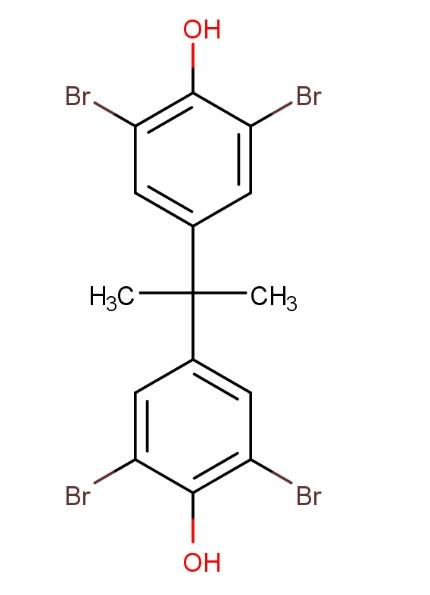
(1) U.S. Patent No. 3,536,302 describes the synthesis of TBBPA through the reaction of bisphenol A and bromine in methanol, generating an equivalent amount of HBr as a byproduct. This method's drawback includes the formation of methyl bromide, a restricted chemical, complicating the recycling of hydrogen bromide.
(2) Japanese Patent 77034620 B4 77/09/05 and U.S. Patents 3,929,907; 4,180,684; 5,068,463 involve bromination of bisphenol A in a biphasic system consisting of water, immiscible halogenated organic compounds, and oxidants. The oxidants convert HBr to Br2, which further brominates more bisphenol A and its underbrominated components. These methods are criticized for their long reaction times and high processing costs.
(3) Japanese Patent 1979-55538 dated May 2, 1979 describes the preparation of TBBPA in the presence of organic solvents and aqueous solutions, utilizing a surfactant at the end of the reaction to improve product separation. However, this method often yields lower product quality.
(4) U.S. Patents 4,990,321; 5,008,469; 5,059,726; and 5,138,103 involve bromination of bisphenol A at low temperatures (0 to 20°C) in methanol solvent with a specific amount of water. Additional water is added at the end to precipitate TBBPA. These methods require extended aging or boiling times after all reactants are added, plus extra handling time for the final water addition.
(5) U.S. Patent 6,002,050 uses saturated bisphenol A with TBBPA in a water-soluble solvent containing H2O2 and 1-20 wt. % acid at relatively high temperatures for bromination. Drawbacks include high temperatures, long reaction times, significant water content, and minor methyl bromide formation.
Currently, the preparation process of TBBPA in most salt fields utilizes the chlorobenzene method. Chlorobenzene serves as the solvent where bisphenol A, hydrogen peroxide, and sulfuric acid are added into the reaction kettle. After cooling with ice water, bromine is added dropwise at 20°C. After completion, the mixture is aged at 85°C for 20 minutes. Upon phase separation, the oil phase is neutralized with sodium sulfite solution at 85°C, followed by washing with water. Crystallization of the oil phase after water washing yields solid Tetrabromobisphenol A product, which is filtered. The mother liquor is reused for bromination but requires distillation due to excessive impurities.
Some salt fields adopt the dichloromethane method for TBBPA production. Dichloromethane acts as the solvent where bisphenol A and sulfuric acid are added to the reaction vessel. After cooling with ice water, bromine and hydrogen peroxide are added dropwise at 20°C. The temperature is then raised to reflux for maturation. After phase separation, the oil phase is neutralized with sodium sulfite solution, followed by washing with water. Evaporation and cooling of the oil phase after water washing lead to crystallization.
Preparation of Ni-Al-Cl hydrotalcite (3:1): Approximately 200 ml of deionized water was placed in a 1-liter four-neck round-bottom flask, stirred magnetically under nitrogen flow at 25°C. A mixture of AlCl3.9H2O (12.07 g) in deionized solution (Al3+=0.05 mol/l), NiCl2.6H2O (35.65 g) (Ni2+=0.15 mol/l), and sodium hydroxide solution (16 g, 0.2 mol/l) was continuously titrated dropwise. The pH of the reaction mixture was maintained between 10.00-10.2. The resulting precipitate was filtered, washed with deionized and decarbonated water, and dried at 70°C for 15 hours.
To achieve 12% anion exchange capacity, 1 g of Ni-Al-Cl hydrotalcite was stirred in 100 ml of 1.87 mM (0.616 g) sodium tungstate solution at 293K for 24 hours. The solid catalyst was filtered, washed with deionized and decarbonated water, and freeze-dried to dryness.
100 g of bisphenol A was combined with 600 ml of dichloroethane (DCE), 75 mg of catalyst, 20 ml of water, and 66.58 g of 49% hydrogen peroxide in a 2-liter round-bottom flask, thoroughly stirred. Bromine (147.7 g) was added dropwise using a pressure equalizing funnel over 8-10 minutes. The addition of bromine was controlled to prevent vapor from escaping the reflux condenser. The reaction mixture was stirred for 30 minutes at the same temperature. Stirring was stopped, and the reaction mixture was transferred and allowed to precipitate in a separating funnel at 60-65°C. The aqueous and organic layers were separated. The organic layer was transferred back into the same 2-liter flask, and 15 g of sodium bisulfite dissolved in 700 ml of water was added to the organic layer. The mixture was heated on an Isomantle to recover DCE. As DCE evaporated, the product separated as a solid from the organic layer. After DCE recovery, the slurry was filtered to separate the solid product from the aqueous layer. The filter cake was reconstituted with water to form a slurry, stirred for 10-15 minutes, and filtered. The filter cake was dried in a vacuum dryer. The dried product is TBBA. The purity of the product in this method was 99.88% TBBA (by HPLC), with a yield of 95%.
(1) Bromine, bisphenol A, sulfuric acid, hydrogen peroxide solution, and dichloromethane were introduced into a continuous bromination reactor for bromination reaction. The masses of bromine, bisphenol A, sulfuric acid, hydrogen peroxide solution, and dichloromethane were 65.8 kg, 45.7 kg, 4.5 kg, 55.4 kg, and 352.6 kg respectively. The reaction conditions were controlled at 55°C and 0.1Mpa.g to produce a solution of tetrabromobisphenol A.
(2) The tetrabromobisphenol A solution obtained in step (1) underwent a curing reaction. The reaction conditions were controlled at 55°C and 0.1Mpa.g, with a curing time of 1 hour. After curing, the mixture was allowed to settle for phase separation, with a settling time of 0.25 hours. The aqueous phase was separated.
(3) 65.8 kg of sodium sulfite solution was added to the organic phase obtained in step (2) for neutralization reaction. The reaction conditions were controlled at 35°C and atmospheric pressure. After the reaction, the mixture was allowed to settle for phase separation, with a settling time of 0.25 hours. The aqueous phase was separated.
(4) The organic phase obtained in step (3) was subjected to water washing, and the aqueous phase was separated. The organic phase was evaporated to crystallize, with the vapor of dichloromethane generated from the bromination reaction of step (1) used as a heat source during the crystallization process. The final product tetrabromobisphenol A was obtained, with 152.1 g produced, yielding 97.0%, and purity of 99.2%.
One key aspect of achieving sustainable development is finding suitable alternatives. For flame retardants, the focus is on replacing tetrabromobisphenol A (TBBPA) with more environmentally friendly alternatives. TBBPA raises concerns due to potential health and ecological risks. Researchers are actively developing safer alternatives that provide equivalent fire protection.
The future of flame retardant technology lies in innovation. People are continuously exploring new materials and methods. This includes developing flame retardants derived from bio-based materials or flame retardants that act through different mechanisms, such as altering the combustibility of materials themselves. Through ongoing research and development, we can ensure sustainable fire safety without compromising the environment or human health.
The synthesis methods for tetrabromobisphenol A are diverse, each with its specific advantages and disadvantages. With continued technological development and progress, we can expect more efficient, environmentally friendly methods for TBBPA synthesis to emerge, providing more choices for its production and promoting its application in industrial and research fields.
[1] https://patents.google.com/patent/US6245950B1/en
[2] Tianjin Changlu Hangu Salt Field Co., Ltd., Tianjin Tiandi Chuangzhi Technology Development Co., Ltd. A continuous production process for tetrabromobisphenol A. 2023-08-08.
[3] https://www.epa.gov/saferchoice/alternatives-assessment-partnership-evaluate-flame-retardants-printed-circuit-boards
[4] https://pubmed.ncbi.nlm.nih.gov/32933740/
[5] https://www.nist.gov/programs-projects/advanced-gas-phase-fire-retardants-project
|
 |
 |
 EN
EN
 Agricultural News
 Food News
 Industrial News
 Cosmetic News
 Pharmaceutical News
 Science News

 13YRS
13YRS