-
We detected your language preference as English. Would you like to switch to the English version for a better experience?
Switch to English
Stay here


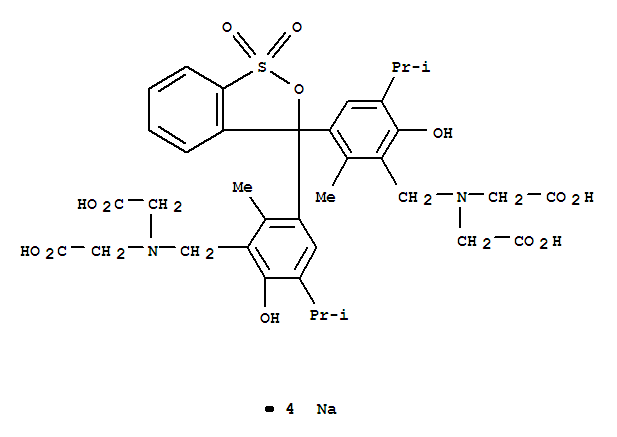
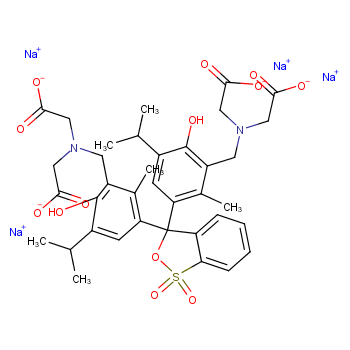
Methylthymol blue (tetrasodium salt), abbreviated as MTB, has the CAS number 1945-77-3 and the molecular formula C37H40N2Na4O13S. It is a representative metal chromogenic indicator containing thymol. Metal chromogenic indicators are widely used in chemical analysis. They serve as end-point indicators in chelation titrations, reagents in spectrophotometric/fluorometric analyses to form stable complexes, and preconcentrators in trace metal analysis. They are also utilized as active modifiers on various nanocomposites and liquid membrane electrodes for metal ion measurements. The MTB-metal chromogenic indicator complexes can form organic metal dyes with different colors and spectral features compared to the complete metal chromogenic indicators. Understanding the physicochemical properties of these complexes provides insights into the chemical contributions of each substance in its coordination system, coordination sites, and molecular geometry of MTB-metal chromogenic indicator complexes. This knowledge is crucial for applications such as measuring acidic or association constants and determining free metal ion concentrations using methods like ion increment analysis. MTB interacts with its target metal ions by forming stable complexes, with color changes indicating the formation of these complexes, which is a key feature of MTB as a chelating indicator.
Appearance: Green-brown crystalline powder
Boiling Point: 891.6°C at 760 mmHg
Flash Point: 493°C
Solubility: 460 g/L
pH: 6.2 (10g/L in H2O at 20°C)
Water Solubility: Soluble in water (460 g/L) at 20°C
Refractive Index: 1.635
Stability: Stable, incompatible with strong oxidizers
MTB has nine active functional groups (four carboxyl, two phenol, two amine, and one sulfonyl group). The indicator is similar to Xylenol Orange, with an N2O6 coordination layer geometry. These groups enable it to complex with various divalent metal ions. MTB is a sensitive but non-selective metal chromogenic indicator, interacting with over 20 metal ions depending on the solution's pH. It has been used as a chelating agent for iron in Fricke gel dosimeters and for three-dimensional dose measurement in cancer radiotherapy. Methylthymol blue calcium assays enable the rapid colorimetric determination of calcium in biological fluids.
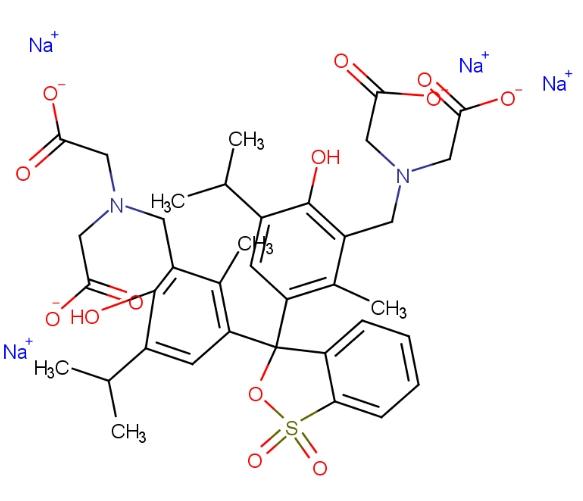
MTB's pH indicating properties make it a crucial tool in analytical chemistry. Its color changes significantly with the pH of the solution: yellow in acidic pH (below 2.0) and blue in basic pH (above 8.0). This sensitive pH response makes MTB widely applicable in:
Acid-Base Titrations: MTB accurately indicates the end-point of titrations for determining acid-base solution concentrations.
pH Titrations: MTB can be used to determine the pKa value of sample solutions, inferring the nature of weak acids or bases.
pH Measurement: MTB provides a quick and easy method for measuring solution pH, applicable in water quality monitoring and soil analysis.
Metal indicators are organic compounds that form specific color metal ion complexes in aqueous media. These dyes are used to detect end-points in volumetric methods (complexometric titrations) and to determine concentrations in colorimetric or photometric methods. Methylthymol blue is used in complexometric titrations for Ba, Bi, Ca, Cd, Cu, Fe, Hg, In, lanthanides, Mg, Mn, Pb, Sc, Sn, Th, Tl, Zn, and Zr. It is also employed in photometric determinations of Al, Be, Bi, Ca, Co, Cr, Cu, Fe, Ga, In, lanthanides, Mg, Mn, Ni, Pb, Pd, Sc, Th, U, V, Y, Zn, and Zr.
Handle Methylthymol Blue sodium salt in a well-ventilated area, wearing protective gloves, goggles, and lab coats.
Perform experiments in a fume hood and wear appropriate personal protective equipment.
Follow laboratory safety procedures to avoid contact with skin, eyes, and clothing.
General Advice: Consult a physician. Provide the safety data sheet to the treating doctor.
Inhalation: Move the person to fresh air. If breathing has stopped, perform artificial respiration. Consult a doctor.
Skin Contact: Wash with soap and plenty of water. Consult a doctor.
Eye Contact: Rinse thoroughly with water for at least 15 minutes and consult a doctor.
Safe Handling Precautions: Avoid contact with skin and eyes. Prevent dust and aerosol formation. Use special instructions before handling. Provide adequate ventilation in dust-forming areas.
Eye/Face Protection: Wear safety glasses with side shields conforming to EN166. Use eye protection tested and approved by relevant government standards (e.g., NIOSH in the USA or EN 166 in the EU).
Skin Protection: Wear impervious clothing. Choose protective equipment based on the concentration and quantity of hazardous substances in the workplace. Wear gloves. Check gloves before use. Use appropriate glove removal techniques to avoid skin contact. Dispose of contaminated gloves according to applicable laws and good laboratory practices. Wash and dry hands. Protective gloves must meet EU Directive 89/686/EEC and its derived standards EN 374.
[1]https://pubchem.ncbi.nlm.nih.gov/compound/Methylthymol-blue
[2]Rasouli Z, Irani M, Jafari S, et al. Study of interaction of metal ions with methylthymol blue by chemometrics and quantum chemical calculations[J]. Scientific Reports, 2021, 11(1): 6465.
[3]Penev, K I; Mequanint, K . (2015). Methylthymol blue in Fricke gels. Journal of Physics: Conference Series, 573(), 012030–. doi:10.1088/1742-6596/573/1/012030
[4]https://pubs.acs.org/doi/10.1021/acsreagents.4230
|
 |
 |
|
 EN
EN
 Agricultural News
 Food News
 Industrial News
 Cosmetic News
 Pharmaceutical News
 Science News

 15YRS
15YRS

