-
We detected your language preference as English. Would you like to switch to the English version for a better experience?
Switch to English
Stay here


Shampoos, conditioners, lotions, sunscreens and virtually every cream on the shelf share one engineering challenge: oil and water do not mix. Without an oil in water (O/W) emulsifier, a lotion separates within hours, delivers uneven doses of active ingredients, and feels greasy instead of elegant. Formulators constantly fight phase separation during freeze-thaw shipping, viscosity loss on the shelf, and inconsistent sensory profiles — all of which trace back to how well the emulsifier builds and protects the oil-water interface. This technical guide explains the mechanism of O/W emulsifiers, the chemical families available to cosmetic chemists, how to select and compare them, and how to process them for stable, regulation-compliant products.
| Function | Target Applications | Key Specifications | Compliance Status |
|---|---|---|---|
| Interfacial tension reduction and droplet stabilization of oil droplets in a continuous water phase (O/W emulsions) | Body lotions, facial moisturizers, hair conditioners, sunscreens, liquid foundations, micellar cleansers | HLB 8-18 for O/W systems; typical use level 0.5-8%; combined with co-emulsifiers (fatty alcohols) at 1:3-1:4 ratio | Major emulsifiers reviewed by CIR as safe as used; listed in EU Cosmetics Regulation 1223/2009 and China IECIC |
| Secondary functions: solubilization of fragrance and lipophilic actives, wetting, spreading and lamellar gel-network formation | Self-emulsifying bases, "gel creams", natural and sulfate-free formulations, barrier-repair products | Nonionic ethoxylates (polysorbates, ceteareths), ester emulsifiers (glyceryl stearate, polyglyceryl esters), anionic soaps/phosphates, cationic quats | Ethoxylates monitored for 1,4-dioxane residuals; cationics subject to Annex V concentration limits in the EU |
An oil in water emulsifier is an amphiphilic molecule: it carries a lipophilic tail (typically a C12-C18 fatty chain) that anchors in the oil droplet and a hydrophilic head (ethoxylated chain, ester, sugar or ionic group) that extends into the aqueous phase. When the emulsion is homogenized, emulsifier molecules migrate to the freshly created oil-water interface, where they perform three simultaneous jobs:

Surfactant molecules adsorbing at an interface: the lipophilic tail solubilizes in oil while the hydrophilic head remains in water — the fundamental action behind every oil in water emulsifier.
Griffin's Hydrophilic-Lipophilic Balance (HLB) assigns each emulsifier a number from 0 (fully lipophilic) to 20+ (fully hydrophilic). By Bancroft's rule, the phase in which the emulsifier is more soluble becomes the continuous phase — so O/W emulsifiers need sufficient hydrophilicity, typically HLB 8-18. Each oil phase has a "required HLB": paraffin oils need about 10-12, silicone oils around 10.5, and polar esters like isopropyl myristate roughly 11-12. In practice, formulators blend a low-HLB emulsifier with a high-HLB partner to bracket the required HLB of the oil phase, which also packs the interfacial film more densely than a single surfactant. You can explore this concept further in the Guidechem oil in water emulsification encyclopedia entry.
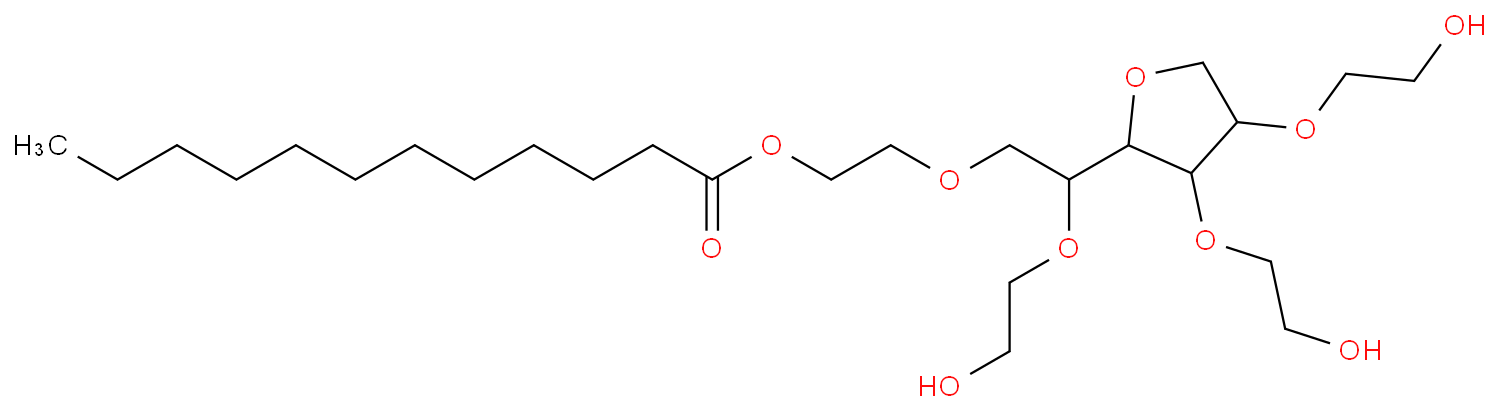
The workhorse nonionic emulsifiers — polysorbates and ceteareths — are produced by base-catalyzed ethoxylation of a fatty hydrophobe. Polysorbate 80 (INCI: Polysorbate 80, CAS 9005-65-6) illustrates the full three-step route used industry-wide:
The ethylene oxide chain length is the HLB dial: Polysorbate 20 (20 EO units on a laurate tail) reaches HLB 16.7, while Sorbitan Monooleate without ethoxylation sits at HLB 4.3 and works as a W/O emulsifier. The same chemistry underlies Ceteareth-20 (CAS 68439-49-6), where a cetearyl alcohol mixture is ethoxylated with an average of 20 EO units. A key quality consideration with all ethoxylates is residual 1,4-dioxane, a reaction by-product that responsible suppliers strip by vacuum and that downstream formulators should verify by GC headspace analysis of incoming lots.
O/W emulsifiers are designed to act at the interface, not on the skin, but their interaction with the stratum corneum matters for both performance and safety. Small-molecule emulsifiers can transiently extract intercellular lipids at high concentrations, which is why modern "liquid crystal" emulsifiers (e.g., cetearyl olivate/sorbitan olivate) form lamellar structures that mimic skin lipids and are noticeably milder. Ester-type emulsifiers are susceptible to hydrolysis in strongly acidic or alkaline formulations, releasing free fatty acids and shifting the HLB over time — a hidden cause of late-stage viscosity drift. In the environment, polysorbates and polyglyceryl esters biodegrade readily through ester cleavage followed by β-oxidation of the fatty chain.
The largest and most versatile class. Polysorbate 80 (CAS 9005-65-6), Polysorbate 20 (CAS 9005-64-5), Ceteareth-20 and PEG-100 Stearate (CAS 25497-53-2) stabilize purely by steric repulsion, so they tolerate pH 3-10, hard water and electrolytes. Limitations: potential 1,4-dioxane residuals from ethoxylation, incompatibility with some "natural" certification schemes (COSMOS/NATRUE restrict PEGs), and a slight soapy or waxy afterfeel at high levels.
Glyceryl Stearate (CAS 31566-38-2) — often self-emulsifying (GMS-SE, blended with potassium stearate) — polyglyceryl-3 methylglucose distearate and sorbitan esters offer milder, PEG-free, naturally certifiable alternatives. They typically form lamellar gel networks with fatty alcohols, giving richer body but lower spontaneous solubility and slower interfacial adsorption than ethoxylates, so they demand more process energy.
Sodium or potassium stearate (classic "vanishing cream" emulsifiers) and potassium cetyl phosphate stabilize through strong electrostatic repulsion and are extremely cost-effective. Their weakness is pH dependence: the carboxylate must stay deprotonated (pH > 7 for soaps), they form soap scum with calcium/magnesium ions in hard water, and they are prone to incompatibility with cationic actives and quaternary conditioners.
Behentrimonium methosulfate, cetrimonium chloride and stearalkonium chloride double as emulsifier and conditioner: their positive charge adsorbs onto the negatively charged keratin surface of hair and skin, leaving an emollient film. This makes them the backbone of rinse-off hair conditioners. In the EU, quats are restricted by concentration limits under Annex V of Regulation 1223/2009, and they cannot be combined with anionic emulsifiers without forming insoluble ion pairs.
Lecithin (CAS 8002-43-5), cetearyl olivate/sorbitan olivate blends and olive-derived ester combinations form biomimetic liquid-crystal phases that encapsulate water between bilayers, releasing it slowly on application. They deliver superior skin feel and hydration claims but are harder to process, more variable between feedstock lots, and sensitive to oxidative rancidity.
| Emulsifier (INCI) | CAS No. | Type / HLB | Water Solubility | Stability Profile | Sensory / Feel | Typical Uses |
|---|---|---|---|---|---|---|
| Polysorbate 80 | 9005-65-6 | Nonionic / 15.0 | Soluble, solubilizer | Steric; tolerant of pH, salts | Light slip | Fragrance/oil solubilizing, cleansing lotions |
| Polysorbate 20 | 9005-64-5 | Nonionic / 16.7 | Very soluble | Steric; excellent electrolyte tolerance | Nearly invisible | Toners, micellar waters, wet wipes |
| Glyceryl Stearate | 31566-38-2 | Nonionic ester / ~3.8 | Dispersible | Low HLB — must pair with high-HLB partner | Rich, creamy | Body creams and lotions (co-emulsifier) |
| PEG-100 Stearate | 25497-53-2 | Nonionic ethoxylate / 18.8 | Dispersible | Steric; robust, classic pairing with GMS | Light, fast-absorbing | Everyday lotions, fluid milks |
| Cetearyl Olivate / Sorbitan Olivate | 70914-50-0 (sorbitan olivate) | Nonionic ester / ~8-9 | Forms liquid-crystal emulsions | Lamellar network; very mild, cold-process capable | Silky, moisturizing | Natural lotions, sensitive-skin creams |
| Sodium Stearate | 822-16-2 | Anionic / ~18 | Soluble in hot water | Electrostatic; needs pH > 7, soft water | Light "vanishing" finish | Classic vanishing creams, deodorant sticks |
| Behentrimonium Methosulfate | 81646-13-1 | Cationic / ~15 | Dispersible | Electrostatic; incompatible with anionics | Soft, conditioning | Hair conditioners, 2-in-1 emulsions |
A practical starting rule: pair one low-HLB emulsifier (GMS, HLB ~3.8) with one high-HLB partner (PEG-100 Stearate, HLB 18.8) in a 1:3 to 1:4 ratio to cover the required HLB of most cosmetic oil phases while building a dense, mixed interfacial film. Sourcing options and current pricing for each CAS number can be checked through the Guidechem supplier listings for Ceteareth-20 and equivalent pages for other CAS numbers, or read more background in the Guidechem HLB system encyclopedia article.
Stability is created in the process vessel, not just on paper. The standard hot-process route for a lamellar O/W lotion follows five controlled stages:
A representative reference formulation for a mid-market facial moisturizer illustrates typical use levels:
| Phase | Ingredient (INCI) | % w/w | Function |
|---|---|---|---|
| A (water) | Aqua | q.s. to 100 | Continuous phase |
| A | Glycerin; Xanthan Gum; Disodium EDTA | 3.0 / 0.2 / 0.1 | Humectant, thickener, chelator |
| B (oil) | Cetearyl Alcohol | 3.0 | Co-emulsifier, body |
| B | Glyceryl Stearate + PEG-100 Stearate | 2.0 + 1.5 | Primary O/W emulsifier blend |
| B | Caprylic/Capric Triglyceride | 8.0 | Emollient (dispersed phase) |
| C (cool-down) | Phenoxyethanol/Ethylhexylglycerin; Parfum | 1.0 / 0.3 | Preservative, fragrance (below 40 °C) |
| Jurisdiction | Framework | Status of Major O/W Emulsifiers |
|---|---|---|
| United States | MoCRA (2022) / FDA; CIR safety reviews | Polysorbates 20/60/80, glyceryl stearate and PEG-100 stearate assessed by CIR as safe as used in cosmetics; supplier registration and safety substantiation required under MoCRA |
| European Union | Regulation (EC) No 1223/2009; SCCS opinions | All listed emulsifiers permitted without restriction except quaternary ammonium cationics, which are subject to Annex V concentration limits; 1,4-dioxane traces controlled by SCCS risk assessments |
| China | Safety and Technical Standards for Cosmetics (2015); IECIC | Polysorbates, glyceryl stearate and PEG stearates listed in the IECIC; imported cosmetics require the ingredient to be catalogued before notification |
| Japan / ASEAN | Standards for Cosmetics (MHLW); ASEAN Cosmetic Directive | Nonionic emulsifiers generally usable without quantity restriction; cationics limited by positive-list concentration caps |
| Certification schemes | COSMOS / NATRUE | PEG/ethoxylated emulsifiers prohibited; polyglyceryl esters, olivate esters and lecithin are the compliant alternatives |
For O/W emulsions, use emulsifiers with an HLB between 8 and 18. The precise target is the "required HLB" of your oil phase (roughly 10-12 for mineral and silicone oils, up to 11-12 for polar esters). Blending a low-HLB and high-HLB emulsifier to hit that value — rather than relying on a single surfactant — packs the interfacial film more tightly and markedly improves coalescence resistance.
Freezing concentrates electrolytes in the remaining liquid water, compresses the electrostatic double layer of ionic emulsifiers and can crystallize emollients, puncturing the interfacial film. Fix it by moving to nonionic steric stabilization, adding a co-emulsifier or wax to strengthen the lamellar network around the droplets, and validating with three freeze-thaw cycles at -10 °C/25 °C before launch.
Yes. The Cosmetic Ingredient Review has assessed polysorbates 20, 21, 60, 61, 65, 80, 81 and 85 as safe as used in cosmetics, including leave-on applications, at the typical 1-5% emulsifier levels. The main technical caveat is residual 1,4-dioxane from the ethoxylation process — a raw-material quality issue solved by sourcing low-1,4-dioxane grades and confirming with certificate-of-analysis data.
Polyglyceryl esters (e.g., polyglyceryl-3 methylglucose distearate), olive-derived cetearyl olivate/sorbitan olivate, and lecithin-based systems all stabilize O/W emulsions without ethoxylation. They are accepted by COSMOS and NATRUE, form biomimetic lamellar structures, and are gentler on the skin barrier; the trade-offs are higher cost, more demanding processing and greater feedstock variability.
|
 |
 |
 |
 EN
EN
 Agricultural News
 Food News
 Industrial News
 Cosmetic News
 Pharmaceutical News
 Science News

 1YR
1YR

