|
Introduction:
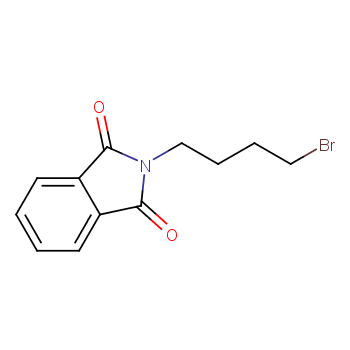
N- (4-Bromobutyl) PHThalimide, as an important organic synthetic intermediate, has a wide range of application prospects in the fields of pharmaceutical chemistry and material science. This article will explore its synthesis methods in depth.
Introduction:
N- (4-bromenocyl) phthalomylimide is a key organic synthetic intermediate, which is widely used in drug synthesis research and the synthesis of chemical emission immunochemical reagents. The synthesis method reported in the literature involves mixing the excess 1,4-dicetalate with phthalomylide and hydraulic carbonate solid powder and heating backflow. However, due to the high response temperature (180 ~ 190 ° C), a large number of by-products of 1,4-diopyl-telbenamine-based catexane will be produced, which not only increases the difficulty of post-processing, but also reduces the yield.
Synthesis:
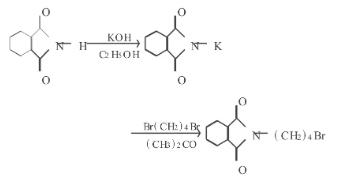
In the synthesis method reported by Kuang Yongqing and others: first convert the deotenomyl amine into the corresponding potassium salt, and then make it return with 1,4-di bromotane The reaction greatly reduced the reaction temperature and avoided the side reaction. After the reaction is over, the acetone is steamed by decompression, and removes excessive amount of excessive amount 1,4-binary bromolate through water vapor distillation. 90%. The specific experimental steps are as follows:
( 1) 1,4-di broma butthide preparation
40%hydrocelatic acid at 618 ml (4.2 mol) is poured into a 1000 mL round bottle, and 35 mL concentrated sulfuric acid is added in batches. After cooling, add 50 ml (0.62 mol) tetrahydrofurate under the stirring conditions, and the drop time is 10 minutes. Mixture refund reaction for 3 hours. After the reaction is over, use water vapor distillation to separate products, use waterless CACL? Dry, then decompress distillation, collect the distillation points of 80-82 ° C/1.33 kPa, obtain a pure product of 124 G, and the yield is 93%.
( 2) n- (4-bromenocyl) synthesis
In the 500 mL round bottle, first add 97.2 g (0.45 mol) 1,4-two-two-bromadane and 150 ml acetone, and then add 27.7 g (0.15 mol) phtone phenyl in batches in batches. Potated potassium salt, and reacted for 12 hours under stirring conditions. After the reaction is completed, the cooling mixture is filtered to remove the generated KBR. Then, the acetone is removed by decompression, and the excess 1,4-binary bromide is removed with water vapor distillation. After cooling the remaining objects, a large amount of white solids are formed. The solid is separated by filtering and washed with a small amount of water -free ethanol. Finally, it was dry naturally. The 38 G product was obtained. The yield was 90%and the melting point was 79-80 ° C.
refer to:
[1] Kuang Yongqing, Zhang Shengyong, Weilinlin.n- (4-bromobutyl) pHThalimide synthesis [J]. Chemical reagent, 2001, (06): 359-361.doi: 10.13822/j.cnki.hxsj.2001.06. 017.
 |
 3YRS
3YRS
 Contact
15YRS
Contact
6YRS
5YRS
Contact
Contact
15YRS
Contact
6YRS
5YRS
Contact
Dictionary Language Options: English Deutsch Français Español 日本語 한국어 Português Pусский язык عربي 中文
About Us | Service | Contact Guidechem | Feedback | CAS Index | Chemical Index | Dictionary | New Products | FAQ | Mobile Site Follow Us:Service Tel: +86-571-87759611, Marketing Tel: +86-571-89739798  Whatsapp
Copyright©2010-2026 Guidechem



 CN
CN