 |
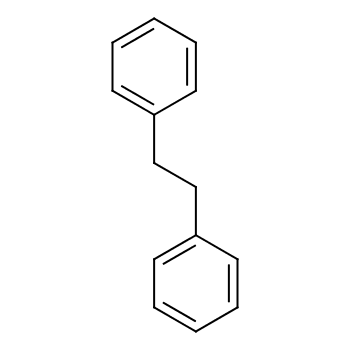
1,2-Diphenylethane, also known as 1,2-Diphenylethane, is a colorless to pale yellow liquid at room temperature and pressure. It is miscible with common organic solvents. With no active functional groups, 1,2-Diphenylethane exhibits excellent chemical stability. It is commonly used as a reaction solvent in organic synthesis and as an internal standard in chemical reactions. It finds applications in basic chemical research and fine chemical production, such as being a dye solvent for carbonless copy paper.
1,2-Diphenylethane has a symmetrical structure, consisting of two benzene rings and an ethyl group. The carbon atom in the benzyl position can undergo oxidative decomposition reactions under the action of oxidants, yielding corresponding benzoic acid compounds.

Figure 1: Acylation reaction of 1,2-Diphenylethane
To a two-neck round-bottom flask equipped with a reflux condenser, add aluminum chloride (21.94 g, 164.54 mmol), acetyl chloride (4.83 g, 42.78 mmol), anhydrous dichloromethane (150 mL), and 1,2-diphenylethane (3 g, 16.45 mmol). After stirring the reaction mixture under an argon atmosphere for 20 minutes, heat the reaction mixture to reflux and continue stirring for 3 hours. Then, transfer it to room temperature and stir overnight. After the reaction is complete, cool the reaction mixture to room temperature, then pour the supernatant into ice water, separate the organic layer, dry it with anhydrous sodium sulfate, filter off the drying agent, and concentrate the resulting filtrate under vacuum. The residue can be purified by silica gel column chromatography to obtain the target product molecule.[1]
1,2-Diphenylethane can be used as a reaction solvent and internal standard reference in organic chemistry. For example, it can be used as a solvent for nitrocellulose and has wide applications in basic organic chemistry research. Additionally, it is used as an impregnating agent for electrical capacitors. In the manufacturing process of electrical capacitors, the impregnating agent is used to fill and fix internal components of the capacitor to improve its electrical insulation performance and stability. It can also serve as a dye solvent for carbonless copy paper and as a plasticizer and high-temperature heating medium in certain specialized high-temperature heating devices.
[1] Taladriz, Andrea; et al Journal of Medicinal Chemistry (2012), 55(6), 2606-2622.
 |
 3YRS
3YRS
 Contact
2YRS
Contact
6YRS
Contact
1YR
Contact
Contact
2YRS
Contact
6YRS
Contact
1YR
Contact
Dictionary Language Options: English Deutsch Français Español 日本語 한국어 Português Pусский язык عربي 中文
About Us | Service | Contact Guidechem | Feedback | CAS Index | Chemical Index | Dictionary | New Products | FAQ | Mobile Site Follow Us:Service Tel: +86-571-87759611, Marketing Tel: +86-571-89739798  Whatsapp
Copyright©2010-2026 Guidechem



 CN
CN