 |
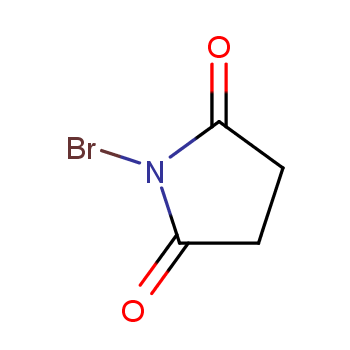
N-Bromosuccinimide (NBS) is a chemical compound commonly used in various reactions. It has the molecular formula C4H4BrNO2 and a molecular weight of 177.98. NBS is also known by its abbreviation and alias, NBS. It has physical properties such as a melting point of 173-175°C and a density of 2.098 g/cm3. It is soluble in acetone, tetrahydrofuran, N,N-dimethylformamide, dimethyl sulfoxide, and acetonitrile, but only slightly soluble in water and acetic acid. It is insoluble in ether, hexane, and carbon tetrachloride. NBS is often found in the form of white powder or crystals.
It is important to note that NBS is sensitive to moisture and should be stored in a refrigerator. During use, inhalation and skin contact should be avoided, and operations should be carried out in a well-ventilated fume hood.
N-Bromosuccinimide (NBS) is commonly used in various reactions, including free radical bromination of allylic and benzylic compounds, electrophilic bromination of ketones, aromatic compounds, and heterocyclic compounds, hydroxylation and ether formation of alkenes, and lactonization reactions.
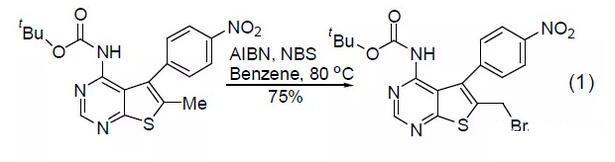
NBS can efficiently undergo free radical bromination reactions with allylic compounds under suitable conditions, exhibiting high selectivity (Equation 1).
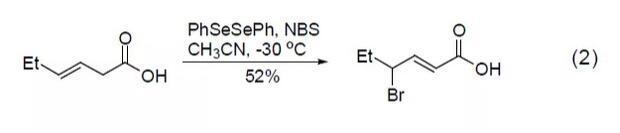
Unsaturated carboxylic acids, aldehydes, esters, and lactones can also be brominated using NBS. In the bromination process of unsaturated carboxylic acids, the unsaturated bond may undergo migration, resulting in α,β-unsaturated carboxylic acids (Equation 2).
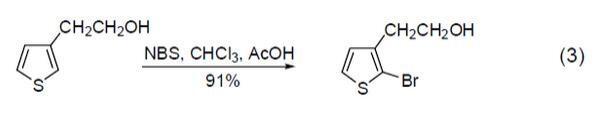
Under the action of NBS, phenols, anilines, and other aromatic compounds with high electron density can efficiently generate ortho- or para-brominated products (Equation 3).
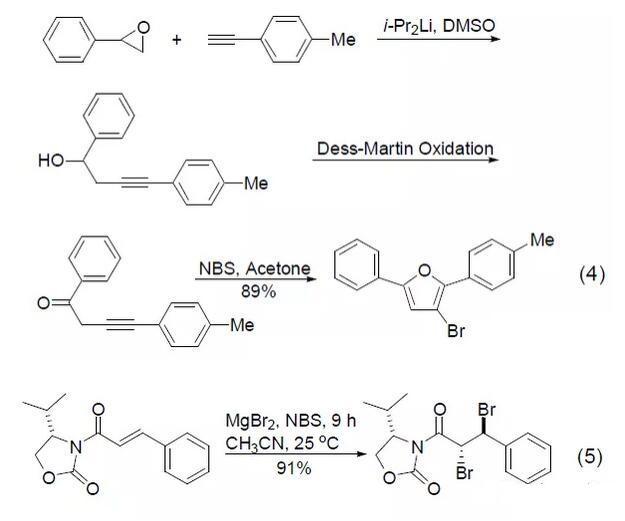
Under the action of other nucleophilic reagents, NBS can undergo addition reactions with alkenes and other compounds (Equation 5). Nucleophilic reagents include alcohols, carboxylates, diazo compounds, and sodium alkoxides. Through addition reactions, various functional groups can be introduced into the products, making it a commonly used method in natural product synthesis.
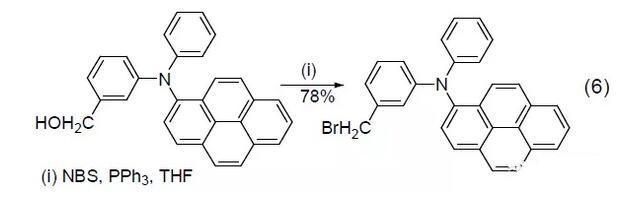
In polar solvents, NBS in the presence of PPh3 can convert primary or secondary alcohols into the corresponding bromides (Equation 6).
1. Dai, Y.; Guo, Y.; Frey, R. R.; Ji, Z.; Curtin, M. L.; Ahmed, A. A.; Albert, D. H.; Arnold, L.; Arries, S. S.; Barlozzari, T.; Bauch, J. L.; Bouska, J. J.; Bousquet, P. F.; Cunha, G. A.;Glaser, K. B.; Guo, J.; Li, J.; Marcotte, P. A.; Marsh, K. C.;Moskey, M. D.; Pease, L. J.; Stewart, K. D.; Stoll, V. S.; Tapang, P.; Wishart, N.; Davidsen, S. K.; Michaelides, M. R. J. Med. Chem., 2005, 48, 6066.
2. Mellegaard, S. R.; Tunge, J. A. J. Org. Chem., 2004, 69, 8979.
3. Herland, A.; Nilsson, K. P. R.; Olsson, J. D. M.; Hammarstroem, P.; Konradsson, P.; Inganaes, O. J. Am. Chem. Soc., 2005, 127, 2317.
4. Kim, Y.; Bouffard, J.; Kooi, S. E.; Swager, T. M. J. Am. Chem. Soc., 2005, 127, 13726.
5. Aratani, N.; Takagi, A.; Yanagawa, Y.; Matsumoto, T.; Kawai, T.; Yoon, Z. S.; Kim, D.; Osuka, A. Chem. Eur. J., 2005, 11,3389.
6. Sniady, A.; Wheeler, K. A.; Dembinski, R. Org. Lett., 2005, 7, 1769.
7. Hajra, S.; Bhowmick, M.; Karmakar, A. Tetrahedron Lett., 2005, 46, 3073.
8. Cordonier, C. E. J.; Satake, K.; Atarashi, M.; Kawamoto, Y.; Okamoto, H.; Kimura, M. J. Org. Chem., 2005, 70, 3425.
9. Burke, M. D.; Berger, E. M.; Schreiber, S. L. J. Am. Chem. Soc., 2004, 126, 14095.
10. Winkler, J. D.; Oh, K.; Asselin, S. M. Org. Lett., 2005, 7,387.
11. Catino, A. J.; Nichols, J. M.; Forslund, R. E.; Doyle, M. P.Org. Lett., 2005, 7, 2787.
12. Thomas, K. R. J.; Thompson, A. L.; Sivakumar, A. V.;Bardeen, C. J.; Thayumanavan, S. J. Am. Chem. Soc., 2005, 127, 373.
 |
 |
 |
 |
 |
 |
 |
 1YR
1YR
 Contact
3YRS
Contact
13YRS
Contact
3YRS
Contact
Contact
3YRS
Contact
13YRS
Contact
3YRS
Contact
Dictionary Language Options: English Deutsch Français Español 日本語 한국어 Português Pусский язык عربي 中文
About Us | Service | Contact Guidechem | Feedback | CAS Index | Chemical Index | Dictionary | New Products | FAQ | Mobile Site Follow Us:Service Tel: +86-571-87759611, Marketing Tel: +86-571-89739798  Whatsapp
Copyright©2010-2026 Guidechem



 CN
CN