 |
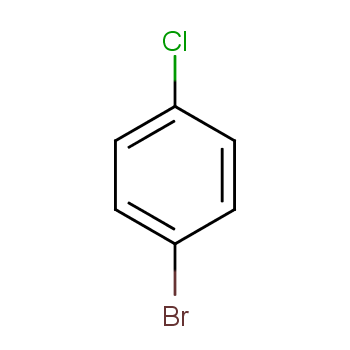
P-Chlorobromobenzene is an important organic chemical raw material. It is mainly used as a solvent and can also be used in organic synthesis. The traditional method to synthesize p-chlorobromobenzene requires a long reaction time, high reaction temperature, cumbersome operation and low yield. A large number of studies and literature reports have shown that ultrasound has been widely used in the field of organic synthesis. It can promote the progress of many reactions and has the advantages of short reaction time and high reaction yield. Ultrasound can even enable some reactions that are difficult to occur under conventional conditions to proceed smoothly [1].
This experiment attempts to synthesize p-chlorobromobenzene using chlorobenzene as raw material by ultrasonic method, and the reaction time, reaction temperature, ultrasonic power, catalyst dosage and reaction material preparation are discussed. The influence of factors such as ratio on the yield was explored in order to obtain better reaction conditions and results for the synthesis of p-chlorobromobenzene under the action of ultrasound. Using chlorobenzene as the raw material, bromine as the bromine source, and iron powder as the catalyst, p-chlorobromobenzene is synthesized under the action of ultrasonic waves. The best reaction conditions are: using equal amounts of chlorobenzene and bromine as reactants, the amount of catalyst material is 1/10 of the amount of reactants, dropping bromine for 20 minutes, and continuing to shake for 10 minutes. At a temperature of 20°C and an ultrasonic frequency of 40 kHz, the yield of p-chlorobromobenzene was 53.44%. The synthesis reaction formula is as follows:

Figure 1 Synthetic reaction formula of 4-Bromochlorobenzene
Synthesis of p-chlorobromobenzene under the action of ultrasonic waves
In a 100 mL three-necked flask equipped with a thermometer, constant pressure dropping funnel, and spherical condenser tube, add 0.77 g. Reduce iron powder and 10mL chlorobenzene (0. 098 6 mol), and connect the exhaust gas treatment device to the spherical condenser tube to absorb the hydrogen bromide produced during the reaction and the bromine escaped with the hydrogen bromide gas. Use a 5 mL pipette to take 5 mL of bromine (0. 097 6 mol) and quickly place it into a constant pressure dropping funnel with an appropriate amount of water. Start the ultrasonic cleaner to start vibrating, and start adding bromine dropwise. After 20 minutes, the dropwise addition is completed. At this time, a large amount of brown-red crystals precipitate in the bottle. Continue shaking for 10 minutes to stop the reaction. Wash the product in the bottle with saturated sodium bisulfite solution until the bromine color fades and the crystals turn off-white. Filter under reduced pressure. Wash the filter cake thoroughly with cold water and drain it. Use an appropriate amount of hot 95% ethanol to completely dissolve the filter cake. Filtrate while it is hot to remove the remaining reduced iron powder. Cool and crystallize. Filter under reduced pressure and remove the filter cake. After draining, white flaky crystals were obtained and weighed. The yield was 10. 17 g and the yield was 53. 87%.
Synthesis of p-chlorobromobenzene without ultrasonic action
In a 100 mL three-necked flask equipped with a thermometer, constant pressure dropping funnel, and spherical condenser tube, add 0.77 g Reduce iron powder and 10mL chlorobenzene (0. 098 6 mol), and connect the tail gas treatment device to the spherical condenser tube to absorb the hydrogen bromide produced during the reaction and the bromine escaped with the hydrogen bromide gas. Heat to 80°C, use a 5mL pipette to take 5 mL of bromine (0. 0976 mol), quickly place it in a constant pressure dropping funnel with an appropriate amount of water, and start adding bromine dropwise. After the dropwise addition is completed, raise the temperature to 90 ~ 100℃, keep warm and stir for 2. 5 h. Slowly add the reaction mixture to an appropriate amount of saturated sodium bisulfite solution while stirring. At this time, a brown-red solid will precipitate. Continue stirring until the bromine color fades and the color of the solid no longer changes. At this time, the solid turns gray-pink. Filter under reduced pressure. Wash the filter cake thoroughly with cold water and drain it. Use an appropriate amount of hot 95% ethanol to completely dissolve the filter cake. Filtrate while it is hot to remove the remaining reduced iron powder. Cool and crystallize. Filter under reduced pressure and remove the filter cake. After being drained, light yellow flaky crystals were obtained, weighing 7.89 g. Move the crude product to a 300 mL beaker, add an appropriate amount of 95% ethanol, heat to completely dissolve the crude product, cool slightly, add 0.5 ~ 1.0 g activated carbon, boil for 10 minutes, filter while hot to remove the activated carbon, and cool the filtrate Afterwards, white flaky crystals precipitated, filtered under reduced pressure and the filter cake was drained and weighed. The yield was 5.02 g and the yield was 26.59%.
1) The product is white flake crystal, indicating that it conforms to the appearance of p-chlorobromobenzene.
2) Dissolve the product in water to see if it is dissolved. The result shows that it is insoluble, indicating that it is consistent with the property of p-chlorobromobenzene being insoluble in water.
3) Dissolve the product in hot ethanol, ether, and benzene to see if it is dissolved. The result shows dissolution, indicating that it is consistent with the properties of p-chlorobromobenzene soluble in hot ethanol, ether, and benzene.
4) Use a WRS-2 microcomputer melting point meter to measure the melting point of the product. The measured melting point value is 67. 6 ~ 68. 2°C, which is consistent with the melting point of p-chlorobromobenzene.
During the process of conducting the above experiments, it was found that there was a lot of remaining iron powder in each reduction. In line with the principle of green energy saving and reducing unnecessary losses, we try to explore the optimal catalyst dosage from the perspective of the impact of catalyst dosage on productivity, in order to achieve a win-win result of productivity and green energy saving. Although using 0.77 g reduced iron powder has a higher yield than using 0.578 g reduced iron powder, the increase in yield is not obvious, and considering the need for green energy saving, it is more efficient to use 0.578 g reduced iron powder as a catalyst. Appropriately, if the amount of reduced iron powder is too small, the content of iron tribromide will decrease, which is not conducive to the catalytic reaction and the yield will decrease. Excessive dosage of reduced iron powder will not significantly increase the yield of p-chlorobromobenzene, but will decrease.
Through single factor analysis, the effects of reaction time, reaction temperature, ultrasonic frequency, catalyst dosage and material ratio on the reaction yield were studied. The optimal reaction conditions were preliminarily determined: using chlorobenzene and bromine as raw materials, reduced iron powder as catalyst, n (chlorobenzene):n (bromine):n (reduced iron powder) is 1:1:0.1, Under the action of ultrasonic waves, the reaction temperature was 20°C, the reaction time was set as the bromine dropping time of 20 min, the shaking continued for 10 min, and the ultrasonic frequency was 40 kHz. Using this reaction condition, the yield of p-chlorobromobenzene can reach 53.44%.
The methods for synthesizing p-chlorobromobenzene currently reported in the literature all use traditional methods, but this article uses an ultrasonic synthesis method, which not only enriches the synthesis process, but also reduces the reaction time from 3 to 3. 5 h is shortened to 30 min, which greatly reduces the reaction time, thereby saving energy, improving equipment utilization, and helping to reduce product costs. At the same time, compared with traditional methods, the synthesis of p-chlorobromobenzene under the action of ultrasound also has the advantages of fast reaction rate, high reaction yield, and easy operation.
[1] Wassmundt, Frederick W.; Kiesman, William F. Journal of Organic Chemistry, 1997, vol. 62, # 24 p. 8304 – 8308
 |
 3YRS
3YRS
 Contact
13YRS
Contact
4YRS
Contact
1YR
Contact
Contact
13YRS
Contact
4YRS
Contact
1YR
Contact
Dictionary Language Options: English Deutsch Français Español 日本語 한국어 Português Pусский язык عربي 中文
About Us | Service | Contact Guidechem | Feedback | CAS Index | Chemical Index | Dictionary | New Products | FAQ | Mobile Site Follow Us:Service Tel: +86-571-87759611, Marketing Tel: +86-571-89739798  Whatsapp
Copyright©2010-2026 Guidechem



 CN
CN