-
We detected your language preference as English. Would you like to switch to the English version for a better experience?
Switch to English
Stay here

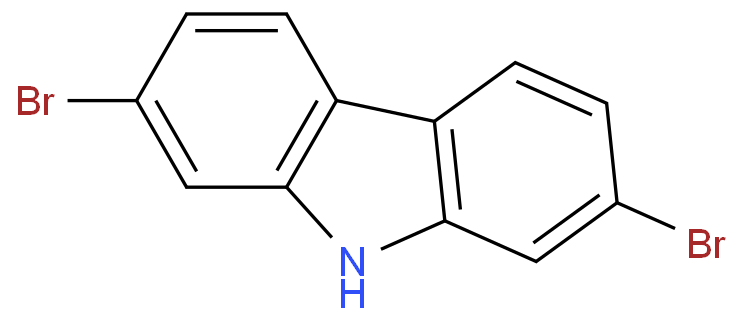
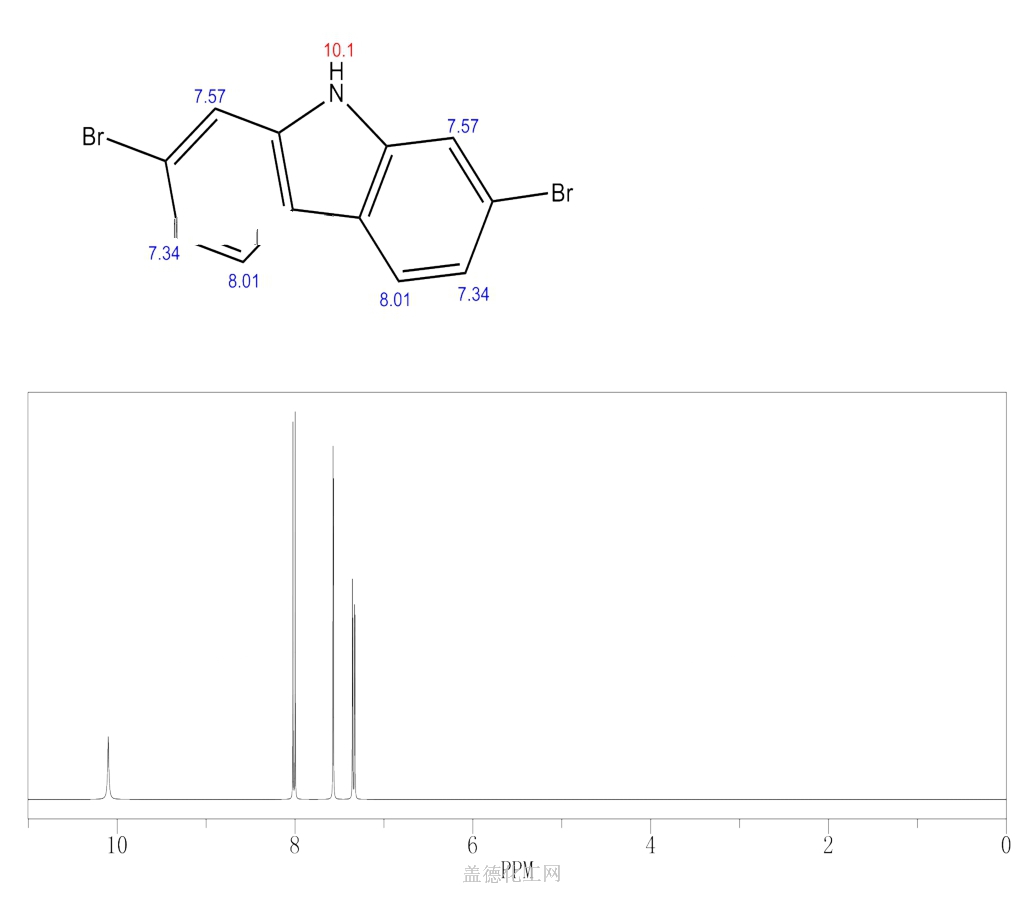
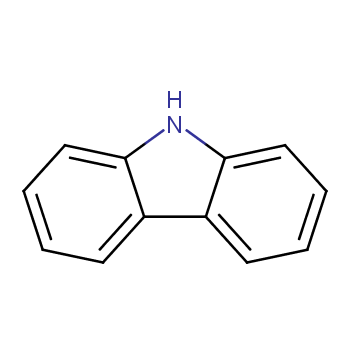
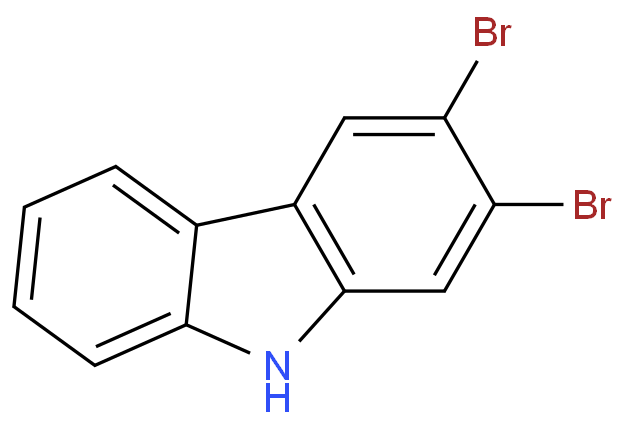
2,7-Dibromo-9H-carbazole (C12H7Br2N) is a halogenated organic compound and an aromatic heterocyclic derivative. At room temperature, it exists as a solid crystalline material typically exhibiting a pale yellow to off-white coloration; it is practically odorless or possesses a faint chemical scent. The compound demonstrates low volatility and limited solubility in water but tends to dissolve more readily in common organic solvents such as dichloromethane, acetone, and ethanol. Its molecular architecture features a carbazole core, consisting of a fused benzene-indole system, with bromine atoms substituted at the 2nd and 7th positions, contributing to its classification as a polyhalogenated arene.
The synthesis of 2,7-dibromo-9H-carbazole was first reported in the early 20th century within the context of dye chemistry and heterocyclic compound derivatization, although no single individual or definitive year is widely credited with its initial preparation. It is commonly synthesized via electrophilic substitution reactions on carbazole using brominating agents such as N-bromosuccinimide (NBS) or molecular bromine under controlled conditions, often in acidic or catalytic environments to facilitate regioselective dibromination. This compound has found niche applications in several industrial sectors, particularly in the development of fluorescent dyes, phosphorescent materials for OLEDs (organic light-emitting diodes), and intermediates in pharmaceutical synthesis. It is not known to occur naturally in plants, animals, or minerals, and is exclusively prepared through synthetic routes. Industrially, its production involves bromination of carbazole derivatives under rigorously controlled stoichiometric and thermal conditions to ensure high product purity and minimize byproduct formation.
2,7-Dibromo-9H-carbazole may pose moderate health hazards upon exposure. While specific toxicological data on this exact compound is limited, structurally similar brominated aromatics have demonstrated potential mutagenic and carcinogenic properties in animal studies. Inhalation or ingestion may lead to symptoms including respiratory irritation, nausea, headache, and dizziness. Prolonged dermal contact could result in skin sensitization or irritation. The International Agency for Research on Cancer (IARC) has not classified this compound specifically, though caution is advised due to the presence of brominated aromatic systems that are sometimes associated with genotoxic activity. For safe handling and storage, the compound should be kept in a tightly sealed container under cool, dry, and well-ventilated conditions. It must be isolated from strong oxidizing agents and reactive metals such as sodium or potassium to prevent hazardous reactions.
View more+2,7-Dibrom-9H-carbazol2,7-DIBROMO-9H-CARBAZOLE2,7-DIBROMOCARBAZOLE2,7-DibroMocarbazole (2,7-DBC)2,7-DibroMocarbazole(2,7-DBC)9H-Carbazole, 2,7-dibroMo-N,N-Bis(M-tolyl)benzenaMine,2,7-DibroMo-9H-carbazole, 9H-Carbazole
The 2,7-Dibromo-9H-carbazole, with cas registry number of 136630-39-2, is also called 2,7-Dibromocarbazole. And it is a kind of air sensitive chemical. Its molecular formula is C12H7Br2N.
The characteristics of this chemical are as followings: (1)ACD/LogP: 5.26; (2)# of Rule of 5 Violations: 1; (3)ACD/LogD (pH 5.5): 5.26; (4)ACD/LogD (pH 7.4): 5.26; (5)ACD/BCF (pH 5.5): 5891.24; (6)ACD/BCF (pH 7.4): 5891.24; (7)ACD/KOC (pH 5.5): 17390.25; (8)ACD/KOC (pH 7.4): 17390.25; (9)#H bond acceptors: 1; (10)#H bond donors: 1; (11)#Freely Rotating Bonds: 0; (12)Polar Surface Area: 4.93 Å2; (13)Index of Refraction: 1.796; (14)Molar Refractivity: 71.75 cm3; (15)Molar Volume: 168.3 cm3; (16)Polarizability: 28.44×10⁻²⁴cm3; (17)Surface Tension: 63.6 dyne/cm; (18)Density: 1.93 g/cm3; (19)Flash Point: 231.4 °C; (20)Enthalpy of Vaporization: 69.18 kJ/mol; (21)Boiling Point: 459 °C at 760 mmHg; (22)Vapour Pressure: 3.58E-08 mmHg at 25°C.
Addtionally, the following datas could be converted into the molecular structure:
(1)SMILES: Brc3ccc2c1ccc(Br)cc1nc2c3
(2)InChI: InChI=1/C12H7Br2N/c13-7-1-3-9-10-4-2-8(14)6-12(10)15-11(9)5-7/h1-6,15H
(3)InChIKey: QPTWWBLGJZWRAV-UHFFFAOYAV
Acute toxicity - Oral, Category 3
Skin irritation, Category 2
Eye irritation, Category 2
Specific target organ toxicity – single exposure, Category 3
| Pictogram(s) | 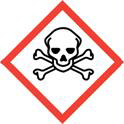 |
|---|---|
| Signal word | Danger |
| Hazard statement(s) | H301 Toxic if swallowed H315 Causes skin irritation H319 Causes serious eye irritation H335 May cause respiratory irritation |
| Precautionary statement(s) | |
| Prevention | P264 Wash ... thoroughly after handling. P270 Do not eat, drink or smoke when using this product. P280 Wear protective gloves/protective clothing/eye protection/face protection. P261 Avoid breathing dust/fume/gas/mist/vapours/spray. P271 Use only outdoors or in a well-ventilated area. |
| Response | P301+P310 IF SWALLOWED: Immediately call a POISON CENTER/doctor/… P321 Specific treatment (see ... on this label). P330 Rinse mouth. P302+P352 IF ON SKIN: Wash with plenty of water/... P332+P313 If skin irritation occurs: Get medical advice/attention. P362+P364 Take off contaminated clothing and wash it before reuse. P305+P351+P338 IF IN EYES: Rinse cautiously with water for several minutes. Remove contact lenses, if present and easy to do. Continue rinsing. P337+P313 If eye irritation persists: Get medical advice/attention. P304+P340 IF INHALED: Remove person to fresh air and keep comfortable for breathing. P312 Call a POISON CENTER/doctor/…if you feel unwell. |
| Storage | P405 Store locked up. P403+P233 Store in a well-ventilated place. Keep container tightly closed. |
| Disposal | P501 Dispose of contents/container to ... |
none
 |
|
|
One of the most popular products made available from 2,7-dibromocarbazole is PCDTBT, a well-known polymer semiconductor used for polymer solar cells. A good example for adjusting the solubility of the carbazole compounds by using 2,7-dibromocarbazole as the starting materials is the synthesis of 2,7-dibromo-9-heptadecanylcarbazole.

Dictionary Language Options: English Deutsch Français Español 日本語 한국어 Português Pусский язык عربي 中文
About Us | Service | Contact Guidechem | Feedback | CAS Index | Chemical Index | Dictionary | New Products | FAQ | Mobile Site Follow Us:Service Tel: +86-571-87759611, Marketing Tel: +86-571-89739798  Whatsapp
Copyright©2010-2026 Guidechem

 EN
EN




 3YRS
3YRS




![11H-Benzo[a]carbazole, 5,8-dibromo-](https://structimg.guidechem.com/1/1/3549660.png)

