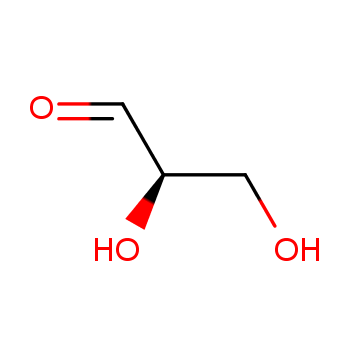
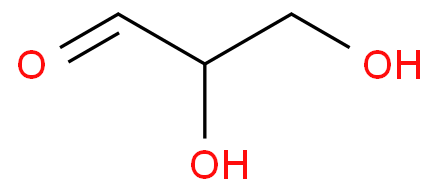
-
We detected your language preference as English. Would you like to switch to the English version for a better experience?
Switch to English
Stay here

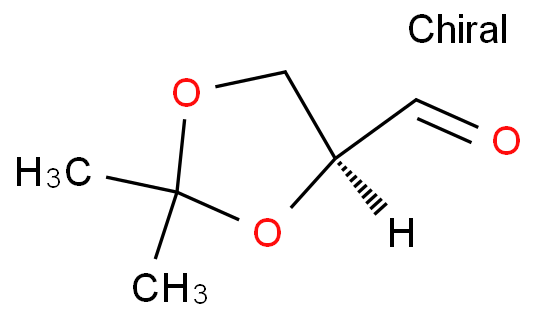
(S)-Glyceraldehyde acetonide (C6H10O3) is a chiral organic compound and a member of the class of compounds known as carbohydrate derivatives. It appears at room temperature as a colorless to pale yellow viscous liquid or semi-solid with a faint, mild odor. Due to its chiral nature, it is often used in enantioselective syntheses and displays optical activity. The compound is moderately soluble in common organic solvents such as ethanol, acetone, and dichloromethane, but exhibits limited solubility in water.
(S)-Glyceraldehyde acetonide was first synthesized in the context of carbohydrate chemistry during the late 20th century as part of efforts to develop chiral auxiliaries and intermediates for asymmetric synthesis. It is typically prepared through the acid-catalyzed acetal formation between (S)-glyceraldehyde and acetone under controlled conditions, often in the presence of a dehydrating agent such as molecular sieves or azeotropic distillation to remove water and shift the equilibrium toward product formation. This compound is widely used in the pharmaceutical and fine chemical industries as a chiral building block for the synthesis of bioactive molecules, including natural products and drug candidates. It is not commonly found in natural sources but is entirely synthetic in origin. Industrially, its preparation is carried out under anhydrous conditions using (S)-glyceraldehyde and excess acetone in the presence of a catalytic amount of a strong acid such as p-toluenesulfonic acid or sulfuric acid.
(S)-Glyceraldehyde acetonide is considered to have low acute toxicity, though limited data are available regarding its long-term health effects. It is not currently classified as a carcinogen by the International Agency for Research on Cancer (IARC) or the United States Environmental Protection Agency (EPA). However, due to its chemical nature, prolonged or repeated exposure may cause mild irritation to the eyes, skin, and respiratory system. Ingestion or inhalation of high concentrations may lead to symptoms such as dizziness, nausea, or headaches. To ensure safe handling, it should be stored in a tightly sealed container under a dry, well-ventilated environment, away from strong acids, bases, and oxidizing agents. It should also be kept out of reach of children and incompatible materials to prevent unwanted chemical reactions.
View more+(4S)-2,2-Dimethyl-1,3-dioxolan-4-carboxaldehyde(4S)-2,2-Dimethyl-1,3-dioxolane-4-carbaldehyde(4S)-2,2-Dimethyl-1,3-dioxolane-4-carboxaldehyde(s)-2,2-dimethyl-1,3-dioxolane-4-carbaldehyde(S)-2,2-Dimethyl-1,3-dioxolane-4-carboxaldehyde(S)-2,3-(Isopropylidenedioxy)propionaldehyde(S)-2,3-ISOPROPYLIDENE GLYCERALDEHYDE(S)-2,3-O-Isopropylideneglyceraldehyde(S)-GLYCERALDEHYDE ACETONIDE(S)-Glyceraldehyde isopropylidene acetal(S)-Isopropylideneglyceraldehyde1,3-Dioxolane-4-carboxaldehyde 2,2-dimethyl-, (4S)-1,3-Dioxolane-4-carboxaldehyde, 2,2-dimethyl-, (4S)-1,3-DIOXOLANE-4-CARBOXALDEHYDE, 2,2-DIMETHYL-, (S)-1,3-Dioxolane-4-carboxaldehyde, 2,2-dimethyl-, L-2,3-O-ISOPROPYLIDENE-L-GLYCERALDEHYDEL-GLYCERALDEHYDE ACETONIDES-(-)-Solketaldehyde
no data available
| Pictogram(s) | no data available |
|---|---|
| Signal word | no data available |
| Hazard statement(s) | no data available |
| Precautionary statement(s) | |
| Prevention | no data available |
| Response | no data available |
| Storage | no data available |
| Disposal | no data available |
no data available
 |
|
Literatures:
Ahrendt, Kateri A.; Williams, Robert M. Organic Letters, 2004 , vol. 6, # 24 p. 4539 - 4541  Yield: ~84% |
|
Dictionary Language Options: English Deutsch Français Español 日本語 한국어 Português Pусский язык عربي 中文
About Us | Service | Contact Guidechem | Feedback | CAS Index | Chemical Index | Dictionary | New Products | FAQ | Mobile Site Follow Us:Service Tel: +86-571-87759611, Marketing Tel: +86-571-89739798  Whatsapp
Copyright©2010-2026 Guidechem

 EN
EN

















 15YRS
15YRS