-
We detected your language preference as English. Would you like to switch to the English version for a better experience?
Switch to English
Stay here


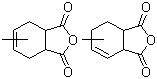
Methyl tetrahydrophthalic anhydride (MTHPA, CAS 11070-44-3) is a high-performance liquid anhydride curing agent widely used in epoxy coatings, electrical encapsulation, and fiber-reinforced composites. This article compares MTHPA with THPA, phthalic anhydride, TMA, and MA based on viscosity, curing behavior, thermal performance, purity grades, and industrial processing advantages.

MTHPA vs Alternatives in Epoxy Curing & Coating Formulations: Reactivity, Performance, and Purity Grades
Methyl tetrahydrophthalic anhydride (MTHPA, CAS 11070-44-3) has become one of the preferred liquid anhydride curing agents for advanced epoxy systems because it combines low viscosity, controlled reactivity, excellent electrical insulation properties, and improved processing efficiency compared with conventional solid anhydrides.
In modern epoxy formulation engineering, the selection of a curing agent is no longer based only on final hardness or glass transition temperature (Tg). Industrial users increasingly evaluate viscosity-temperature behavior, filler loading capability, curing latency, exotherm management, hydrolytic stability, and batch-to-batch consistency.
Compared with traditional curing agents such as tetrahydrophthalic anhydride (THPA), phthalic anhydride (PA), trimellitic anhydride (TMA), and maleic anhydride (MA), MTHPA provides a balanced property profile suitable for large-volume castings, electrical components, composite manufacturing, and high-performance industrial coatings.
Comparative Performance Matrix: MTHPA vs. Conventional Anhydride Curing Agents
The major advantage of MTHPA is its liquid physical state at ambient temperature. Unlike solid aromatic anhydrides, MTHPA can be directly blended with liquid epoxy resin without a melting process, reducing energy consumption and improving formulation repeatability.
For high-fill epoxy systems containing silica, alumina, glass beads, or ceramic powders, viscosity control is critical. Lower initial viscosity improves filler dispersion, reduces trapped air, and enhances fiber wetting efficiency during composite processing.
Liquid Isomer Advantages: MTHPA vs Tetrahydrophthalic Anhydride (THPA) and Phthalic Anhydride (PA)
The liquid characteristics of MTHPA provide significant advantages during epoxy resin processing. Solid anhydrides such as THPA and PA require pre-melting operations, which increase production complexity and introduce additional thermal exposure.
In industrial epoxy plants, eliminating the melting step can reduce:
When combined with bisphenol-A epoxy resin (DGEBA), MTHPA typically demonstrates a moderate reaction profile. With tertiary amine accelerators such as benzyldimethylamine (BDMA) or 2,4,6-tris(dimethylaminomethyl)phenol (DMP-30), manufacturers can adjust gel time and cure speed according to application requirements.
Selecting an epoxy curing agent requires balancing crosslink density, flexibility, thermal resistance, and electrical reliability. Highly reactive curing agents may achieve rapid conversion but can create brittle networks, while flexible systems may sacrifice thermal performance.
MTHPA occupies a middle position between highly rigid aromatic anhydrides and highly reactive unsaturated systems. Its cycloaliphatic structure provides improved toughness while maintaining strong thermal and electrical properties.
The commercial value of MTHPA is strongly connected with its ability to deliver balanced mechanical performance, electrical reliability, and processing advantages across multiple epoxy applications. Unlike highly aromatic anhydrides that may provide higher thermal resistance but increased brittleness, MTHPA enables engineers to design systems requiring long-term durability under thermal cycling, humidity exposure, and mechanical stress.
For industrial formulation development, MTHPA is commonly combined with bisphenol-A epoxy resin (DGEBA) at approximately stoichiometric anhydride-to-epoxy ratios. A typical starting formulation uses 70–90 phr MTHPA depending on epoxy equivalent weight (EEW), accelerator level, and targeted cure profile.
MTHPA has become an important curing agent in industries where reliability, dimensional stability, and electrical performance are critical. Typical applications include:
Lab Validation to Industrial Scale-Up: Purity Grades, Sampling, and QA Protocols
A common challenge during epoxy development is the difference between laboratory reagent performance and commercial production performance. MTHPA purchased in small research packages may demonstrate excellent curing behavior, but scale-up failures can occur when commercial batches show variations in isomer ratio, water content, color, or viscosity.
For this reason, professional formulation teams should evaluate commercial MTHPA samples before committing to drum or bulk purchasing.
| Grade Type | Typical Usage | Recommended Evaluation |
|---|---|---|
| Laboratory Grade | 100 g–1 kg formulation screening | Basic cure response and Tg testing |
| Commercial Grade | Production validation | Full COA and batch consistency review |
| Industrial Bulk Grade | Drum/IBC procurement | Pilot production approval required |
Laboratory MTHPA packages may cost significantly more per kilogram because of purification, packaging, and logistics requirements. Industrial buyers should avoid selecting suppliers based only on catalog pricing and instead evaluate cost-performance consistency during scale-up.
According to polymer processing researchers including Professor John D. Muzzy’s work on composite manufacturing, successful industrial polymer production depends on controlling material variability throughout the supply chain. For MTHPA procurement, formulation engineers should request pre-shipment samples, compare curing kinetics by DSC analysis, and verify viscosity-temperature behavior before approving large-volume purchases.
The most common scale-up mistake is assuming that a laboratory-grade product automatically represents industrial performance. MTHPA is an isomeric mixture, and subtle differences in composition can influence gel time, exotherm profile, and final mechanical properties.
Incoming quality control is essential for epoxy manufacturers because anhydride degradation caused by moisture exposure can significantly change curing behavior. Hydrolyzed anhydride produces free acids, which may accelerate premature reactions and reduce storage stability.
| COA Parameter | Recommended Specification | Testing Method |
|---|---|---|
| Anhydride Content | ≥41.0% | Acid-base titration |
| Free Acid Content | ≤1.0% | Chemical titration |
| Viscosity | 50–80 mPa·s at 25°C | Rotational viscometer |
| Water Content | <0.1% | Karl Fischer titration |
| Color | Gardner/Pt-Co controlled | Colorimetric analysis |
Recommended incoming inspection methods include:
FAQs
Q1: Why is MTHPA preferred over solid anhydride curing agents?
MTHPA is liquid at room temperature, reducing the need for melting operations and improving epoxy mixing efficiency, filler dispersion, and large-scale processing stability.
Q2: What purity level should industrial buyers request for MTHPA?
Industrial applications generally require commercial MTHPA grades with controlled anhydride content, low moisture, stable viscosity, and complete COA documentation.
References
[1] CAS Registry Database. Methyl tetrahydrophthalic anhydride (CAS 11070-44-3). American Chemical Society Chemical Abstracts Service.
[2] May, C. A. Epoxy Resins: Chemistry and Technology. Marcel Dekker, New York.
[3] Ellis, B. Chemistry and Technology of Epoxy Resins. Springer Science & Business Media.
[4] ISO 9001:2015. Quality management systems — Requirements.
[5] ASTM D1652. Standard Test Method for Epoxy Content of Epoxy Resins.
[6] Muzzy, J. D. Polymer Composite Processing and Manufacturing Research Publications, Georgia Institute of Technology.
Looking for stable, high-purity MTHPA with reliable viscosity control, consistent curing performance, and complete regulatory documentation? Discover why global epoxy manufacturers choose professional MTHPA supply solutions for electrical insulation, coatings, and advanced composite applications.
 |
 |
|
 |
 |
 |
 EN
EN
 Agricultural News
 Food News
 Industrial News
 Cosmetic News
 Pharmaceutical News
 Science News

 1YR
1YR


The epoxy industry is moving toward lower-emission, solvent-free processing platforms. According to Dr. John D. Muzzy, Professor Emeritus of Chemical and Biomolecular Engineering at Georgia Institute of Technology, “processing efficiency and material consistency increasingly determine the commercial success of polymer composite systems.” For MTHPA users, the key opportunity is not simply replacing a solid anhydride, but redesigning the entire resin mixing and production workflow around lower viscosity and improved process control.
From a formulation engineering perspective, purchasing teams should evaluate MTHPA based on viscosity stability, isomer distribution, moisture control, and curing consistency rather than only nominal purity values. A stable commercial grade with controlled 3-methyl and 4-methyl isomer ratios often provides better production performance than laboratory reagents with limited batch history.