-
We detected your language preference as English. Would you like to switch to the English version for a better experience?
Switch to English
Stay here


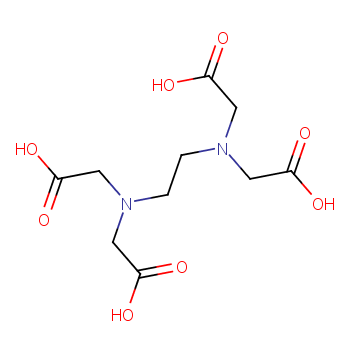
EDTA, also recognized as ethylenediaminetetraacetic acid, manifests as a colorless crystalline substance widely employed for metal ion chelation. Before delving into the intricacies of EDTA, it is imperative to provide a succinct overview of chelation. The term "chelation" originates from the Greek word "chele" or "khele," signifying a claw, a metaphor aptly used to convey the capability of certain substances to seize atoms or ions, forming complexes. Chelation materializes when a ligand binds to a metal ion, with the term "ligand" derived from the Latin word "ligare," meaning to bind. A ligand acts as a Lewis base, defined as an electron pair donor. Water often serves as a Lewis base in aqueous solutions, donating electron pairs to metal ions, forming coordinate covalent bonds. For instance, the dissolution of a Cu2+ compound in water results in four water molecules donating electron pairs to copper, constituting the complex ion Cu(H2O)42+. In this context, water acts as a monodentate ligand, having a single binding site.

EDTA stands out as a prevalent polydentate ligand. In its solution, the removal of hydrogen atoms leads to the formation of the anionic EDTA4-. In its anionic configuration, EDTA presents six binding atoms, encompassing two nitrogen and four oxygen atoms, as illustrated in Figure " Potential binding sites in EDTA. ". EDTA envelops the metal ion at the six binding sites, creating a highly stable complex. The robust grip of EDTA on the metal ion parallels the action of a crab or lobster clasping an object with its claw, hence the term chelation. The efficacy of EDTA as a chelating agent stems from its ability to deactivate a metal at up to six sites (Figure " EDTA-4 chelating a metal, M. ").

Ferdinand Münz, a German chemist working for I. G. Farben, pioneered the synthesis of EDTA in the early 1930s. Initially seeking a substitute for citric acid in dye solutions for the textile industry, Münz patented the process for EDTA synthesis in Germany in 1935 and subsequently applied for United States patents in 1936 and 1937 (U.S. Patent Number 2130505). Simultaneously, in the United States, Frederick C. Bersworth utilized different methods, yielding higher production efficiency and rendering EDTA economically viable. Bersworth's synthesis involved the reaction of formaldehyde, amines, and hydrogen cyanide. Both Bersworth and Münz secured patents for EDTA production in the 1940s (U.S. Patent Numbers 2407645 and 2461519).
EDTA is commercially available in salt forms like sodium EDTA or calcium EDTA, finding applications in both industrial and medical settings as a chelating agent. Its significance stems from the role of metals and metal compounds as catalysts in various reactions. By chelating metals, EDTA inhibits their catalytic activity, thereby mitigating degradation, oxidation, and other undesirable reactions. Industries extensively employing EDTA and similar chelating agents include paper and pulp, cleaning products, chemicals, agriculture, and water treatment. The paper and pulp industry, in particular, relies heavily on EDTA to stabilize bleaches by sequestering metals that catalyze bleach degradation. This ability extends to laundry detergents and various cleaning products, where EDTA enhances bleaching efficiency and softens hard water by binding divalent metal ions, such as Ca2+ and Mg2+, responsible for water hardness.
In water treatment applications, EDTA aids in softening water, preventing scale and corrosion. With low toxicity, EDTA is sanctioned for use in the food and beverage industry. It serves to preserve color, flavor, and nutrient content, as well as extend shelf life in various food products. When incorporated into beverages, EDTA preserves color and stabilizes ingredients like citric acid and benzoates. In the chemical industry, EDTA manages metal catalytic processes during reactions, and in agriculture, EDTA salts are utilized to supply metal micronutrients in fertilizers.
Within the medical domain, EDTA has been employed since the 1950s in chelation therapy, involving the intravenous administration of a calcium EDTA salt solution to eliminate metal toxins from the bloodstream. The FDA has approved chelation therapy with EDTA for over four decades, primarily for treating heavy metal poisoning. This therapy, conducted over multiple sessions, raises concerns about nutrient depletion, prompting the inclusion of supplements in chelation solutions.
While established for heavy metal poisoning, chelation therapy has sparked controversy in the medical community due to its varied applications. Despite its alternative use for heart disease, atherosclerosis, and cancer, among others, major health organizations like the American Heart Association and American Cancer Society do not endorse it as a standard treatment, citing insufficient scientific evidence. Ongoing research, exemplified by a National Institute of Health study initiated in 2003, aims to assess the efficacy of EDTA chelation therapy for individuals with coronary artery disease over a five-year period.
Richard L. Myers (2009). The 100 Most Important Chemical Compounds: A Reference Guide. Greenwood Publishing Group. October 1, 2009. https://doi.org/10.1021/ed086p1182
|
 |
 |
 |
 EN
EN
 Agricultural News
 Food News
 Industrial News
 Cosmetic News
 Pharmaceutical News
 Science News

 1YR
1YR

