-
We detected your language preference as English. Would you like to switch to the English version for a better experience?
Switch to English
Stay here


Triuranium octoxide is a stable, uranium-rich oxide of major importance in uranium ore processing, nuclear fuel-cycle chemistry, and the production and storage of uranium concentrates. Commonly associated with yellowcake, U3O8 illustrates the relationship between inorganic oxidation chemistry, mineral processing, and nuclear energy.
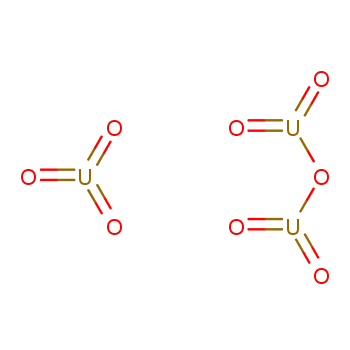
Triuranium octoxide is a mixed-valence uranium oxide containing uranium and oxygen in a 3:8 atomic ratio. It is commonly represented by the formula U3O8. Its uranium atoms do not all have the same formal oxidation state: the average oxidation state of uranium is +5⅓, reflecting the compound's mixed-valence character.
The history of triuranium octoxide is closely connected to the discovery of uranium and the development of modern analytical chemistry. In 1789, German chemist Martin Heinrich Klaproth identified a new element in a mineral sample and named it uranium, after the planet Uranus, discovered several years earlier. The material he examined was associated with uranium-rich minerals, although the element itself was not isolated as a pure metal at that time.
Uranium minerals contain several oxide phases, including uranium dioxide (UO2), uranium trioxide (UO3), and mixed-valence oxides such as U3O8. The composition of natural uranium-bearing solids varies with geological history, oxidation conditions, and weathering. U3O8 became especially important as a relatively stable form in which uranium concentrates could be characterized, transported, and stored.
3 UO2 + O2 → U3O8
Uranium dioxide can be oxidized to triuranium octoxide in an oxygen-containing atmosphere. The actual reaction pathway and resulting solid phases depend on temperature, oxygen availability, and the physical properties of the material.
Another useful representation of the relationship between uranium oxides is the thermal conversion of uranium trioxide. A simplified, balanced equation is:
6 UO3 → 2 U3O8 + O2
Idealized thermal decomposition equation; actual phase transformations depend on conditions.
Uranium oxide chemistry has influenced mineral processing, analytical standards, nuclear fuel fabrication, and the management of radioactive materials. U3O8 is particularly significant because uranium concentrates are commonly reported on a U3O8-equivalent basis, even when the actual material contains multiple uranium-bearing phases.
“Yellowcake” is an industry term for a uranium concentrate, not a guarantee that the material is yellow or consists exclusively of pure U3O8.
Unlike small covalent molecules, U3O8 forms a complex solid-state structure with uranium centers coordinated by oxygen atoms. Its crystallographic arrangement is often described in terms of distorted uranium–oxygen polyhedra. Structural descriptions can include uranium environments with approximately seven oxygen neighbors, but coordination geometry and bond lengths should be interpreted in the context of the particular crystal phase and measurement conditions.
The formula U3O8 gives an overall charge balance when the eight oxygen atoms are treated as O2−, contributing a total formal charge of −16. The three uranium atoms must therefore contribute a total formal charge of +16, corresponding to an average uranium oxidation state of +16/3. This non-integer average is a useful indicator of mixed-valence chemistry; it does not mean that each uranium atom carries a fractional charge in a simple, localized sense.
3x + 8(−2) = 0
x = +16/3 = +5.33 (average)
Uranium oxides can transform as the oxygen chemical potential changes. Oxidation of UO2 can produce higher oxides, including U3O8, while reduction under appropriate controlled conditions can yield more oxygen-deficient phases. These transformations are important in ore processing and fuel fabrication because oxygen content affects phase identity, material properties, and downstream chemical behavior.
Triuranium octoxide is associated with the production of uranium concentrates from ore. Industrial operations generally separate uranium-bearing minerals from surrounding rock, transfer uranium into a process solution, remove impurities, and recover a concentrated uranium product. The precise flowsheet depends on ore mineralogy, grade, carbonate content, and local environmental requirements.
Uranium-bearing ore is mined or recovered using an appropriate method.
Physical preparation and chemical leaching transfer uranium into solution.
Ion exchange or solvent extraction can separate uranium from impurities.
Uranium is recovered as a solid concentrate commonly called yellowcake.
Acid leaching commonly uses sulfuric acid for suitable ores, although alkaline carbonate-based systems are also used. After dissolution and purification, uranium may be precipitated as an intermediate compound, dried, and calcined. The resulting concentrate can contain substantial U3O8, but yellowcake composition varies and may include other uranium oxides or uranium-bearing compounds. It should not be treated as a universally pure substance with a fixed formula.
U3O8 is widely used as a reference basis for describing uranium concentrate quantities. Commercial concentrate may be assayed and reported as a U3O8 equivalent, even if the physical product contains a mixture of phases.
In some nuclear fuel cycles, uranium concentrate is chemically converted into uranium hexafluoride (UF6) for isotope enrichment. Other conversion routes are used when enrichment is not required or when a different fuel cycle is selected. Enriched uranium may subsequently be converted to uranium dioxide (UO2) powder and fabricated into ceramic fuel pellets for reactors. These are specialized, regulated industrial operations involving radiological protection, criticality safety, chemical containment, and safeguards.
U3O8 is therefore an important intermediate and storage form, but it is not usually the final ceramic fuel form in conventional light-water reactors. Reactor fuel is commonly based on UO2 pellets assembled into engineered fuel rods.
Natural uranium is a mixture of isotopes, primarily uranium-238 and uranium-235, with a very small contribution from uranium-234. Approximate natural abundances are 99.27% U-238 and 0.72% U-235 by atom fraction; the exact values vary slightly with the sample. Uranium-235 is fissile with thermal neutrons, while uranium-238 is fertile and can be converted through neutron capture and subsequent nuclear transformations into plutonium-239.
A naturally occurring fissile isotope that can sustain a chain reaction under suitable neutron and reactor conditions.
The predominant natural isotope. It is not fissile with thermal neutrons but can undergo neutron capture and contribute to the production of fissile material.
Commercial light-water reactor fuel commonly contains uranium enriched to a few percent U-235, although the exact specification depends on reactor design and fuel-management strategy. Enrichment separates isotopes; it does not change the chemical identity of U3O8 directly. Industrial enrichment facilities typically use UF6 because it can form a gas under suitable process conditions, enabling isotope separation based on small mass differences.
At atmospheric pressure, uranium hexafluoride is a solid near room temperature and sublimes at approximately 56.5°C. Its handling requires stringent containment because UF6 reacts with moisture to form corrosive hydrogen fluoride and uranium-containing products.
Uranium mining, uranium conversion, isotope enrichment, and fuel fabrication are distinct industrial stages. They involve different chemical forms, specialized facilities, and separate regulatory controls. U3O8 is central to the concentrate stage but is not itself the gaseous feed used in conventional uranium isotope enrichment.
Nuclear power plants generate electricity by converting heat from controlled nuclear fission into mechanical energy and then electrical energy. In many commercial reactors, uranium dioxide ceramic pellets are stacked inside fuel rods, commonly made from zirconium-based alloys. The fuel rods are arranged into fuel assemblies within a reactor core.

Fission releases energy and additional neutrons. A moderator, where used, slows neutrons to energy ranges that make further fission more likely for the chosen fuel. Coolant carries heat away from the core, while control rods and other engineered systems regulate reactivity. The exact design and safety systems differ among reactor types.
| Reactor type | Coolant / moderator | Key characteristic |
|---|---|---|
| Pressurized water reactor (PWR) | Light water | Primary coolant remains under pressure; heat is transferred to a secondary steam system. |
| Boiling water reactor (BWR) | Light water | Water boils in the reactor vessel and steam drives the turbine system. |
| Heavy-water reactor | Heavy water (D2O) | Heavy water absorbs relatively few neutrons, allowing some designs to use natural uranium fuel. |
| Fast reactor | Often a liquid metal, such as sodium | Uses fast neutrons without a conventional neutron moderator; some designs can breed fissile material. |
Some reactor concepts are designed to convert fertile U-238 into fissile plutonium-239. In simplified nuclear notation, the sequence begins with neutron capture by U-238, followed by radioactive beta decays:
U-238 + n → U-239
U-239 → Np-239 + β−
Np-239 → Pu-239 + β−
Conceptual nuclear transformation sequence; the intermediate nuclides have distinct half-lives and decay characteristics.
Fast-spectrum reactors can support breeding under suitable fuel and neutron-economy conditions. Liquid sodium has been used as a coolant in some fast-reactor designs because of its favorable heat-transfer properties and low neutron moderation. However, sodium reacts vigorously with water and can burn in air, so its use requires specialized engineering and safety measures.
Breeder-reactor technology raises technical, economic, waste-management, safeguards, and nuclear-proliferation considerations. Plutonium production is not unique to breeder reactors, and the proliferation risk of any nuclear technology depends on material form, facility design, operational controls, and effective international safeguards.
The primary industrial significance of U3O8 lies in uranium concentrate production and the nuclear fuel supply chain. Concentrates can be assayed, stored, transported, and converted into other uranium compounds for subsequent processing. Commercial transactions often use a standardized U3O8-equivalent basis to compare concentrate quantities and grades.
Uranium oxides are important in mineralogical studies, geochemical surveys, and the characterization of uranium deposits. Uranium concentration measurements help geologists evaluate mineral resources and understand the mobility of uranium under different groundwater and redox conditions. Because uranium minerals can be heterogeneous, reliable analysis may require multiple complementary techniques.
Uranium-derived fuel supports electricity generation in nuclear power plants, which can supply large quantities of low-carbon electricity during operation. The full environmental profile of nuclear power also depends on uranium mining, milling, conversion, enrichment, fuel fabrication, plant construction, waste management, decommissioning, and long-term stewardship.
U3O8 and other uranium oxides are used in specialized research into actinide chemistry, solid-state structure, corrosion, and nuclear materials. Uranium-bearing materials are also relevant to calibration, reference measurements, waste characterization, and the development of containment and monitoring methods. Such work requires licensed facilities and controls appropriate to the material's chemical and radiological hazards.
Triuranium octoxide presents both chemical and radiological hazards. Risk depends on uranium isotope composition, activity, particle size, exposure pathway, quantity, and duration. U3O8 should not be considered safe simply because it is relatively stable or poorly soluble in water.
Uranium does not degrade into a non-radioactive element through ordinary environmental processes. Instead, its mobility changes with oxidation state, mineral association, pH, carbonate concentration, and interactions with soil or sediment. Under oxidizing conditions, some uranium species can become more mobile in groundwater; under reducing conditions, uranium may form less soluble phases or associate with minerals and organic matter.
Mining and milling can generate waste rock, tailings, process residues, and contaminated water that require engineered containment and monitoring. Potential concerns include uranium migration, radon release from uranium-bearing materials, and the presence of other naturally occurring radionuclides in ore and waste. The magnitude of risk depends on site geology, waste composition, water management, and long-term controls.
Uranium-bearing materials should only be handled by trained personnel in authorized facilities. Do not handle, grind, heat, or transfer uranium oxide powders outside appropriate licensed procedures. Dust control, containment, exposure monitoring, radiological protection, and regulated waste management are essential.
Answer: No. Yellowcake is a uranium concentrate produced during ore processing. Its composition varies with the ore and processing method and can include different uranium oxides and other uranium compounds. U3O8 is commonly used as a reporting basis for its uranium content.
Answer: It is a relatively stable uranium oxide associated with uranium concentrates. It can be stored and transported as an intermediate material before conversion into other uranium compounds required for a particular fuel cycle.
Answer: Usually not. Conventional light-water reactors commonly use uranium dioxide (UO2) ceramic pellets. U3O8 is more commonly associated with the uranium concentrate stage and may undergo further chemical conversion before fuel fabrication.
Answer: Poor water solubility does not eliminate risk. Fine particles can be inhaled, and uranium has chemical toxicity as well as radioactive properties. Exposure assessment must consider particle size, solubility, isotopic composition, and the route and duration of exposure.
The following references provide further information on uranium chemistry, uranium oxide materials, nuclear fuel-cycle processes, and radiation protection.
Editorial note: This page is intended for general scientific education. Uranium chemistry and nuclear fuel-cycle processes are technically complex and subject to strict regulatory requirements. Process descriptions are conceptual and should not be used as operating instructions.
|
 |
|
|
 EN
 Agricultural News
 Food News
 Industrial News
 Cosmetic News
 Pharmaceutical News
 Science News


 1YR


