-
We detected your language preference as English. Would you like to switch to the English version for a better experience?
Switch to English
Stay here


Benzyltriethylammonium chloride is an important quaternary ammonium salt compound with wide-ranging applications. This article aims to explore the various uses and functions of benzyltriethylammonium chloride in different fields to understand its significance and value comprehensively. As a quaternary ammonium salt compound, benzyltriethylammonium chloride possesses unique chemical properties and diverse functional characteristics, playing a crucial role in industries such as chemical engineering. By discussing the applications and scope of benzyltriethylammonium chloride, we can gain a comprehensive understanding of its importance across various industries and provide more references and assistance for research and production in related fields.
Benzyltriethylammonium chloride (TEBA), with the molecular formula C13H22ClN and a molecular weight of 227.77, appears as white crystalline powder with strong hygroscopicity and a melting point of 185℃. The use of phase transfer catalysts allows heterogeneous reactions to proceed under mild conditions, providing advantages such as high catalytic activity and low cost. Initially applied in nucleophilic substitution reactions, phase transfer catalysts have evolved to be used in various types of reactions such as oxidation, peroxidation, reduction, and polymerization, finding applications in fields including pesticides, fragrances, photographic materials, and pharmaceuticals. What is the role of benzyltriethylammonium chloride? Benzyltriethylammonium chloride, as a quaternary ammonium salt cationic surfactant, is the most widely used quaternary ammonium salt phase transfer catalyst domestically. It is mainly used in organic synthesis and polymerization reactions, showing outstanding catalytic effects and favored by the chemical industry.
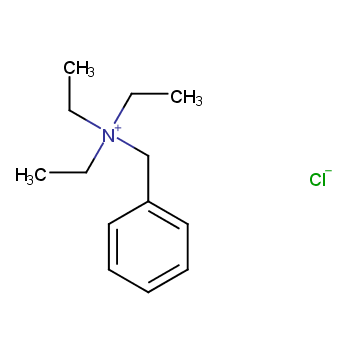
Benzyltriethylammonium chloride possesses a unique molecular structure. Its characteristic features a central nitrogen atom surrounded by four organic groups bearing positive charges (cations). One of these groups is the bulky benzyl group (C6H5CH2), while the other three are smaller ethyl groups (C2H5). This combination affects the solubility of benzyltriethylammonium chloride. Benzyltriethylammonium chloride is readily soluble in water, ethanol, dichloromethane, dimethylformamide (DMF), and slightly soluble in ethyl acetate. The structure of benzyltriethylammonium chloride is as follows:

The stability and reactivity of benzyltriethylammonium chloride are also noteworthy. The benzyl group shields the nitrogen atom carrying a positive charge to some extent, making it less reactive compared to other quaternary ammonium salt compounds. However, benzyltriethylammonium chloride can still participate in ion interactions and serve as a phase transfer catalyst to facilitate reactions between immiscible liquids.
Using ethyl acetate and acetonitrile as solvents, benzyl chloride and triethylamine as reactants, benzyltriethylammonium chloride, a phase transfer catalyst, is synthesized through quaternization reaction under heating conditions. The mass ratio of ethyl acetate to acetonitrile in the solvent system is 7:10, the molar ratio of benzyl chloride to triethylamine is 1.1:1.0, the reaction temperature is 70℃, and the reaction time of 2 hours is the optimal condition, with a yield of 84% and a purity of 98%. Ethyl acetate can be used to wash and purify the crude product to a purity of over 99%, and solvent recovery and reuse can improve the yield of the product. The process is as follows:

The specific experimental operation is as follows: Place a four-necked flask equipped with a thermometer, stirrer, and reflux condenser in a water bath heater, add a certain proportion of benzyl chloride, triethylamine, corresponding solvent, and crystallization agent into the four-necked flask, stir for 30 minutes, and then heat to the reaction temperature for a certain time. After the reaction, cool the entire reaction system at 5℃ for crystallization, recycle the liquid (solvent, crystallization agent, and unreacted material), recrystallize the crude quaternary ammonium salt product again, wash and purify it, separate the solid-liquid, dry, and finally obtain the high-purity product—benzyltriethylammonium chloride.
Benzyltriethylammonium chloride is a lipophilic phase transfer catalyst used in phase transfer catalysis (PTC) to catalyze condensation reactions forming high molecular weight polymers under biphasic conditions. Traditionally, many organic reactions are challenging because reactants are in separate, immiscible phases (usually water and organic solvent). Benzyltriethylammonium chloride bridges this gap by shuttling reactants between phases, significantly enhancing reaction rates and efficiency. This means faster production times, reduced waste, and increased yields in various chemical processes. It can also be used to:
In addition to traditional catalysis, TEBA has found its place in the development of ionic liquids. These unique salts remain liquid at room temperature and possess tunable properties, making them ideal alternatives to volatile organic solvents. TEBA can be incorporated into the design of ionic liquids, influencing their solubility and compatibility with different reaction components. This paves the way for "greener" chemical practices, reducing reliance on environmentally harmful solvents.
TEBA also holds promise in the fields of biology and pharmaceuticals. Researchers are exploring its potential to facilitate drug transmembrane delivery. TEBA can interact with both water and lipids, making it a potential tool to encapsulate drugs in delivery vehicles, thus crossing biological barriers more effectively. This opens the door for developing novel drug delivery systems and improving therapeutic strategies.
Potential health effects on eyes: may cause eye irritation. May lead to tearing, blurred vision, and photophobia. May cause chemical conjunctivitis and corneal damage.
Thoroughly clean after handling. Remove contaminated clothing and wash before reuse. Use in a well-ventilated area. Minimize dust generation and accumulation. Avoid contact with eyes, skin, and clothing. Retain empty containers containing residues (liquid and/or vapors), which may be hazardous. Keep away from heat, sparks, and open flames. Avoid ingestion and inhalation. Do not pressurize, cut, weld, solder, drill, grind, or expose empty containers to heat, sparks, or open flames.
Keep away from heat, sparks, and open flames. Keep away from ignition sources. Store in a cool, dry place. Keep container tightly closed when not in use.
The future of benzyltriethylammonium chloride is full of possibilities. The focus of research is on developing more targeted and efficient benzyltriethylammonium chloride catalysts. This may involve adjusting its structure to promote specific reactions and reduce unnecessary by-products. Additionally, the market for TEBA is expected to grow steadily as its applications in industries such as textiles and pharmaceuticals expand. However, a key focus is on minimizing TEBA's environmental footprint to the maximum extent possible. Developing biodegradable alternatives or exploring entirely solvent-free reactions using TEBA are promising areas for sustainable applications. By addressing these limitations and leveraging its advantages, TEBA has the potential to become a more valuable tool for chemists and researchers in the coming years.
This article has discussed and summarized the uses and potential of benzyltriethylammonium chloride in various fields. Reviewing the diverse uses and functions of benzyltriethylammonium chloride, we can see its importance and extensive application prospects in chemical engineering, pharmaceuticals, and other fields. We encourage exploration and innovation in the application of benzyltriethylammonium chloride, which can bring more development opportunities and innovative breakthroughs to related industries.
[1] https://www.sigmaaldrich.com/US/en/product/aldrich/146552
[2] https://pubs.rsc.org/en/content/articlehtml/2024/ra/d3ra07325d
[3] https://fscimage.fishersci.com/msds/96626.htm
[4] Liu J., Zhou C., Yu Y., et al. Investigation of the synthesis process of benzyltriethylammonium chloride [J]. Zhejiang Chemical Industry, 2023, 54 (05): 17-22.
[5] Yang X., Guo Z. Optimization of the high-yield synthesis process of benzyltriethylammonium chloride [J]. Science and Technology Innovation Herald, 2013, (15): 25-26. DOI:10.16660/j.cnki.1674-098x.2013.15.018.
|
 |
 |
 |
 EN
EN
 Agricultural News
 Food News
 Industrial News
 Cosmetic News
 Pharmaceutical News
 Science News

 6YRS
6YRS

