Dipentaerythritol is a polyol compound with wide-ranging applications and significant functional characteristics. This article aims to explore the various uses and application values of dipentaerythritol in chemical and pharmaceutical industries. As a multifunctional compound, dipentaerythritol plays an important role in synthesizing resins, lubricants, adhesives, and more. A thorough examination of its uses allows us to better understand its application characteristics and potential across different fields, providing valuable insights for related research and production.
Introduction to Dipentaerythritol:
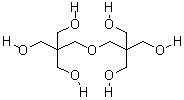
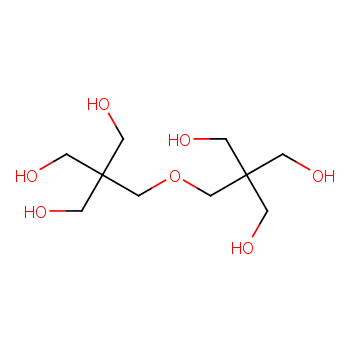
Dipentaerythritol (DPE) is an ether compound of pentaerythritol. Its chemical name is 2,2-bis(hydroxymethyl)-1,3-propanediol, with the molecular formula C10H22O7 and a molecular weight of 254.28. Its molecular structure is depicted in the diagram below:

What are the applications of dipentaerythritol? Several hydroxyl groups in dipentaerythritol molecules can undergo esterification, halogenation, nitration, etc., and the molecule contains stable ether bonds and a typical star-shaped structure. This gives dipentaerythritol derivatives superior performance compared to pentaerythritol derivatives and other similar products. For instance, lubricating oils based on dipentaerythritol carboxylic esters not only exhibit biodegradability but also demonstrate superior antioxidant and thermal stability. Additionally, dipentaerythritol finds widespread applications in areas such as photocurable coatings, polymers, ink binders, etc., making it one of the noteworthy new application materials in recent years.
Understanding the Dipentaerythritol Uses
What is Dipentaerythritol used for? Dipentaerythritol can be used to produce polyethers, polyesters, polyurethanes, and alkyd resins for the coatings industry. Its propionic acid esters can serve as high-density crosslinking agents, pigment dispersions inks, oil well agents, and binders. Lower fatty acid esters can be used as plasticizers for polyvinyl chloride (PVC), producing high-temperature electrical insulation materials. Higher fatty acid esters can be used in the aviation industry and other sectors as advanced lubricating oils for aircraft, turbines, and turbochargers, as well as specialty oils. Notably, dipentaerythritol esters as advanced aviation lubricants exhibit excellent performance that other products cannot replace.
Exploring Dipentaerythritol in the Chemical Industry:
(1) Role of Dipentaerythritol in Alkyd Resins:
Dipentaerythritol, a multifunctional polyol with six hydroxyl groups, plays a crucial role in the chemical industry, particularly in the production of alkyd resins. These resins combine the ideal properties of drying oils with the strength and durability of polyesters. The unique structure of dipentaerythritol makes it easily react with fatty acids from drying oils, forming alkyd resins with excellent adhesion, flexibility, and gloss retention, ideal for high-quality paints, coatings, and inks.
(2) Applications in Ester Gels and Rosin Esters:
Apart from alkyd resins, dipentaerythritol is also used in ester gels and rosin esters. When reacted with rosin (a natural resin), it forms rosin esters. These esters exhibit better water resistance and adhesion compared to unmodified rosins, making them crucial components in adhesives, printing inks, and even hot melt adhesives.
(3) Other Chemical Applications:
Derivatives of dipentaerythritol are used as plasticizers for PVC products, lubricants for high-performance machinery, and even as starting materials for some cosmetics and personal care products.
Applications Beyond Chemicals: Emerging Trends
Potential Applications in Pharmaceuticals
Although dipentaerythritol is not directly applied in pharmaceuticals, there are some potential indirect applications:
Drug Delivery Systems:
Due to its multiple hydroxyl groups, dipentaerythritol can be modified to create drug delivery carriers. These carriers can encapsulate drugs and facilitate controlled release in the body.
Excipients:
Dipentaerythritol derivatives can be used as excipients in drugs. Excipients are inactive ingredients that help increase tablet volume, improve drug stability, or aid in drug absorption. However, extensive testing is needed to ensure safety and efficacy.
Synthetic Intermediates:
The chemical structure of dipentaerythritol can serve as a starting point for synthesizing novel drug compounds. Researchers can modify this molecule to create new drugs with specific properties.
It's worth noting that these are potential applications, and extensive research and development are needed before dipentaerythritol can be used in any pharmaceutical field.
Application Trends
As awareness of environmental issues grows, "green chemistry" has emerged, garnering increasing attention to replacing traditional products with environmentally friendly alternatives or developing new uses. Dipentaerythritol and most of its derivatives are easily biodegradable, non-toxic, environmentally friendly, and safe for human health, making them potential key ingredients in the future of "green" materials, with broad application prospects. With multiple hydroxyl groups, dipentaerythritol offers significant potential for chemical modification. Current modifications mainly focus on crosslinking and graft copolymerization reactions, allowing the creation of a series of dipentaerythritol derivatives with new, unparalleled functions that cannot be replaced by other products, thus developing many new, special-purpose products. While its synthesis is not difficult, there is little domestic reporting on it, lagging behind foreign countries. Therefore, strengthening research on the application of dipentaerythritol and its derivatives, especially in lubricants, will be the main direction for future development.
Dipentaerythritol Solubility: Insights and Considerations
(1) Solubility in Water and Organic Solvents
Is dipentaerythritol soluble in water? Dipentaerythritol has the molecular formula (CH2OH)3CCH2-O-CH2C(CH2OH)3, a molecular weight of 254.28, and a relative density of 1.356. Its water solubility is 1g/345ml (15°C). At room temperature, dipentaerythritol is a white powder, slightly soluble in water and insoluble in most organic solvents.
(2) Factors Affecting Solubility and Practical Significance
In applications such as resin production, selecting the correct solvent is crucial for efficient processing and product quality. Additionally, controlling solubility is essential for the crystallization process, which may require separating dipentaerythritol from mixtures. By considering factors such as temperature, solvent polarity, and the presence of other solutes, chemists can optimize reaction conditions and achieve better control over these processes.
Conclusion: Unleashing the Potential of Dipentaerythritol
The multifunctionality of dipentaerythritol opens up its wide application in the chemical industry. From its fundamental roles in alkyd resins and ester gels to the potential in lubricating oils and pharmaceuticals, this versatile polyol proves its value across various fields. With continued research, dipentaerythritol is poised to become a component or starting material for novel drugs, further expanding its influence and consolidating its crucial position in the chemical domain. We encourage readers to further explore its potential in these emerging fields, offering great promise for future development.
References:
[1] Hu Wei. Industrial Separation Methods for High Purity Mono- and Dipentaerythritol. Contemporary Chemical Research, 2017, (01): 73-74.
[2] Liu Shiqi. Study on Solid-Liquid Phase Equilibrium of Pentaerythritol and Dipentaerythritol. Zhengzhou University, 2014.
[3] Liu Ye. Brief Talk on the Synthesis Purpose and Significance of Mono- and Dipentaerythritol. Chinese Petroleum and Chemical Standards and Quality, 2011, 31 (04): 53.
[4] https://en.wikipedia.org/wiki/Excipient
[5] https://www.lcycic.com/lcy/en/faq_methanol_2.php
[6] https://pubchem.ncbi.nlm.nih.gov/compound/Dipentaerythritol



 EN
EN
 Agricultural News
 Food News
 Industrial News
 Cosmetic News
 Pharmaceutical News
 Science News

 1YR
1YR

