-
We detected your language preference as English. Would you like to switch to the English version for a better experience?
Switch to English
Stay here


Ethyl 3-ethoxyacrylate is an important compound with various synthesis methods and a wide range of applications. Its unique structure and properties make it significant and valuable in the chemical industry. This article explores the synthesis methods and uses of ethyl 3-ethoxyacrylate in different fields to help readers understand the characteristics and application prospects of this compound. By delving into the synthesis and uses of ethyl 3-ethoxyacrylate, this article aims to provide valuable reference and inspiration for researchers and technical personnel in related fields.
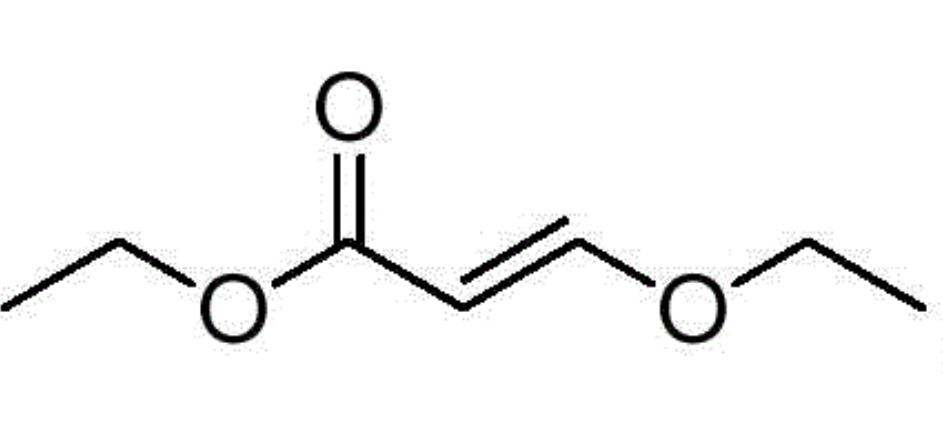
Ethyl 3-ethoxyacrylate, also known as 3-ethoxy-2-propenoic acid ethyl ester, is an important chemical intermediate widely used in pharmaceuticals, pesticides, and polymer materials. It is used in the synthesis of drugs such as levofloxacin, ciprofloxacin hydrochloride, and cefprozil. Ethyl 3-ethoxyacrylate has resilient properties, making it a fundamental chemical in organic synthesis and an intermediate compound in producing complex molecules. Additionally, it is a valuable adhesive in the paint and coatings industry, effectively combining various components. The chemical structure of ethyl 3-ethoxyacrylate is as follows:
Using ethyl acrylate and ethanol as raw materials, ethyl 3-ethoxyacrylate and 3,3-diethoxypropionic acid ethyl ester were successfully synthesized with palladium chloride as a catalyst. The latter can be further cracked to obtain ethyl 3-ethoxyacrylate. Previous studies have shown that the reaction of ethyl acrylate and ethanol under the co-catalysis of polystyrene-supported quinone and palladium dichloride yielded a 17% yield of ethyl 3-ethoxyacrylate and a 78% yield of 3,3-diethoxypropionic acid ethyl ester.

By using sodium 3-ethoxy-2-propanoate and bromoethane as starting materials, ethyl 3-ethoxyacrylate was successfully synthesized under solvent-free conditions using PEG400 as a catalyst. In this reaction system, polyethylene glycol (PEG) acts as a phase transfer catalyst, facilitating the rapid entry of carboxylate anions into the liquid phase, transforming them into strong nucleophiles, thereby initiating a nucleophilic substitution reaction. This synthesis method is simple, environmentally friendly, and yields high products. However, due to the complexity of raw materials, it is not yet suitable for industrial-scale production.

Wang Chen et al. reported a preparation method for ethyl 3-ethoxyacrylate, including the following steps: (1) Add a quantitative amount of vinyl ether dropwise to trichloroacetyl chloride, maintain the temperature at 20-40℃ for 1-10 hours; (2) Evaporate low-boiling by-products under reduced pressure below 40℃; (3) Add an organic base and ethanol, maintain the temperature at 20-50℃ for 1-10 hours; (4) Filter, recover the filter cake, and evaporate ethanol under reduced pressure below 50℃; (5) Add a quantitative amount of acid catalyst, heat to 50-100℃, and introduce nitrogen gas, maintain the temperature for 1-10 hours; (6) Distill under reduced pressure to obtain ethyl 3-ethoxyacrylate. This method uses cheap and readily available raw materials, mild reaction conditions, simple operation, high yield, good product purity, and minimal waste. The solid waste can be recycled, and solvents can be reused, making it a low-cost, environmentally friendly green synthesis technology suitable for industrial production.
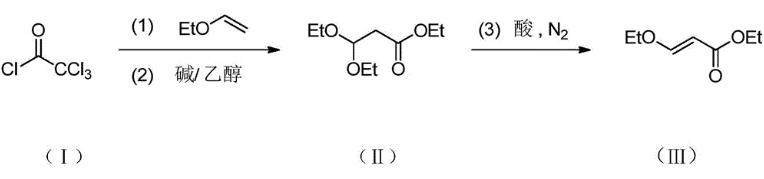
In a three-necked flask, add 91g (0.5mol) of trichloroacetyl chloride, slowly add 54g (0.75mol) of vinyl ether dropwise, complete in about 1 hour, maintain the temperature at 25℃ for 8 hours, then evaporate low-boiling by-products under reduced pressure below 40℃; after evaporation, add 66g (0.65mol) of triethylamine and 100g of ethanol, maintain the temperature at 30℃ for 8 hours, filter, recover the filter cake, and evaporate ethanol under reduced pressure below 50℃; after evaporation, add 6.8g (0.05mol) of potassium bisulfate, heat to 80℃, introduce nitrogen gas at a flow rate of 300mL/min, maintain the temperature for 5 hours, and distill under reduced pressure to obtain 61.8g of ethyl 3-ethoxyacrylate, with a yield of 85.7% and a purity of 98.6% as measured by gas chromatography.
Ethyl 3-ethoxyacrylate is a colorless liquid organic compound commonly used as a building block in organic synthesis. This means it serves as a starting material for creating more complex molecules. Some applications of ethyl 3-ethoxyacrylate include:
Due to its reactivity, ethyl 3-ethoxyacrylate can be a valuable component in adhesive formulations. The presence of the acrylate functional group (C=C-C=O) allows it to crosslink with other molecules. This crosslinking creates a strong, interconnected network that bonds surfaces together. Specific applications include:
Ethyl 3-ethoxyacrylate can serve as a cornerstone for various acrylic adhesives, often used to bond materials such as plastics, metals, and wood.
These adhesives form bonds when pressure is applied, commonly used in tapes, labels, and stickers. Ethyl 3-ethoxyacrylate can enhance the tackiness and adhesive performance of PSAs.
The reactivity and film-forming properties of ethyl 3-ethoxyacrylate make it useful in various coating applications. Here’s how it can be utilized:
Ethyl 3-ethoxyacrylate can be used as a component in clear coating formulations to provide protection and gloss to surfaces like wood, furniture, and even concrete floors.
Its ability to participate in crosslinking reactions makes ethyl 3-ethoxyacrylate suitable for producing functional coatings with specific properties, such as enhanced scratch resistance or water repellency.
These versatile resins are used in various applications, including paints, inks, and composites. Ethyl 3-ethoxyacrylate can improve the strength, durability, and adhesion of these resins.
By modifying formulations, ethyl 3-ethoxyacrylate can be incorporated into specialty resins for specific uses, such as high-temperature resistance or electrical insulation.
It is important to note that the specific applications of ethyl 3-ethoxyacrylate in each category will depend on the chosen formulation and the desired performance of the final product.
Ethyl 3-ethoxyacrylate stands out in various applications due to its unique properties. Unlike other compounds, it offers exceptional purity and consistent performance, seamlessly integrating into complex formulations. This reliable quality makes it a cornerstone in industries such as pharmaceuticals and cosmetics. Additionally, the distinct chemical structure of ethyl 3-ethoxyacrylate, with its active acrylate group and ethoxy portion, provides numerous possibilities. This unique combination allows chemists to modify and enhance the characteristics of final products, ultimately improving performance and functionality.
Ethyl 3-ethoxyacrylate is an important compound with various synthesis methods and a wide range of applications. Its diverse uses in chemicals, pharmaceuticals, and materials showcase its significance and potential in modern science and engineering. As research on ethyl 3-ethoxyacrylate continues to deepen, it is expected to have broader applications and development in the future. Hopefully, this article has inspired readers to better understand and appreciate the characteristics and application prospects of this compound, providing valuable reference and guidance for research and applications in related fields.
[1] Zhejiang Huafang Pharmaceutical Co., Ltd., Shandong Changyi Sifang Pharmaceutical Chemical Co., Ltd. A method for preparing ethyl 3-ethoxyacrylate. 2021-05-28.
[2] https://procure-net.com/product/ethyl-3-ethoxyacrylate/
[3] https://www.fishersci.com/shop/products/ethyl-3-ethoxyacrylate-98-thermo-scientific/AAH5918709
|
 |
 |
|
 EN
EN
 Agricultural News
 Food News
 Industrial News
 Cosmetic News
 Pharmaceutical News
 Science News

 6YRS
6YRS

