-
We detected your language preference as English. Would you like to switch to the English version for a better experience?
Switch to English
Stay here


Ferrocyanide is an inorganic coordination compound built from iron and cyanide ions, appearing in personal care in several forms, the most widely used being ferric ferrocyanide, known as Prussian blue. It delivers an intense, durable indigo shade that is difficult to reproduce with other pigments.
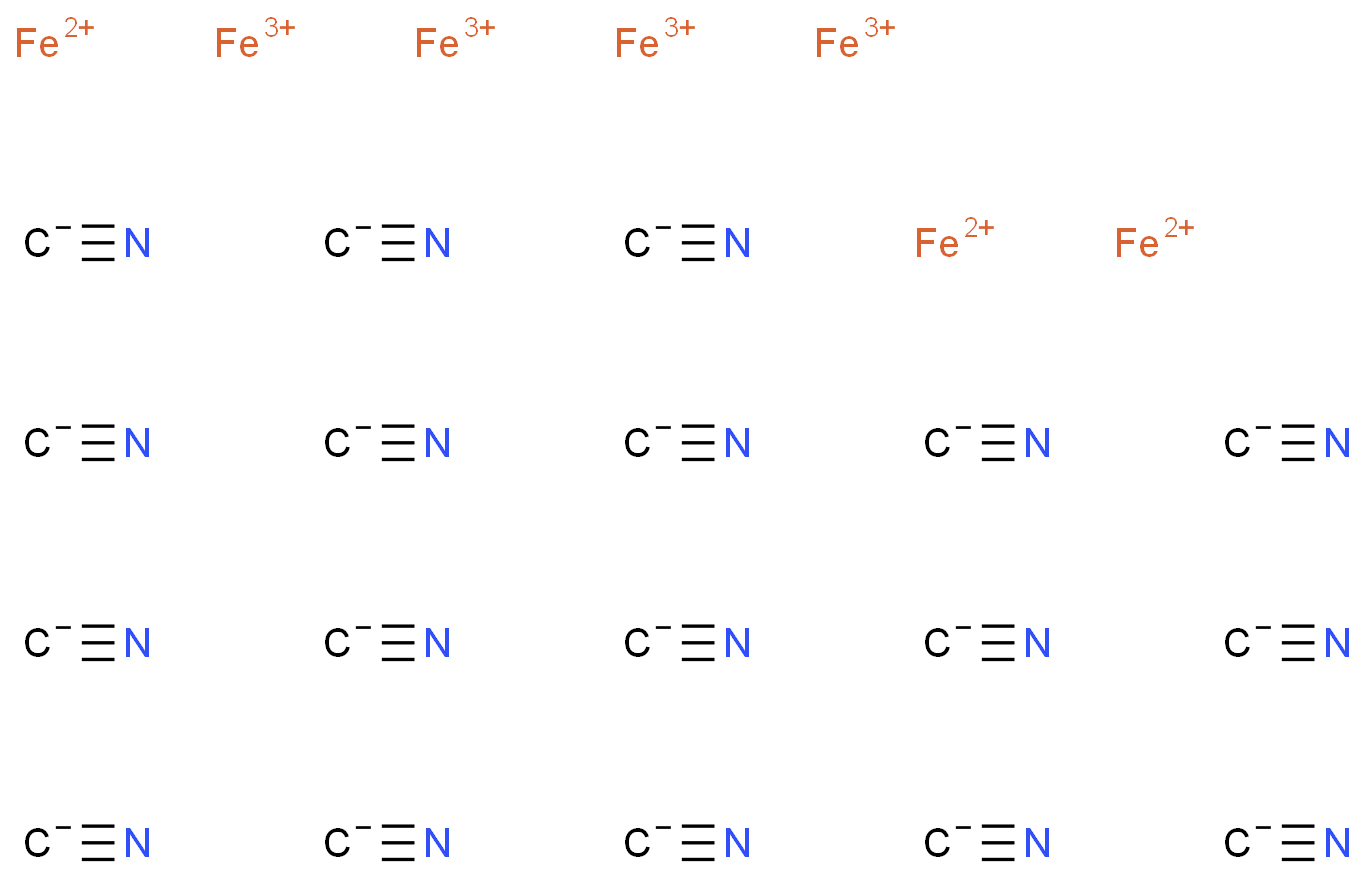
For product developers, the key technical questions are not simply whether ferrocyanide can color a formula blue, but how its coordination chemistry governs dispersibility, stability and regulatory treatment, and why the insoluble pigment behaves very differently from its soluble salts.
| Function | Suitable Users | Core Technical Indicators | Compliance Framework |
|---|---|---|---|
| Inorganic blue colorant (Prussian blue) | Color-cosmetics formulators working on eyeshadow, eyeliner, mascara and nail polish where a stable indigo shade is required | CAS 14038-43-8; CI 77510; deep indigo blue with a cobalt undertone; water-insoluble; density about 1.83 g/cc | US FDA-listed color additive; EU Cosmetics Regulation Annex IV Part I; must be free from cyanide ions |
| Anti-caking and flow agent | Developers of loose and pressed powders who need to prevent lumping and improve the flow of granulated materials | Fine powder and crystals; typical colorant use level 0.05 to 0.2%; improves powder flowability | Evaluated within the finished color cosmetic under good manufacturing practice |
| Soluble salt intermediate (potassium ferrocyanide) | Manufacturers preparing dispersions and pigment intermediates rather than finished formulations | CAS 14459-95-1; molecular weight 368.35 g/mol; trihydrate soluble about 28.9 g/100 mL | Handled as a process intermediate; finished pigment must meet cyanide-free requirements |
Ferrocyanide is a coordination complex formed from iron and cyanide ions and represented by the formula [Fe(CN)6]4-. Within this anion, a central iron atom carries a positive charge and is surrounded by six cyanide ligands arranged in a roughly hexagonal geometry, producing a stable complex whose reactivity is dominated by the metal-ligand bonding.
That distinction is central to how ferrocyanide should be understood. Because the cyanide groups are coordinated to iron rather than existing as free ions, ferrocyanides do not behave like toxic cyanide salts under normal handling and use. Ferric ferrocyanide extends this structure into a mixed-valence iron framework that gives rise to the deep blue color of Prussian blue.
Commercially, ferrocyanides appear as several salts with materially different behavior. Potassium and sodium ferrocyanide are water-soluble crystalline solids, whereas ferric ferrocyanide is an intensely colored, water-insoluble pigment. This explains why the pigment can be dispersed in oils and powders without leaching, and why the soluble salts are typically encountered as manufacturing intermediates.
Explore the ferrocyanide technical encyclopedia for additional chemical and application information.
| Parameter | Specification / Description |
|---|---|
| Chemical name | Iron(2+);iron(3+);octadecacyanide (ferric ferrocyanide) |
| Common names | Ferric ferrocyanide, Prussian blue, iron(III) hexacyanoferrate |
| Molecular formula | C18Fe7N18 (as the mixed-valence complex) |
| Molecular weight | Approximately 859.2 g/mol |
| CAS Number | 14038-43-8 |
| EC Number | 237-875-5 |
| Color index | CI 77510 |
Ferrocyanide is not used in cosmetics because it performs a reactive function such as preservation or emulsification. Its value is optical and physical: it supplies a stable color through electronic transitions and modifies the handling behavior of powders.
The deep blue of ferric ferrocyanide arises from charge-transfer transitions between the iron centers and the coordinated cyanide ligands. Because the color originates in the electronic structure of the complex rather than in a soluble dye molecule, it resists fading and does not readily change when exposed to light or heat.
Ferric ferrocyanide is insoluble in water, so it does not dissolve into the aqueous phase but remains a discrete particulate colorant. This is advantageous because the pigment stays where it is placed and can be dispersed in oils and other common cosmetic ingredients, so the practical requirement is dispersion quality rather than dissolution.
Beyond color, ferrocyanide functions as an anti-caking agent, preventing powdered or granulated materials from forming lumps and improving flowability. Ferric ferrocyanide also behaves as a chelating agent with strong affinity for thallium, cesium and other metal ions, so interactions with other ionic ingredients should be treated as a formulation variable.
Ferric ferrocyanide is synthesized chemically by combining ferric and hexacyanoferrate ions that differ in the oxidation state of their iron atoms. Two common reactive pairings are Fe3+ with [FeII(CN)6]4-, or Fe2+ with [FeIII(CN)6]3-. The route and mixing conditions influence crystal form, particle size and final shade, so the same nominal chemistry can yield materials of noticeably different performance.
Potassium ferrocyanide, a soluble precursor and a distinct commercial product, is produced by reacting sodium ferrocyanide with potassium chloride at a mole ratio of roughly 1.1 to 1.2, which drives formation of coarse crystals that are easier to separate. After adding a further 10 to 20 percent by weight of potassium chloride, the finished product typically contains a high percentage of potassium ferrocyanide, often 98.5 percent or more.
For cosmetic-grade material, the production route is only part of qualification. Manufacturers should also evaluate residual free cyanide, heavy metals, particle-size distribution, moisture, color strength, ash content and batch consistency, and confirm the grade is intended for cosmetic rather than industrial use.
From a formulation perspective, the most relevant comparison is among the ferrocyanide salts and the inorganic colorants a formulator might consider alongside them, rather than among unrelated chemical families.
This is the workhorse member of the family for color cosmetics and is identified as CI 77510. It provides a deep, neutral indigo blue with a cobalt undertone and is stable and insoluble in water, so it neither fades nor changes form under ordinary storage conditions.
This closely related iron blue shares the CI 77510 designation in the European framework and is subject to the same requirement that the material be free from cyanide ions. Because it falls under the same color index entry, formulators should confirm which specific iron blue form is present in a supplied blend.
These soluble salts behave very differently from the insoluble pigment: potassium ferrocyanide is a light, lemon-yellow crystalline solid that dissolves readily in water. They are useful as process intermediates, but should not be treated as interchangeable with the pigment, because their solubility would undermine dispersion behavior.
| Parameter | Ferric Ferrocyanide (Prussian Blue) | Potassium Ferrocyanide |
|---|---|---|
| CAS number | 14038-43-8 | 14459-95-1 |
| Chemical type | Insoluble mixed-valence iron coordination pigment | Water-soluble alkali-metal ferrocyanide salt |
| Molecular weight | About 859.2 g/mol for the extended Fe-CN framework | 368.35 g/mol for the common trihydrate form |
| Water solubility | Insoluble, keeping the pigment in place within the matrix | Trihydrate dissolves at about 28.9 g/100 mL |
| Primary cosmetic use | Blue colorant and anti-caking aid in color cosmetics | Process intermediate, not a direct consumer colorant |
| Key limitation | Dispersion must be controlled; cyanide-free specification required in some markets | Solubility makes it unsuitable where durable deposited color is wanted |
| Property | Typical Description |
|---|---|
| Physical form | Powder and crystals, typically supplied as a fine blue powder |
| Color | Deep, neutral indigo blue with a cobalt undertone |
| Density | About 1.83 g/cc, influencing settling in liquids |
| Melting point | Approximately 1539 degrees C, far above processing temperatures |
| Solubility | Insoluble in water; dispersible in oils and cosmetic ingredients |
| Storage | Keep dry, cool and well-ventilated away from moisture |
| Function | Typical Applications | Key Formulation Objective |
|---|---|---|
| Blue colorant | Eyeshadows, eyeliners, mascaras, nail polishes, lipstick and body or face paints | Achieve a stable indigo shade not easily obtained otherwise |
| Powder colorant | Loose powders and pressed eyeshadows or blushes where even color distribution matters | Maintain uniform shade with minimal agglomeration |
| Anti-caking and flow aid | Powdered and granulated cosmetic materials that tend to lump or cake | Improve flowability while preventing clumping during filling |
| Eye-area color | Cosmetics applied to the eye area, where regulatory treatment is closely defined | Confirm permitted eye-area use and verify market requirements |
Start from the intended product form and the shade the consumer must see. A nail polish, a pressed eyeshadow and a body paint each place different demands on dispersion, opacity and deposition. The target use level for ferric ferrocyanide is commonly 0.05 to 0.2 percent, justified by the color target.
Before batching, confirm identity, color index, assay, particle-size distribution, moisture, ash content, heavy metals and free-cyanide status against the approved purchasing specification. The certificate of analysis should be matched against that specification, and the grade confirmed as suitable for cosmetic use.
Because ferric ferrocyanide is insoluble, dispersion quality determines the visual appearance and color strength delivered. Milling and wetting should be controlled so that aggregates are broken down without over-processing, and the pigment should be dispersed in a compatible phase with appropriate wetting agents to avoid streaking or shade variation between batches.
Confirm that the chosen system does not promote agglomeration, color shift or interaction with other ionic or chelating ingredients over the intended shelf life, and verify that the finished product meets the applicable colorant requirements, including any cyanide-free condition, for every intended market.
The following formulation is an illustrative technical example rather than a universal commercial recipe. Actual ingredient levels must be recalculated according to the color target, raw-material potency and processing losses.
| Ingredient | Illustrative Quantity | Technical Role |
|---|---|---|
| Castor oil | 31.5% | Oil phase providing glide and pigment wetting |
| Candelilla wax, beeswax and ozokerite | About 14% combined | Wax blend building structure and pay-off in a crayon |
| Emollient esters and shea butter | About 24% combined | Cushioning emollients that improve spreadability and skin feel |
| Antioxidant and preservative system | q.s. | Protects the oil phase and supports product stability over shelf life |
| Mica, titanium dioxide and ferric ferrocyanide blend | 32% | Color concentrate delivering the blue pearl shade, ferric ferrocyanide acting as colorant |
Regulatory treatment of ferrocyanide depends on both its identity as an inorganic colorant or anti-caking agent and the intended use of the finished product. A supplier's statement that a material is "cosmetic grade" does not by itself establish compliance in every destination market, and the cyanide-free condition makes documentation especially important.
| Market / Framework | Technical Relevance | Compliance Action |
|---|---|---|
| United States FDA | Listed as an approved color additive under CI 77510 and regarded as safe for externally applied cosmetics, including the eye area, consistent with good manufacturing practice. | Confirm the product category and use level and verify current FDA color-additive requirements. |
| European Union | Ferric ferrocyanide and ferric ammonium ferrocyanide are listed as CI 77510 in Annex IV, Part I of the EU Cosmetics Regulation, permitted provided they are free from cyanide ions. | Verify the cyanide-free condition through supplier documentation. |
| National authorities and other markets | Many jurisdictions align with CI color-index naming yet apply their own permitted-use or free-cyanide conditions, which can differ even where the naming is shared. | Check current national requirements for every intended market. |
| EU REACH | REACH obligations depend on the substance, the manufacturer or importer, the tonnage and any applicable exemptions or downstream-use conditions. | Verify the exact registration and classification status for the supply chain. |
| EU BPR | The Biocidal Products Regulation is generally not the governing framework for ferrocyanide used solely as a cosmetic colorant. | BPR becomes relevant only where the finished product is placed on the market for a biocidal purpose. |
| ISO / GMP quality systems | Good manufacturing practice and quality-management systems support control of contamination, traceability and batch consistency. | Maintain supplier qualification, batch traceability and validated quality procedures. |
Ferrocyanides occupy a distinctive position in cosmetic safety because their name invites comparison with cyanide salts while their chemistry is fundamentally different. The cyanide groups are bound within a stable coordination complex, and the pigment is insoluble in water, so it does not release free cyanide ions under normal use. This is the principal reason ferrocyanide colorants are considered safe for cosmetic application.
Because ferric ferrocyanide is intended for external application, the most relevant exposure routes are dermal and, for eye-area products, ocular. Formulators should respect the good-manufacturing-practice expectation on use level and evaluate the finished product for irritation potential where it will be applied close to the eyes or to sensitive skin.
For product developers, the most important safety principle is to separate colorant function from therapeutic claims. A conventional color cosmetic should not be marketed with unsupported claims that imply treatment or prevention of disease.
No, and the distinction matters for safety and communication. In ferrocyanide the cyanide groups are chemically bound to iron within a stable complex, and the pigment is insoluble in water, so it does not release harmful cyanide ions under normal use. Regulators permit ferrocyanide colorants on that basis.
It delivers a deep indigo blue with a cobalt undertone that is difficult to obtain from other pigments, and it is stable and insoluble, so it does not fade over time. It can also be dispersed in oils, making it easy to incorporate into many product forms.
At minimum, qualification should cover identity, color index, assay, particle-size distribution, moisture, heavy metals and free-cyanide status. Buyers should also confirm the grade is intended for cosmetic use and that the documentation supports the cyanide-free condition where required.
In the United States it is regarded as safe for coloring externally applied cosmetics, including eye-area cosmetics, in amounts consistent with good manufacturing practice, and in the EU it is permitted subject to being free from cyanide ions. Requirements differ by jurisdiction, so verify each market before launch.
| Identifier | Value | Resource |
|---|---|---|
| Chemical name | Ferric ferrocyanide | Technical encyclopedia |
| CAS Number | 14038-43-8 | Chemical dictionary |
| CAS product lookup | 14038-43-8 | Supply search |
| Supplier / trade search | 14038-43-8 | Supplier search |
1. U.S. Food and Drug Administration. Color Additive Status List: Ferric Ferrocyanide, CI 77510.
2. European Parliament and Council. Regulation (EC) No 1223/2009 on cosmetic products, Annex IV, Part I.
3. U.S. Food and Drug Administration. Guidance on color additives in cosmetics.
4. European Commission. Cosmetic Ingredient Database entries for ferric ferrocyanide.
5. European Chemicals Agency. Substance information for ferric ferrocyanide, EC 237-875-5.
6. Color Index International. CI 77510 pigment classification and technical notes.
7. International Organization for Standardization. ISO 22716, Cosmetics — Good Manufacturing Practices.
8. Peer-reviewed literature on Prussian blue synthesis, structure and pigment stability.
|
 |
|
|
 EN
EN
 Agricultural News
 Food News
 Industrial News
 Cosmetic News
 Pharmaceutical News
 Science News

 3YRS
3YRS

