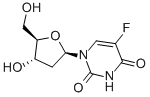
Floxuridine, also known as fluorouridine, is a vital antimetabolite chemotherapy drug widely used in the treatment of various cancers. Floxuridine uses include the treatment of solid tumors such as colorectal cancer, gastric cancer, and breast cancer. Floxuridine functions by disrupting the DNA synthesis of cancer cells, thereby inhibiting their proliferation and spread, effectively suppressing tumor growth. Additionally, floxuridine is utilized for the local treatment of liver cancer, acting directly on tumor sites through arterial infusion to minimize damage to normal tissues. This article will delve into the uses of floxuridine and its efficacy in different cancer treatments to better understand its significance in clinical therapy. What is the drug floxuridine used for?
In 1946, nitrogen mustard was introduced for the treatment of hematologic malignancies, marking the beginning of modern cancer chemotherapy, albeit with limited efficacy. The synthesis of the first-generation fluoropyrimidine drug, 5-fluorouracil (5-FU), in 1957 by Duschinsky et al. heralded the second milestone in modern cancer chemotherapy. Subsequently, chemotherapy has achieved considerable success in clinical practice. In recent years, there have been significant advancements in the development and clinical application of fluoropyrimidine drugs, with improved antitumor activity and reduced toxicity. Floxuridine emerged in this context as a widely used drug with diverse applications.

What are the uses of floxuridine? Floxuridine, a fluoropyrimidine antimetabolite, is a deoxy derivative of fluorouracil. It undergoes conversion into the active form, fluorouridine monophosphate, in the body, thereby blocking DNA synthesis and inhibiting tumor cell growth. It is a cell cycle-specific drug primarily acting on the G1, S, and G2 phases, exerting a delaying effect on the G1/S boundary and S phase. It inhibits thymidylate synthase, hindering the conversion of deoxyuridine monophosphate to thymidine monophosphate, thereby affecting DNA synthesis and exhibiting antiviral and antitumor effects. It demonstrates significant inhibitory effects on various tumor cells and is clinically used for liver cancer, gastrointestinal cancers, breast cancer, head and neck tumors, and more. Additionally, it can be combined with oxaliplatin, calcium folinate, etc., for metastatic liver cancer. Preoperative oral administration can also inhibit gastric cancer cell proliferation and reduce microvessel density, benefiting gastric cancer treatment. Compared to the commonly used anticancer drug 5-fluorouracil, it offers advantages of lower cytotoxicity and better absorption in the body.
Floxuridine (FUDR) undergoes two conversion pathways in the body: one pathway involves the catalysis of thymidine kinase to generate fluorodeoxyuridine monophosphate (FdUMP), primarily inhibiting DNA synthesis to produce a series of antitumor mechanisms; the other pathway transforms into 5-FU under the action of thymidine kinase phosphorylase, and subsequently, 5-FU undergoes three conversion pathways in the body, namely, synthetic metabolism, decomposition metabolism, and glucoside binding. Research has shown that while FUDR tends to favor the first pathway in vitro, it rapidly converts to 5-FU through the second pathway in vivo, suggesting that FUDR primarily acts in the body by converting to 5-FU. After metabolism, 5-FU mainly produces two active substances: fluorouridine triphosphate (FUTP), which binds to RNA, interfering with its function, and fluorodeoxyuridine monophosphate (FdUMP), generated through the action of uridine kinase, which inhibits thymidylate synthase (TS), thereby halting DNA synthesis. Upon formation, FdUMP binds to thymidylate synthase, forming a stable ternary complex covalently bonded with N5,10-methylenetetrahydrofolate. The strength of 5-FU's antitumor effect directly correlates with the degree of thymidylate synthase inhibition, determined by the stability of the ternary complex. The mechanism of action is depicted in the figure below:
A study reported on the efficacy of hepatic arterial infusion (HAI) chemotherapy in combination with standard care chemotherapy compared to standard care chemotherapy alone in patients with unresectable colorectal liver metastases. The PUMP trial, a Phase III trial, compared hepatic arterial infusion (HAI) chemotherapy (pump chemotherapy) combined with standard care chemotherapy to standard care chemotherapy alone in patients with colorectal cancer that had spread to the liver (liver metastases) and could not be removed by surgery (unresectable). HAI uses a catheter to deliver a tumor-killing chemotherapy drug called floxuridine directly to the liver. HAI has been approved by the U.S. Food and Drug Administration (FDA) for metastatic colorectal cancer to the liver but is available only at a few hospitals and is usually used only after standard chemotherapy stops working. Standard chemotherapy drugs work in different ways to stop the growth of tumor cells, either by killing the cells, stopping them from dividing, or stopping them from spreading. Adding HAI to standard chemotherapy can effectively shrink or stabilize unresectable colorectal liver metastases.
A Phase II trial examined the safety, side effects, and effectiveness of preoperative hepatic arterial (HA) chemotherapy with floxuridine (FUDR) and oxaliplatin (neoadjuvant) in patients with locally confined (localized) pancreatic cancer. Floxuridine belongs to a class of drugs called antimetabolites. Its action is to slow down or stop the growth of cancer cells in the body. Oxaliplatin belongs to a class of drugs called platinum-containing antineoplastic drugs. It damages the deoxyribonucleic acid (DNA) of cells and may kill cancer cells. Hyaluronic acid infusion delivers chemotherapy drugs directly to the liver, which may reduce liver recurrence. Neoadjuvant HA FUDR and oxaliplatin may be safe, tolerable, and effective in treating patients with localized pancreatic cancer.
Angiogenesis plays a crucial role in the occurrence and development of tumors. Inhibiting this process can affect tumor tissue proliferation and metastasis, further improving clinical efficacy. Zhang et al. investigated the effects of preoperative oral administration of floxuridine on gastric cancer cell proliferation and microvessel density (MVD).
Preoperative chemotherapy, known as neoadjuvant chemotherapy, was proposed by Frei in 1982 as part of comprehensive cancer treatment. However, the clinical development of neoadjuvant chemotherapy has been somewhat limited due to the toxic side effects of chemotherapy drugs. Floxuridine is a new generation chemotherapy drug developed by Roche, Switzerland, with good oral absorption. It converts into 5-FU, which displays high activity in tumor tissue, exerting selective anticancer effects. It has a high therapeutic index and minimal side effects, making it a potential first-line drug for neoadjuvant chemotherapy.
PCNA is an auxiliary protein of δ protein, directly involved in DNA synthesis and repair, mainly expressed in the S phase of cell proliferation. Detecting PCNA can effectively mark the degree of tumor proliferation. The higher the tumor cell proliferation activity, the greater the malignancy. The experimental group's gastric cancer cell proliferation index was significantly lower than that of the control group, indicating that preoperative oral administration of floxuridine can inhibit gastric cancer cell proliferation and reduce tumor malignancy. After the action of floxuridine, poorly differentiated gastric cancer still exhibits a higher proliferation index than well-differentiated gastric cancer, indicating that the degree of differentiation is an important factor affecting prognosis.
The study results suggest that preoperative oral administration of floxuridine can inhibit gastric cancer cell proliferation, reduce microvessel density, decrease tumor burden during surgery, and minimize the risk of intraoperative iatrogenic dissemination, thereby benefiting gastric cancer treatment. However, the efficacy and mechanism of preoperative chemotherapy may differ from those of postoperative chemotherapy. Further research is needed to explore the impact on the choice of preoperative chemotherapy regimen, course, and timing of surgery, as well as the continuation of postoperative chemotherapy.
A Phase II trial investigated the effects of gemcitabine and oxaliplatin with or without floxuridine and dexamethasone pump on cancer patients with bile duct cancer (cholangiocarcinoma) that cannot be removed by surgery. Researchers are combining the chemotherapy drugs gemcitabine and oxaliplatin (GemOx; the standard treatment for this type of cancer) with another treatment provided by a pump device called hepatic arterial infusion (HAI). During surgery, an HAI pump implanted in the abdomen continuously delivers the chemotherapy drugs floxuridine and dexamethasone directly to the liver. Floxuridine disrupts genetic information (DNA and RNA) in the body, thereby preventing cancer cell growth and reproduction. Dexamethasone helps minimize swelling and other side effects caused by floxuridine. Gemcitabine and oxaliplatin both act by disrupting cancer cell DNA. Combining gemcitabine and oxaliplatin with floxuridine and dexamethasone pump via HAI may potentially be more effective in treating patients with unresectable bile duct cancer.
The ability of floxuridine to disrupt DNA synthesis makes it a valuable tool in cell biology research. Scientists use floxuridine to study various aspects of the cell cycle and DNA replication process.
Floxuridine can also inhibit the replication of certain viruses, especially those dependent on rapid cell division. Researchers are exploring its potential in treating viral infections.
In conclusion, floxuridine plays a crucial role in the treatment of various cancers, including colorectal cancer, gastric cancer, breast cancer, and liver cancer. By inhibiting the DNA synthesis of cancer cells, it effectively halts tumor growth and spread. However, the specific treatment outcomes and applicability vary depending on individual patient conditions. Therefore, it is essential to consult a doctor and formulate personalized treatment plans based on professional advice. Physician guidance can not only maximize treatment efficacy but also help manage and alleviate potential side effects.
[1] Cao Mengmeng. Research on the improvement of the synthesis process of drugs floxuridine and mogistein [D]. Tianjin University, 2007.
[2] Zhang Zhi. Effects of oral administration of floxuridine before surgery on the proliferation and microvascular density of gastric cancer cells [J]. Practical General Medicine, 2005, (03): 209-210. DOI:10.16766/j.cnki.issn.1674-4152.2005.03.019.
[3]https://www.sciencedirect.com/science/article/abs/pii/S0960894X00001086
[4]https://www.cancer.gov/research/participate/clinical-trials/intervention/floxuridine
[5]https://www.sciencedirect.com/topics/pharmacology-toxicology-and-pharmaceutical-science/floxuridine
[6]https://pubmed.ncbi.nlm.nih.gov/2143063/
[7]https://jamanetwork.com/journals/jamasurgery/article-abstract/594801
[8]https://go.drugbank.com/drugs/DB00322
|
 |
 |



 3YRS
3YRS