-
We detected your language preference as English. Would you like to switch to the English version for a better experience?
Switch to English
Stay here


Gallic acid monohydrate is a chemical substance with various important uses. It is widely applied in industrial production, scientific research, and the pharmaceutical field. This article will delve into the extensive uses of gallic acid monohydrate and its immense potential in different areas to help readers gain a comprehensive understanding of its importance and value across various fields.

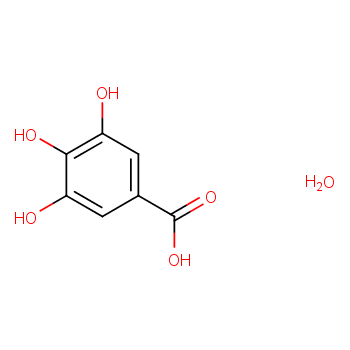
Gallic acid monohydrate, also known as gallic acid hydrate, 3,4,5-trihydroxybenzoic acid monohydrate, with the chemical formula C7H6O5·H2O, is a white crystalline or powdery substance, odorless and slightly acidic in taste. It is easily soluble in water and has some solubility in organic solvents such as ethanol and acetone.

Gallic acid monohydrate is an antioxidant with CAS number 5995-86-8. It reacts with ferric chloride to produce a blue-black color. It is used as an antioxidant in food and beverage products. Gallic acid monohydrate is utilized in various food and beverage applications, including vinegar, wine, hot chocolate, and white tea. It has antibacterial, anti-inflammatory, and hemostatic effects, commonly used to treat diarrhea, dysentery, gastrointestinal bleeding, and other diseases. Gallic acid monohydrate can also be used as a tanning agent, dyeing auxiliary, and analytical reagent. With its extensive applications, gallic acid monohydrate is an important chemical.
Gallic acid monohydrate is a polyphenol found in various foods and herbs. Numerous studies have shown that gallic acid monohydrate has neuroprotective and antioxidant properties, making it a promising candidate for treating diseases such as cancer, cardiovascular diseases, neurodegenerative diseases, and fatty liver disease. Gallic acid monohydrate protects cells from oxidative damage caused by reactive substances frequently encountered in biological systems, including hydroxyl, superoxide, and peroxides, as well as non-radicals, hydrogen peroxide, and hypochlorous acid. However, its ability to induce apoptosis is mainly related to its pro-oxidant rather than antioxidant action.
Gallic acid monohydrate is an effective antioxidant that can help protect the skin from damage caused by free radicals. Free radicals are unstable molecules that lead to wrinkles, fine lines, and other signs of aging. By neutralizing free radicals, gallic acid monohydrate can help maintain youthful skin.
Gallic acid monohydrate may also have anti-inflammatory properties. This can be beneficial for conditions characterized by inflammation, such as acne or rosacea.
Some studies suggest that gallic acid monohydrate may have antibacterial properties. This can help reduce the growth of bacteria on the skin, which can lead to acne and other problems.
In the food industry, as a natural antioxidant, it can effectively prevent the generation of free radicals and damage to cell membranes. Therefore, gallic acid monohydrate can be widely used in producing antioxidant foods.
The unique molecular structure of gallic acid and its derivatives makes it easily oxidized, especially under alkaline or enzymatic conditions, which accelerates oxidation and consumes environmental oxygen, thereby protecting biological tissues. In the food industry, gallic acid and its derivatives can serve as good antioxidants, particularly in lipid-based foods. Compared with synthetic antioxidants (such as butylated hydroxyanisole) on the market, gallic acid is a natural antioxidant without carcinogenicity. Food-grade gallic acid can also be used as a preservative for wine. Additionally, when used with vitamin E or licorice, it can effectively improve the thermal stability of palm oil.
Edible films are a new type of packaging material different from traditional food packaging films. Due to its antibacterial and anti-inflammatory properties, gallic acid is especially favored by edible film researchers. Studies have found that combining gallic acid with chitosan to prepare edible films can not only effectively solve the environmental problem of "white pollution" but also improve food quality to a certain extent and extend shelf life.
Gallic acid monohydrate can be used as a reducing agent to synthesize nanomaterials. For example, tin oxide (SnO2) nanoparticles can be synthesized using tin(II) chloride as the precursor salt through a precipitation method. This method has the advantages of simple operation and high yield.
Di Huo and colleagues used a simple, repeatable hydrothermal synthesis method to synthesize two-dimensional Bi2Se3 nanosheets with gallic acid as a reducing agent. The study found that gallic acid effectively reduces Se4+ to Se2? and forms Bi2Se3. Maintaining a molar ratio of gallic acid to precursor elements (Bi+Se) of 1:1 (or higher) and using a strong alkaline solution as reaction conditions are key to synthesizing high-purity crystalline Bi2Se3 nanosheets. Additionally, adding an appropriate amount of Triton X-100 can easily prepare flower-like Bi2Se3 composed of nanosheets with a thickness of tens of nanometers. This study provides a new method for the controllable synthesis of ultrathin Bi2Se3 nanosheets.
Gallic acid monohydrate has significant acidity and can neutralize alkaline substances to form corresponding organic salts. This property makes it important in organic synthesis. For example, sodium gallate can be used as a buffer to adjust the pH of solutions.
The phenolic hydroxyl group on the benzene ring and the carboxyl group in the structure can undergo alkylation reactions with alkyl halides such as iodomethane under weakly alkaline conditions. This property can be used to synthesize new organic compounds. For example, methyl gallate is an important fragrance used as a food additive and pharmaceutical intermediate.
Gallic acid monohydrate can also be used as an analytical reagent. For example, it can be used for the photometric determination of cerium, titanium, phosphate, and nitrite. Additionally, it can be used as a depolarizer in electrochemical analysis.
Gallic acid monohydrate is also used in the manufacture of ink and photography. It is an important component of iron gall ink, the standard ink for writing and drawing in Europe from the 12th to 19th centuries, with a history dating back to the Roman Empire and the Dead Sea Scrolls. Pliny the Elder (AD 23-79) described using gallic acid to detect forged verdigris and wrote that it was used to produce dyes. Crushing galls from oak trees (also known as oak apples) and mixing them with water produces tannic acid. This can then be mixed with green vitriol (ferrous sulfate), obtained by evaporating the saturated sulfate water from spring water or mine drainage, and gum arabic from acacia trees; the combination of these ingredients produced ink.
Through this introduction, it is clear that gallic acid monohydrate has important uses in multiple fields. As a multifunctional compound, it plays a significant role in industry, science, and medicine. Whether used as a reducing agent, analytical reagent, or in ink manufacturing and photography, gallic acid monohydrate demonstrates its unique value and potential. With the continuous development of science and technology and the expansion of application fields, gallic acid monohydrate will continue to play an important role and contribute even more to the development of human society.
[1] https://www.ulprospector.com/en/asia/Food/Detail/17115/428586/Gallic-Acid-Monohydrate
[2] https://en.wikipedia.org/wiki/Gallic_acid
[3] https://www.frontiersin.org/journals/pharmacology/articles/10.3389/fphar.2018.01486/full
[4] https://pubmed.ncbi.nlm.nih.gov/33212373/
[5] https://www.paulaschoice.com/ingredient-dictionary/ingredient-gallic-acid.html
[6] https://drugs.ncats.io/substance/48339473OT
[7] https://pubs.rsc.org/en/content/articlelanding/2022/ra/d2ra01129h
[8] https://pubchem.ncbi.nlm.nih.gov/compound/24721416
|
 |
 |
 |
 EN
EN
 Agricultural News
 Food News
 Industrial News
 Cosmetic News
 Pharmaceutical News
 Science News

 13YRS
13YRS

