-
We detected your language preference as English. Would you like to switch to the English version for a better experience?
Switch to English
Stay here


Ibuprofen (C13H18O2) is a common nonsteroidal anti-inflammatory drug (NSAID) known for its analgesic, antipyretic, and anti-inflammatory properties. As a complex organic compound composed of thirteen carbon atoms, eighteen hydrogen atoms, and two oxygen atoms, ibuprofen exhibits a unique set of physical and chemical properties. One of the most significant characteristics of ibuprofen is its polarity, which arises due to the presence of a carboxyl (-COOH) group. This polarity affects how ibuprofen interacts with other substances, making it an effective therapeutic agent in pain relief, fever reduction, and inflammation management. Moreover, the polar nature of ibuprofen is central to its solubility and bioavailability, key features that underlie its widespread use in pharmaceuticals. But what exactly is polarity? How does this fundamental concept influence the behavior and applications of chemical compounds like ibuprofen?
Polarity describes the uneven distribution of electrons within a molecule or compound, leading to the formation of positive and negative poles. In the context of chemistry, polarity arises when there is an unequal sharing of electrons between atoms, typically due to differences in electronegativity—the ability of an atom to attract electrons.
When atoms in a bond have significantly different electronegativities, with a difference typically ranging from 0.5 to 2, the shared electrons tend to be pulled closer to the more electronegative atom. This shift in electron density results in one part of the molecule carrying a partial negative charge and the other a partial positive charge, thereby giving the molecule its polar character.
Polar molecules, such as water, exhibit distinctive chemical and physical behaviors, including higher solubility in water, elevated boiling and melting points, and unique interactions in biological systems. These characteristics make polarity a crucial factor in many chemical and biological processes. Is ibuprofen polar or nonpolar?
Is ibuprofen polar or nonpolar? To determine whether ibuprofen (C13H18O2) is polar or nonpolar, we can examine it from three key perspectives: molecular geometry, dipole moment, and electronegativity.
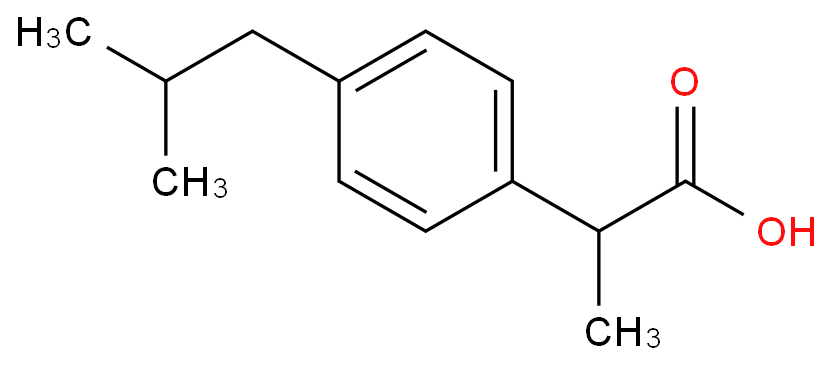
Molecular Geometry:Ibuprofen consists of a long carbon chain and a carboxyl group (-COOH) attached to one of the carbons. The carbon atoms in the chain are primarily sp³ hybridized, adopting a tetrahedral geometry, while the carboxyl group has a bent shape due to the lone pairs on the oxygen atom. Although the carboxyl group introduces a region of partial charge separation, the overall shape of the molecule is relatively nonpolar because the large hydrocarbon chain, which is nonpolar, dominates the molecule’s structure. As a result, the nonpolar parts of ibuprofen reduce the overall polarity of the molecule.

Dipole Moment: A molecule’s dipole moment measures the separation of positive and negative charges. While the carboxyl group in ibuprofen contributes to a dipole moment due to the more electronegative oxygen atoms, the overall effect is weakened by the large nonpolar hydrocarbon chain. The oxygen atoms in the carboxyl group attract electrons more strongly, creating partial negative charges near the oxygen and partial positive charges near the hydrogen atoms. However, because the nonpolar carbon chain does not create significant charge separation, the molecule does not have a strong dipole moment.
Electronegativity: Electronegativity plays a key role in determining polarity. In ibuprofen, the oxygen atom has a higher electronegativity (3.44 on the Pauling scale) compared to the carbon atoms (2.55) and hydrogen atoms (2.20). This creates an uneven distribution of electron density, particularly around the -COOH group. However, the presence of the long nonpolar hydrocarbon chain reduces the molecule’s overall polarity. The carbon-oxygen bonds in the carboxyl group contribute to the dipole moment, but the molecule’s overall nonpolar nature is largely due to the hydrocarbon chain.
| Element Electronegativity | |
| O | 3.44 |
| H | 2.20 |
| C | 2.55 |

Therefore, ibuprofen (C₁₃H₁₈O₂) is considered a largely nonpolar molecule. The nonpolar hydrocarbon chain and the weaker dipole contribution from the carboxyl group lead to its overall nonpolar character. This accounts for ibuprofen's low solubility in water and its solubility in nonpolar solvents like oils. The molecular structure of ibuprofen explains its effectiveness as a therapeutic agent in various applications, where its hydrophobic properties are beneficial in reaching target tissues.
| Ibuprofen Cas 15687-27-1 | |
| Molecular formula | C13H18O2 |
| Molecular shape | Tetrahedral |
| Relative molecular mass | 206.28 g/mol |
| Solubility | almost insoluble in water and readily soluble in acetone, methanol, and dichloromethane. |
| Melting point | 76-78 °C |
| Boiling point | 157 °C (4 mmHg) |
| Compound | Polarity | Applications |
| Aspirin (C9H8O4) | Polar due to the carboxyl (-COOH) and phenolic (-OH) groups; similar to ibuprofen in terms of polarity. | Solvent in pharmaceuticals, pain relief, and anti-inflammatory agents. |
| Naproxen (C14H14O3) | Polar due to the carboxyl (-COOH) group; similar to ibuprofen but with a longer carbon chain. | Used for pain relief, anti-inflammatory agents, and menstrual cramp relief. |
After exploring the polarity chemistry of C₁₃H₁₈O₂, have you gained a deeper understanding of whether it is "polar or nonpolar"? While C₁₃H₁₈O₂ as a molecule is nonpolar, this does not necessarily mean that all of its bonds are nonpolar bonds. If you're interested in similar compounds or related supply chain resources, Guidechem offers a comprehensive list of global ibuprofen suppliers, where you can find the right procurement plan to meet your research and production needs.
 |
 |
 |
 |
 |
 |
 EN
EN
 Agricultural News
 Food News
 Industrial News
 Cosmetic News
 Pharmaceutical News
 Science News

 3YRS
3YRS

