-
We detected your language preference as English. Would you like to switch to the English version for a better experience?
Switch to English
Stay here


N carbobenzyloxy l aspartic acid, formula is C12H11NO6, is used as a biochemical reagent and in peptide synthesis. It is a derivative of L-Aspartic Acid. Aspartic Acid is an α-amino acid, and its left-handed isomer is one of the 20 amino acids that make up proteins, with the genetic codons GAU and GAC. As an acidic amino acid, Aspartic Acid has similar properties to Glutamic Acid and is classified as a non-essential amino acid. It is widely present in biosynthesis processes and participates in various critical biological reactions, serving as a precursor for many amino acids such as Lysine, Threonine, Isoleucine, Methionine, as well as purine and pyrimidine bases. The amino group of N-Carbobenzyloxy-L-aspartic acid is protected by the Benzyloxycarbonyl (Cbz) group, which is commonly used in organic synthesis to protect amines.

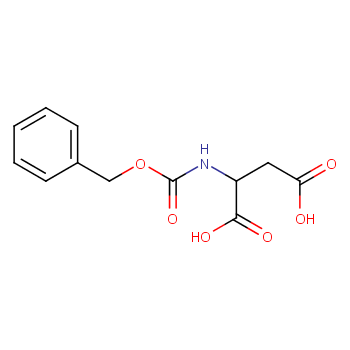
N-Carbobenzyloxy-L-aspartic acid, also known as N-Carbobenzyloxy-L-aspartic Acid, CAS: 1152-61-0, N carbobenzyloxy l aspartic acid formula is C12H13NO6. This compound features a complex molecular structure with several key characteristics. Its core structure consists of a four-carbon chain with a carboxyl group at each end. On one side of this structure, the main chain of L-Aspartic Acid is connected to an amino group (NH2), while the other side connects to a side chain with a second carboxyl group, defining it as L-Aspartic Acid. Additionally, the amino end is linked to a Benzyl group (C6H5CH2) via a carbonyl group (C=O), forming a Benzyloxycarbonyl (Z) protecting group. This design effectively protects the amino group from unwanted chemical reactions during peptide synthesis. N carbobenzyloxy l aspartic acid structure is as follows:

N carbobenzyloxy l aspartic acid structure
C. Won et al. used p-toluenesulfonic acid as a catalyst, with N-Carbobenzyloxy-L-aspartic acid anhydride (2) and 1,4-Cyclohexanedimethanol (3) as raw materials, to synthesize a novel biodegradable polyester with pendant amine functional groups through a condensation reaction. The synthesized polymer 4 exhibited a characteristic ester carbonyl absorption peak at 1732 cm-1 in IR spectra, and the NMR spectra were consistent with IR data. The polymer's weight-average molecular weight ranged from 1140 to 5050 and increased with reaction time. This new polymer shows potential for drug delivery biodegradable materials.
N-Carbobenzyloxy-L-aspartic acid (Z-L-Asp) is commonly used as a carboxyl substrate for enzymatic synthesis of Aspartame precursors (sweeteners). A biphasic reaction system was employed, using N-Carbobenzyloxy-L-aspartic acid and L-Phenylalanine methyl ester (PM) as raw materials, to enzymatically synthesize the Aspartame precursor N-Carbobenzyloxy-L-Aspartyl-L-Phenylalanine Methyl Ester (ZAPM).
D. Vidhya et al. prepared N-Carbobenzyloxy-L-aspartic acid crystals and characterized them to study their nonlinear optical crystal properties. The primary chemical species of the organic compound is L-Aspartic Acid, which was enhanced by injecting hexagonal active ligands to improve its nonlinear optical performance. XRD analysis revealed that the basic lattice of the molecular complex is orthorhombic, with point and space group molecular structures of C1 and P212121, respectively. The frequency doubling efficiency was calculated to be 0.5381, 1.39 times higher than the reference KDP. The measured laser damage threshold was 13.97 GW/cm2. The dipole vibration and Raman scattering bands were studied, and the polarization capacity of these bonds was examined. Oscillatory chemical potential dynamics were observed in the core and related carbon chemical shifts. Direct and indirect band gaps in the infrared and UV-visible regions were measured. Chemical consistency and chemical potential were assessed to study optical capabilities. The π and δ conjugated electron donor and proton acceptor elements in the molecular structure were identified through interaction composite orbitals. UV-visible transmission and absorption on degenerate electronic energy levels were distinguished, and the CT composite source of this crystal composite material was determined to be (COOH)2. The superactive polarization mechanism was measured, which was five times larger than thiourea and KDP crystals. The estimated depletion energy between high electrophilic and proton regions was ±6.026 e2; the dielectric properties of the title organic composite material were enhanced. The non-superimposability of the enantiomers was captured, verifying electro-optic capabilities.
N-Carbobenzyloxy-L-aspartic acid is commonly used as a synthesis unit in Solid Phase Peptide Synthesis (SPPS). SPPS is a technique for efficient peptide chain synthesis on a solid support. The presence of the Cbz group helps to stabilize the Aspartic Acid residue on the resin and supports the extension of the peptide chain.
Avoid inhaling dust or powder. Use appropriate respiratory protection to minimize risk.
Dust or powder contact with skin or eyes may cause irritation. Wear gloves and safety goggles for protection.
Ingesting these substances may cause gastrointestinal discomfort. Thoroughly wash hands after handling to ensure safety.
If inhaled, move the patient to fresh air.
Remove contaminated clothing and wash skin thoroughly with soap and water. Seek medical attention if discomfort persists.
Separate eyelids and rinse with flowing water or saline. Seek immediate medical attention.
Rinse mouth. Seek immediate medical attention.
Avoid contact with skin and eyes. Prevent dust and aerosol formation. Avoid contact - obtain special instructions before use. Provide appropriate exhaust ventilation where dust may be formed.
Store in a cool place. Keep the container sealed and store in a dry, well-ventilated area.
N-Carbobenzyloxy-L-aspartic acid is a widely studied amino acid derivative due to its significant role in biosynthesis and drug development. Understanding more about N-Carbobenzyloxy-L-aspartic acid can help researchers and manufacturers better utilize its properties. We encourage you to further explore the application potential of this product and find reliable N-Carbobenzyloxy-L-aspartic acid suppliers through the Guidechem platform to meet your needs.
[1]Won C Y, Chu C C, Yu T J. Novel amine‐containing biodegradable polyester via copolymerization of aspartic anhydride and 1, 4‐cyclohexanedimethanol[J]. Macromolecular rapid communications, 1996, 17(9): 653-659.
[2]Vidhya D, Ramalingam S, Periandy S, et al. NLO activity analysis and spectroscopic investigation on electro-optic and physico-chemical properties of organic complex; N-benzyloxycarbonyl-L-Aspartic acid[J]. Optical Materials, 2020, 104: 109840.
[3]Murakami Y, Yoshida T, Hayashi S, et al. Continuous enzymatic production of peptide precursor in aqueous/organic biphasic medium[J]. Biotechnology and bioengineering, 2000, 69(1): 57-65.
[4]https://baike.baidu.com/search?word=N-%E8%8B%84%E6%B0%A7%E7%BE%B0%E5%9F%BA-L-%E5%A4%A9%E5%86%AC%E6%B0%A8%E9%85%B8
[5]https://pubchem.ncbi.nlm.nih.gov/compound/N-Carbobenzyloxy-L-aspartic acid
[6]Isono Y, Nakajima M. Application of membrane phase separation for enzymatic synthesis of aspartame precursor in biphasic reaction system[J]. Biochemical engineering journal, 2000, 4(2): 143-147.
|
 |
|
|
 EN
EN
 Agricultural News
 Food News
 Industrial News
 Cosmetic News
 Pharmaceutical News
 Science News

 3YRS
3YRS

