-
We detected your language preference as English. Would you like to switch to the English version for a better experience?
Switch to English
Stay here


Naphthol AS is an organic compound. Naphthol as chemical formula is C10H6(OH)C(O)NHC6H5. It is the aniline of 3-hydroxy-2-carboxynaphthalene. The preferred IUPAC name is 3-hydroxy-N-phenyl-naphthalene-2-carboxamide. Several similar compounds are known, differing only by suffix. For example, in Naphthol AS-OL, the aryl substituent on the nitrogen is C6H4-2-OCH3. These compounds are used as coupling agents in the preparation of certain azo dyes. In 1911, chemists at K. Oehler Anilin- und Anilinfarbenfabrik Offenbach discovered it as a good precursor for wool dyes. The structure of Naphthol AS is as follows:
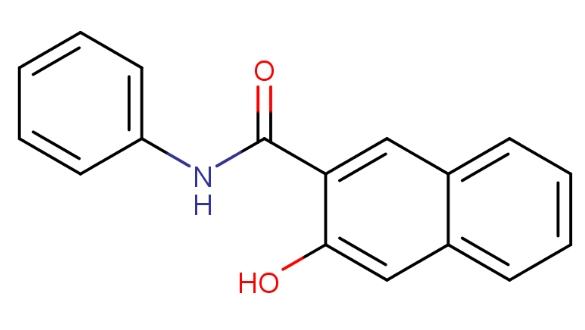
Naphthol AS does not contain water-soluble groups, which allows it to adhere firmly to fibers, providing excellent wash fastness. Additionally, Naphthol colour offers vivid hues and a complete color spectrum, good lightfastness, and wash fastness, and its dyeing process is straightforward. However, its abrasion fastness is relatively low. Due to these characteristics, Naphthol AS is widely used in various sectors of the textile industry, particularly in the dyeing and printing of cotton fabrics. It is primarily used for the dyeing and printing of cotton fabrics but can also be applied to cotton yarns, polyester/cotton blends, rayon, nylon, silk, and acetate fibers. It is also used in the preparation of fast pigments, fast amines, fast sulfonic acids, and organic pigments.
What is the full form of naphthol as?
Naphthol AS is the aniline of 3-hydroxy-2-carboxynaphthalene. The preferred IUPAC name for Naphthol AS is 3-hydroxy-N-phenyl-naphthalene-2-carboxamide, with other chemical names including Naphthol AS, 3-hydroxy-2-naphthanilide, and β-hydroxy-naphthoic anilide.
Definition
Naphthol AS is insoluble in water. It is a phenolic compound that dissolves in alkaline solutions and has an affinity for cotton, especially in the presence of salt. In the presence of strong alkali, it converts to the corresponding naphtholate anion and dissolves in water. Naphtholates are always coplanar and preferably have an elongated molecular structure. These relatively small molecules have low to medium affinity for cotton. Naphthols can be classified based on their affinity for cotton into four categories:
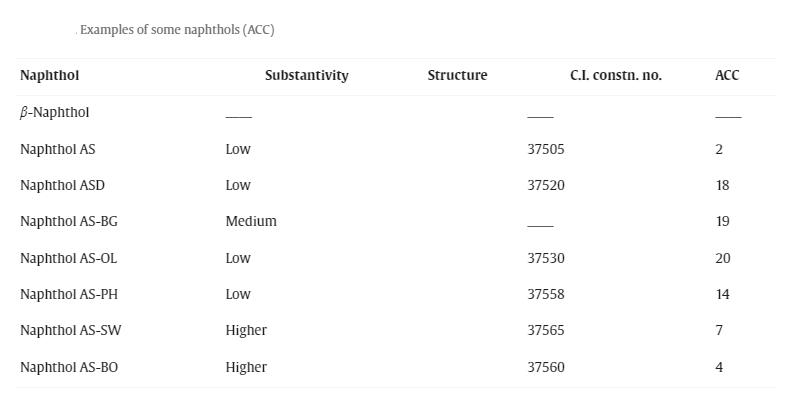
Generally, higher affinity results in better abrasion fastness as fewer azo pigments form on the fiber surface. As the size of the naphthol anion molecule increases, affinity increases, but diffusion rate in the fiber and solubility in dilute alkaline solutions decrease. Adding salt can enhance absorption in the bath; lower affinity naphthols require more salt. To dissolve naphthol AS, a 72°TW or 38°Be caustic soda solution is typically used. The first ACC used in commercial synthesis of azo dyes is 2-hydroxy-naphthalene, or β-naphthol. Later, it was replaced by the more affinitive 2-hydroxy-3-naphthoic acid anilide discovered in Germany in 1911. This product is now known as Naphthol AS. Several other substantial naphthols were developed over the following years through different substitutions on the basic structure, named as members of the Naphthol AS series (as shown in the table below).
Naphthol as uses in Dyeing
In Naphthol AS pigments, 2-hydroxy-3-naphthoic acid anilide (trade name: Naphthol AS) and its derivatives are used as coupling components. This type of pigment initially became popular as a colorant for cotton. In this group of dyes, 2-hydroxy-3-naphthoic acid anilide (Naphthol AS) was used as a coupling component instead of β-naphthol in 1911. The sodium salt of Naphthol AS is absorbed by cellulose fibers due to its affinity. High color fastness is achieved through coupling with diazo components to form insoluble colorants (i.e., pigments) on the fibers. The discovery of Naphthol A pigments was patented as early as 1911. Naphthol AS and many derivatives with substituted aniline groups have been described. However, these derivatives only became significant when the price of 2-hydroxy-3-naphthoic acid anilides dropped due to the widespread use of Naphthol AS colorants. Naphthol AS derivatives (red naphthols) produce orange, red, brown, or chestnut hues when coupled with diazotized aryl amines, with red hues being particularly important. Various Naphthol AS pigments are available on the market, some in large quantities. These pigments typically have high coloring power, good chemical resistance, and good light fastness, even in lighter shades. Solvent resistance can be improved by adding amide groups.
Development of New Azo Dyes
The chemical properties of Naphthol AS are similar to those of phenol, also undergoing electrophilic substitution of the aromatic ring and reactions of the phenolic hydroxyl group. Unlike phenol, the hydroxyl group in Naphthol AS can be replaced by an amino group to produce naphthylamine. Naphthol AS can undergo coupling reactions with diazonium salts, which is fundamental in the synthesis of azo dyes. Naphthol AS serves as a crucial component in this coupling reaction. Researchers are working on developing derivatives of Naphthol AS to enhance the light fastness, wash fastness, and other properties of azo dyes to meet various industrial needs.
Naphthol as uses in medicine
Some derivatives of Naphthol AS are being researched for biomedical applications, especially for antimicrobial and antifungal purposes. However, further studies are needed to evaluate the effectiveness and safety of these derivatives in such applications.
The importance and versatility of Naphthol AS should not be overlooked. It plays a key role in the synthesis of azo dyes and exhibits extensive application potential. From enhancing dye performance to exploring its possibilities in biomedical fields, Naphthol AS demonstrates significant value. To better utilize this chemical, readers are encouraged to explore its various application scenarios and consider its use according to actual needs. If you need to purchase Naphthol AS or other related products, you can find and buy them from Guidechem to obtain high-quality supplier services.
|
 |
|
|
 EN
EN
 Agricultural News
 Food News
 Industrial News
 Cosmetic News
 Pharmaceutical News
 Science News

 6YRS
6YRS

