
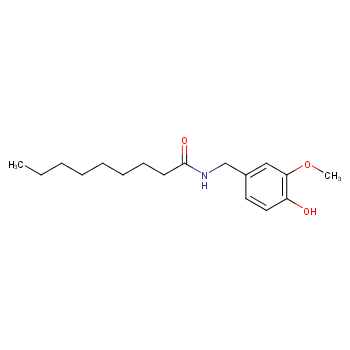
N-vanillylnonanamide (Nonivamide), also known as nonyl vanillylamide, pelargonic acid vanillylamide (PAVA), and synthetic capsaicin, is an aromatic organic compound that belongs to the capsaicinoid family. It is an amide of pelargonic acid and vanillin, found in chili peppers but usually produced synthetically. It has better thermal stability than capsaicin. Nonivamide is a synthetic equivalent of capsaicin and is a potent sensory stimulant, currently widely used by police forces in the UK and other regions. It is used as a food flavoring agent (up to 10 ppm) and in human medicine as a topical rubefacient (like capsaicin), although data on its use as a self-defense spray or RCA is limited.
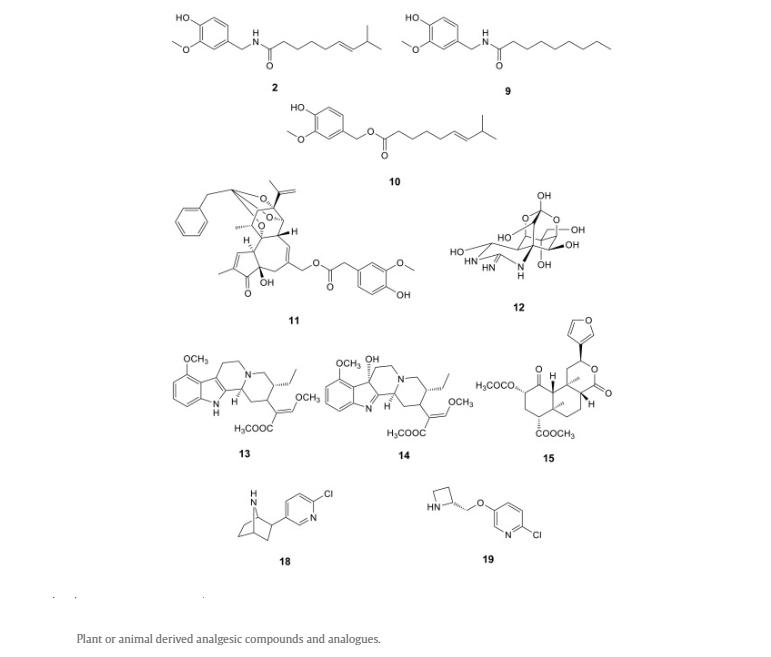
Nonivamide, sold under brand names like Finalgon and Zostrix, is primarily used for pain relief and can alleviate chronic pain symptoms such as arthritis and neuropathy. In various clinical trials, natural capsaicinoid compounds like cis-capsaicin, Nonivamide (9), and capsaicinoid esters (10) have been tested for pain relief. Several topical and intranasal formulations containing cis-capsaicin (also known as civamide) have been tested in Phase II and Phase III clinical trials for treating various pain conditions. Unlike capsaicin, which is only found as a trans-isomer in nature, civamide requires synthesis in the lab. Nonivamide (9), present in chili peppers, differs from capsaicin in its side chain, which lacks double bonds, making it more heat-resistant. Due to its vanillyl group, it also acts as a TRPV-1 agonist. Topical preparations containing nicoboxil (2.5%) and nonivamide (0.4%) are in Phase III clinical trials for treating non-specific lower back pain.
Nonivamide has also been found to have anti-inflammatory properties, further enhancing its effectiveness as a pain management solution. Inflammation-related diseases are a global issue. Using compounds that activate the trigeminal nerve to combat inflammation is one strategy. Jessica Walker and colleagues compared Nonivamide's anti-inflammatory potential with two known anti-inflammatory compounds: primary peripheral blood mononuclear cells (PBMCs) and U-937 macrophages were stimulated with 1 µg/mL of E. coli LPS (EC-LPS) to induce inflammation. Bead-based assays revealed that Nonivamide reduced the release of IL-6 and TNF-α in PBMCs and U-937 macrophages induced by EC-LPS. This anti-inflammatory mechanism is independent of the NF-κB pathway but may involve the mitogen-activated protein kinase (MAPK) pathway. Additionally, combining trigeminally active compounds with TRPV1 or TRPA1 antagonists eliminated the anti-inflammatory activity. Studies found that Nonivamide has anti-inflammatory potential similar to capsaicin and t-pellitorine. In U-937 macrophages, the tested compounds exert anti-inflammatory effects by inhibiting the MAPK pathway activation induced by EC-LPS. TRP channel activation also plays an important role in the anti-inflammatory ability of capsaicin and Nonivamide.
Nonivamide is used as a payload (under the name PAVA) for "less-lethal munitions" such as FN Herstal’s FN 303 ammunition or as the active ingredient in most pepper sprays, and it may also be used as a chemical weapon. As a chemical irritant, pepper spray is used both as a riot control agent and as a weapon to disperse peaceful demonstrators. It is also used in other environments such as military or police training exercises. After pilot trials by Sussex Police in the UK, PAVA sprays are now in use by Northamptonshire Police and other forces in Europe and North America as a chemical incapacitant alternative to CS spray. The spray used is a 0.3% solution of PAVA in 50% aqueous ethanol, dispersed from a handheld canister via a nitrogen propellant. The coarse liquid stream spray pattern is considered directed and precise. The maximum effective range is 8–15 feet, aimed at the subject's face, especially the eyes. Users should avoid using it at distances of less than 3 feet to prevent pressure injuries to the eyes. The spray's particle size suggests that most droplets exceed 100 microns, though a small proportion is in the 2-10 micron range, with trace amounts below 2 microns. Therefore, it is unlikely that a large amount of PAVA will enter the respiratory system.
Nonivamide is used as a food additive to impart spiciness to seasonings, condiments, and spice mixtures. It is also employed in the confectionery industry to create a warming sensation.
Nonivamide's side effects primarily include skin irritation, respiratory irritation, eye irritation, gastrointestinal discomfort, and allergic reactions. When applied topically, it often causes redness, itching, and a burning sensation in the skin. These symptoms are usually mild and short-lived, though individuals with sensitive skin or those who use excessive amounts may experience more severe irritation, potentially leading to dermatitis. Eye contact can cause intense pain, redness, and tearing, and in severe cases, temporary blindness. Products containing Nonivamide should be handled with care, and hands should be washed thoroughly after use to avoid accidental eye contact. Allergic reactions, though rare, are a possible side effect, with symptoms including hives, swelling, and difficulty breathing, which may require immediate medical attention. Some police forces use PAVA spray, a 0.3% solution in 50% aqueous ethanol. Volunteers (including mild asthmatics) were exposed to aerosolized PAVA produced using a nebulizer providing respiratory particles to study its effects on the respiratory and cardiovascular systems. Normal volunteers experienced transient coughing, with minimal impact on FEV1 (forced expiratory volume in one second, reduced by 1%), heart rate (increased by 15%), and blood pressure (increased by 8%). Similarly, mild asthmatics exposed to 0.1% PAVA experienced similar results, with FEV1 reduced by 3%, heart rate increased by 5%, and blood pressure increased by 5%. It should be noted that subjects under real-life stress could experience clinically significant bronchospasm. Experience has shown no significant adverse reactions or lasting damage to the skin or eyes in exposed individuals. However, according to animal studies, it is an ocular irritant and could affect contact lens wearers significantly. Given the limited data, a full assessment of its adverse health effects cannot be made.
According to the EMA summary report, Nonivamide appears to have low acute toxicity. The oral LD50 for rats is reported at 5110 mg/kg, and the dermal LD50 for rabbits is greater than 10,000 mg/kg. After intraperitoneal administration, the LD50 in rats is approximately 90 mg/kg. When combined with nicoboxil, the acute dermal toxicity of Nonivamide increases. Toxic symptoms (depression, respiratory distress, diarrhea) were observed at doses as low as 32 mg/kg body weight of Nonivamide combined with 200 mg/kg body weight of nicoboxil.
Nonivamide and capsaicin are both used for their pungency and irritant properties, but they differ in some respects. Nonivamide is a synthetic substitute for capsaicin, commonly used in food additives and topical ointments. Compared to capsaicin, Nonivamide offers advantages in terms of lower cost and higher stability, making it more economical for production and storage.
In 1928, chemists Corson and Stoughton synthesized 2-chlorobenzylidene malononitrile (CS), but it was not formally adopted as an RCA until 1959 by the military. As a chemically more stable compound with greater potency and lower toxicity than CN, it gradually replaced CN as the preferred RCA. Nonivamide, marketed under the trade name Captor, gained popularity as a defensive aerosol spray in the early 1990s. This compound is reported to cause more severe pain to the eyes than CS tear gas. The effects of Nonivamide are immediate but dissipate after 15–20 minutes in fresh air. However, PAVA does have its drawbacks. Although it is highly effective, it has been found to be ineffective against individuals under the influence of alcohol (ACPO, 2006).
[1]https://www.sciencedirect.com/topics/pharmacology-toxicology-and-pharmaceutical-science/nonivamide
[2]https://www.sciencedirect.com/science/article/pii/S0065774320300129
[3]https://go.drugbank.com/drugs/DB11324
[4]https://www.sciencedirect.com/topics/medicine-and-dentistry/nonivamide
[5]https://zh.wikipedia.org/wiki/N-%E9%A6%99%E8%8D%89%E5%9F%BA%E5%A3%AC%E9%85%B0%E8%83%BA
[6]https://onlinelibrary.wiley.com/doi/10.1002/mnfr.201600474
 |
 |
|


 13YRS
13YRS

