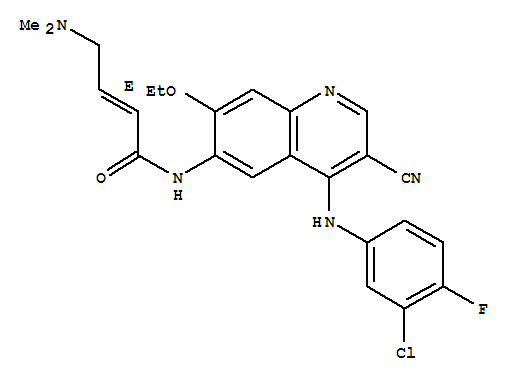
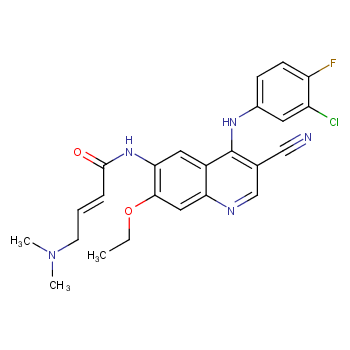
Pelitinib's chemical name is (E)-N-[4-[(3-chloro-4-fluorophenyl)amino]-3-cyano-7-ethoxyquinolin-6-yl]-4-(dimethylamino)-2-butenamide. Its structure is shown below:
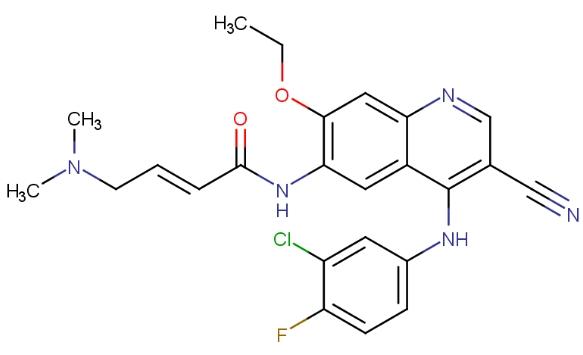
This drug, developed by Wyeth in the U.S., is an irreversible epidermal growth factor receptor (EGFR) inhibitor. Clinically, it can be used to treat advanced non-small cell lung cancer (NSCLC), colorectal cancer, and more. Pelitinib (EKB-569) is a potent, low-molecular-weight, selective, and irreversible EGFR inhibitor being developed as an anticancer agent.
Pelitinib (EKB-569, Wyeth, New Jersey, USA) is a selective, irreversible EGFR inhibitor. Phase I clinical trials in patients with advanced solid tumors suggested a daily oral dose of 75 mg for Phase II trials. Researchers believe the toxicity and long half-life of this irreversible EGFR inhibitor warrant further evaluation of its use as a monotherapy and in combination with other drugs. The Maximum Tolerated Dose (MTD) was found to be 75 mg per day after Phase I studies, with dose-limiting toxicities (DLT) being grade 3 diarrhea. Clinical trials combining Pelitinib with capecitabine for colorectal cancer were not very successful. Recently, a Phase I trial of 48 patients with advanced solid tumors, using Pelitinib and temsirolimus as controls, was reported. Two Phase II trials of Pelitinib as a monotherapy for advanced colorectal cancer (NCT00072748) and NSCLC (NCT00067548) have been completed, but the results have not been fully evaluated, leading to the postponement of further trials on this molecule.
A Phase I dose-escalation study was conducted on Japanese patients. EKB-569 was administered once daily in 28-day cycles to patients with advanced malignancies known to overexpress EGFR. Two cases of advanced NSCLC with EGFR mutations and acquired gefitinib resistance were detailed in this Phase I study. Case 1 involved a 63-year-old male with a smoking history. He started treatment on March 4, 2004, and completed 10 cycles by December 16 with no severe adverse events. He experienced grade 2 rash, elevated ALT, and grade 1 diarrhea and nail changes. A chest CT scan on August 4, 2003, showed a reduction in the size of multiple lung metastases. Case 2 involved a 49-year-old female with no smoking history. She began treatment on February 9, 2004, and completed 5 cycles by June 22, 2004. She experienced grade 3 nausea and vomiting, grade 1 diarrhea, and skin dryness. A chest CT scan on March 3 showed a reduction in the size of multiple lung metastases. A brain MRI on March 4 revealed a reduction in the size of multiple brain metastases. According to RECIST criteria, their conditions were stable, but radiologically, there was tumor regression.
Pelitinib completed a Phase II clinical trial for rectal/colon/colorectal cancer treatment (NCT00072748). This non-randomized, open-label, outpatient clinical trial aimed to evaluate the safety and efficacy of daily oral EKB-569 in patients with advanced colorectal cancer. Participants had to have been treated with fluoropyrimidines (such as 5-FU or capecitabine) and either oxaliplatin or irinotecan prior to the trial (either in combination or separately). The primary objective of the study was to assess the clinical efficacy of EKB-569 as second-line or later treatment in patients with advanced colorectal cancer.
Pelitinib has entered Phase II clinical trials for NSCLC and colorectal cancer. Adverse events during treatment include diarrhea, abdominal pain, gastrointestinal cancer, bowel obstruction, and vomiting. EKB-569 is a potent, low-molecular-weight, selective, and irreversible EGFR tyrosine kinase inhibitor. At higher concentrations, it also inhibits the ErbB2 receptor. In a Phase I study, patients with advanced solid tumors tolerated continuous oral administration of EKB-569 up to 75 mg/day well, with the main toxicities being diarrhea and rash. Plasma concentrations remained above the enzyme inhibition target at a daily dose of 50 mg of EKB-569. Recent studies have confirmed that the combination of EKB-569 with irinotecan and infused 5-FU is safe. At a dose of 25 mg, the EKB-569/full-dose irinotecan and 5-FU infusion completely inhibited phosphorylated EGFR and its downstream signaling pathways in skin and tumor samples.
Pelitinib is a targeted therapy drug primarily used for treating specific types of cancer. Despite its important role in treatment regimens, its specific uses and dosages should be determined based on the individual patient's condition and health status. Therefore, it is essential to consult a doctor before using Pelitinib to ensure that the drug is appropriate for your treatment needs and can safely and effectively help combat the disease.
[1]https://clinicaltrials.gov/study/NCT00072748
[2]Sun Jinxia. A clean production method for the intermediate of antitumor drug pelitinib: CN201810245609.3[P]. 2018-10-19.
[3]https://pubchem.ncbi.nlm.nih.gov/compound/Pelitinib
[4]https://www.sciencedirect.com/topics/medicine-and-dentistry/pelitinib
[5]https://www.ncbi.nlm.nih.gov/pmc/articles/PMC4543615/
[6]https://drugs.ncats.io/drug/X5DWL380Z6
[7]https://pubmed.ncbi.nlm.nih.gov/16364494/
[8]https://www.ncbi.nlm.nih.gov/pmc/articles/PMC3086427/
[9]https://go.drugbank.com/drugs/DB05524
|
 |


 4YRS
4YRS