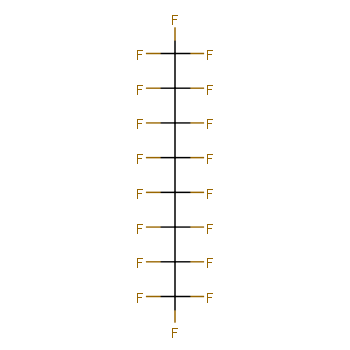
Perfluorooctane, also known as perfluorooctane, CAS number: 307-34-6, with a molecular weight of 438.06 and LogP of 5.92280, appears as a colorless liquid. It is a perfluorinated derivative of the hydrocarbon octane. It is well-suited as an insulating oil in high-voltage electronic devices. Besides heat transfer applications, it is used as a breathable fluid in partial liquid ventilation.
Perfluorooctane is a colorless, transparent liquid with a slight kerosene odor at room temperature. It is insoluble in water, ethanol, acetic acid, and formaldehyde but can dissolve in ether, acetone, dichloromethane, chloroform, and fluorinated alkanes (e.g., F-113). Perfluorooctane can dissolve large amounts of oxygen and carbon dioxide. At 37°C and 0.1 MPa, one volume of perfluorooctane can dissolve 0.48 volumes of oxygen and 1.8 volumes of carbon dioxide.
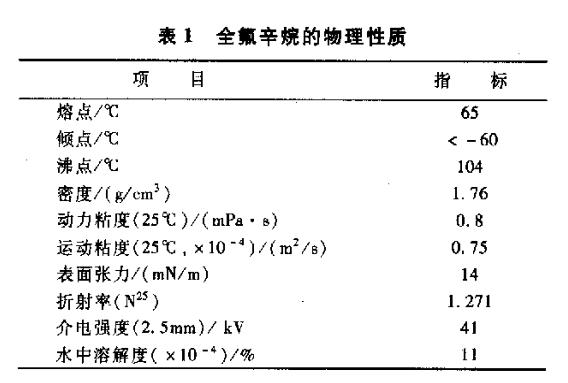
Perfluorooctane is an inert liquid with no flammability, featuring low surface tension and high dielectric strength. It has excellent thermal stability, with a decomposition temperature exceeding 800°C. It is stable and only degrades in the presence of alkali metals at 400-500°C, forming metal fluorides and carbon. The physical properties of perfluorooctane are listed in the table below.
Perfluorooctane is extensively used in various electrical equipment due to its high density, low viscosity, low surface tension, non-flammability, non-toxicity, high chemical stability, and excellent electrical insulation properties. It is commonly used as a cooling medium and insulating liquid in switch transformers, radio frequency, and microwave devices. It also serves as hydraulic fluid and lubricant in precision mechanical devices. Perfluorooctane can be used as a cleaner, heat transfer medium, instrument sealant, chemical reaction medium or solvent, and is used as a stationary phase in advanced gas chromatography. Additionally, it can be mixed with other fluorinated compounds for applications such as artificial blood and ex vivo organ preservation.
Research has also shown that perfluorooctane vapor can significantly alter the surface tension of many liquids. Fluorocarbon compounds that can reduce liquid surface tension through their vapor are called vapor surfactants (this class also includes perfluoroheptane C7F16 and perfluoronaphthene C10F18). Unlike traditional surfactants, they alter the surface tension of the liquid simply by covering it with their low-pressure vapor. Thus, perfluorooctane is also known as a volatile surfactant or "gas soap." This property has opened up new application areas for perfluorooctane.
Studies indicate that perfluorooctane may accumulate in the body and is associated with some health issues, though the exact mechanisms are still under investigation. Although detailed toxicity data on perfluorooctane is limited, related PFAS (perfluoroalkyl substances) research has revealed potential health risks, warranting further investigation.
Perfluoroalkyl substances (PFAS) are a class of man-made chemicals that have been produced and used globally since the 1940s. Their excellent thermal stability, chemical stability, and surface activity have led to their widespread use in various industrial processes and products. Perfluorooctane sulfonate (PFOS) is one of the most widely used PFAS. The extensive use of PFOS has raised concerns about its toxicity and human health risks, reflected in the increasing number of publications on the topic over the past decade. Due to its long perfluorinated chain and the stable carbon-fluorine (C-F) bonds, PFOS is difficult to degrade in nature, leading to its persistence in the environment and human body. PFOS has been detected in food, drinking water, various environmental components, and even human tissues. A study on PFAS accumulation in human tissues confirmed the presence of PFOS in the brain, kidneys, liver, and lungs, with higher levels in the liver. According to biomonitoring data on PFAS concentrations in blood, hair, milk, nails, and urine, PFOS is predominantly found in human blood. Major exposure routes include contaminated food and drinking water, use of PFOS-containing consumer products, and occupational exposure during PFOS production or related processes.
Exposure to PFOS has been shown to cause hepatotoxicity, neurotoxicity, reproductive toxicity, immunotoxicity, thyroid disruption, cardiovascular toxicity, pulmonary toxicity, and nephrotoxicity in experimental animals and various in vitro human systems. These findings, along with related epidemiological studies, confirm the health risks of PFOS to humans, especially through food and drinking water exposure. Oxidative stress and physiological processes disrupting fatty acid similarity are widely studied mechanisms of PFOS toxicity.
Due to concerns about the toxicity of perfluorooctane, some manufacturers are gradually phasing out its production and use. Successful alternatives to PFOS materials include non-perfluorinated chemicals, such as hydrocarbon surfactants, chemicals with shorter perfluorinated chains (C3 - C4), organosilicon compounds, and copolymers.
PFAS are toxic and highly persistent, so less toxic and effective alternative surfactants must be used. A general method for identifying safer alternative surfactants has been described. Bio-based BG10 alternative surfactants outperform PFAS surfactants in improving the wetting properties of TMAH etchants on target substrates, as evidenced by significantly reduced contact angles. The wetting properties of PAN and BOE etchants containing BG10 and CG50 surfactants are comparable to PFAS surfactants. Toxicity comparisons show these alternatives pose far less health risk than PFAS. These safer alternatives have been successfully tested by over 100 semiconductor companies. These companies provided positive feedback with no reported harmful effects on the final products. This successful approach opens up new possibilities for replacing PFAS in many other applications where PFAS are typically used as surfactants. Using this approach, alkyl polyglucosides such as BG10 and CG50, and polyethylene glycol surfactants such as Brij35 and BrijS100, have been identified as alternatives to PFAS surfactants.
[1]Wang Enren, Wang Kui. Perfluorooctane[J]. Fine and Specialty Chemicals, 2004, 12(8):11-12. DOI:10.3969/j.issn.1008-1100.2004.08.004.
[2]https://en.wikipedia.org/wiki/Perfluorooctane
[3]https://baike.baidu.com/item/%E5%85%A8%E6%B0%9F%E8%BE%9B%E7%83%B7
[4]https://www.epa.gov/pfas/our-current-understanding-human-health-and-environmental-risks-pfas
[5]https://www.sciencedirect.com/science/article/pii/S0160412018331507
[6]https://pubs.rsc.org/en/content/articlelanding/2023/em/d3em00202k/unauth
[7]https://www.sciencedirect.com/science/article/abs/pii/S0959652623020371
[8]https://chm.pops.int/Implementation/Alternatives/AlternativestoPOPs/ChemicalslistedinAnnexB/Perfluorooctanesulfonicacidandperfluorooctane/tabid/5869/Default.aspx
|


 14YRS
14YRS