-
We detected your language preference as English. Would you like to switch to the English version for a better experience?
Switch to English
Stay here


Polyether ether ketone (PEEK), as a high-performance engineering plastic, has attracted much attention in the industrial field in recent years. It possesses excellent heat resistance, chemical resistance, mechanical properties, and wear resistance, making it widely used in aerospace, medical devices, automotive manufacturing, and other fields. PEEK not only exhibits outstanding performance but also has good processability and ductility, making it an indispensable material in many industries. In this article, we will delve into the definition, characteristics, and extensive applications of PEEK in various fields, hoping to demonstrate to readers the importance and potential of PEEK as an innovative material.
Polyether ether ketone (PEEK) is a colorless organic thermoplastic polymer belonging to the polyaryletherketone (PAEK) family, used for engineering applications. It was invented in November 1978 and introduced to the market in the early 1980s by Imperial Chemical Industries (ICI), later part of Victrex plc. PEEK is a semi-crystalline thermoplastic with excellent mechanical and chemical properties, capable of maintaining its properties at high temperatures. The polymer is very hard, with a Young's modulus of 3.6 GPa and tensile strength in the range of 90–100 MPa. Its glass transition temperature is approximately 143°C. The polymer exhibits strong resistance to thermal degradation as well as organic and aqueous degradation. PEEK finds widespread applications in aerospace, automotive, electrical, and medical industries. Due to its robustness, it is used to manufacture items in chemical and engineering industries. Common examples include bearings, piston components, pumps, HPLC chromatography columns, compressor valve plates, and cable insulation.
PEEK polymer is synthesized by the reaction of dihalobenzene with the disodium salt of hydroquinone, using a step-growth polymerization method. In a typical polymerization process, 4,4'-difluorobenzophenone reacts with the disodium salt of hydroquinone, and the nucleophilic substitution reaction is carried out in a polar, non-protonic solvent such as diphenyl sulfone at about 300°C (see figure below).
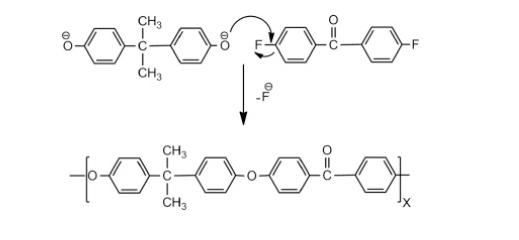
PEEK has a linear and symmetrical molecular structure, consisting of repeating units of 4,4'-difluorobenzophenone and biphenol. This gives it high crystallinity, making it semi-crystalline. Strong intermolecular forces such as hydrogen bonds, van der Waals forces, and pi-pi interactions hold the polymer chains together. These strong bonds contribute to its excellent mechanical and thermal properties.
PEEK has a melting temperature (Tm) of up to around 343°C, allowing it to maintain its mechanical properties at high temperatures. It also has a high glass transition temperature (Tg) of about 143°C, meaning it has good dimensional stability and stiffness at elevated temperatures. PEEK also exhibits strong resistance to acids, bases, hydrocarbons, and radiation, making it suitable for harsh environments. Additionally, it has low water absorption and excellent wear resistance.
The chemical resistance of polyether ether ketone is excellent, and therefore, it exists in various chemicals. PEEK is compatible with almost any solvent used in HPLC. The only solvents that corrode PEEK are concentrated nitric acid and sulfuric acid. However, PEEK tubing can safely withstand 20-30% nitric acid when passivated. Dichloromethane, dimethyl sulfoxide, and tetrahydrofuran can cause swelling of PEEK.
PEEK has widespread applications in several fields including petroleum and oil environments, electronics, nuclear, automotive, marine, medical, general industry, and aerospace.
The excellent chemical resistance of PEEK makes it an ideal material for components exposed to corrosive chemicals and environments. It is used for pump components, seals, valves, and linings for handling corrosive fluids.
Due to its good electrical insulation properties and high-temperature resistance, PEEK is used in electrical connectors, circuit boards, and other electronic components.
The biocompatibility and wear resistance of PEEK make it a valuable material for medical implants. Spinal implants, bone plates, and prosthetic components can be made from PEEK, offering long-term performance and reducing the risk of rejection.
PEEK is used in various medical devices due to its sterilizability and ability to withstand repeated use. Components for syringe bodies, surgical instruments, and diagnostic equipment can benefit from the performance of PEEK.
The aerospace industry utilizes PEEK to replace heavier metal components in aircraft, as it offers a high strength-to-weight ratio. This helps improve fuel efficiency and overall aircraft performance. Engine components, bearings, and internal parts can be made from PEEK.
With the trend towards downsizing engine compartments, PEEK provides an alternative to metal and offers weight reduction, noise reduction, and functional integration. The main performance benefits of polyether ether ketone are enhanced surface interactions with dryness and lubrication, outstanding mechanical properties over a wide temperature range, ease of processing, and excellent fatigue performance. Major applications include:
Piston units under the hood
Gaskets
Bearings
Various active components for transmission, braking, and air conditioning systems
Advancements in 3D printing technology have opened up new avenues for PEEK. Custom medical implants, complex aerospace components, and lightweight automotive parts can now be efficiently produced using 3D printing and PEEK.
Combining polyether ether ketone with other materials such as carbon fiber or glass fiber can further enhance its performance. These composites offer higher strength, improved wear resistance, and tailored performance for specific applications.
Polyether ether ketone is not biodegradable. Its strong chemical bonds and structure make it highly resistant to microbial degradation. This makes PEEK a good choice for long-term applications, but it also means that it may accumulate in the environment if not properly disposed of.
Some research has blended PEEK with other biodegradable materials such as polyethylene glycol. These blends can provide the strength and biocompatibility advantages of PEEK while addressing the issue of biodegradability.
(1) Excellent dielectric properties and low loss
(2) Good radiation resistance, solvent resistance, wear resistance, and friction resistance
(3) Low friction coefficient, low smoke, and toxic gas emission
(4) Extremely low moisture absorption
(5) Unaffected by prolonged exposure to hot water or steam
(6) Excellent fatigue resistance, stress cracking resistance, oxidation resistance, and acid resistance
(7) Good thermal stability and excellent mechanical properties
(8) Outstanding UV resistance, high purity, lightweight
While PEEK is a versatile material with many advantages, it also has some limitations and disadvantages to consider:
(1) Cost: PEEK is relatively expensive compared to some alternatives, which may make it inaccessible for certain applications.
(2) Processing: High processing temperatures and specialized machinery are required to work with PEEK, which may limit its use by manufacturers lacking the necessary equipment.
(3) Chemical resistance: Concentrated acids and strong oxidants can damage PEEK.
(4) Biocompatibility: PEEK is generally considered to have biocompatibility, but its inert surface impedes tissue attachment, which is crucial for long-term success in oral implants. Research is ongoing to improve adhesion through surface modification techniques.
(5) Wear: Depending on the application and filler materials used, PEEK can wear over time, especially when paired with softer materials.
In this article, we have delved into the characteristics of Polyether Ether Ketone (PEEK) as a high-performance engineering plastic and its wide range of applications. PEEK has become a favored material choice in many industries due to its excellent heat resistance, chemical resistance, mechanical properties, and wear resistance. Whether in aerospace, medical devices, or automotive manufacturing, PEEK has demonstrated its unique value and potential. With the continuous advancement of technology and innovation in engineering materials, PEEK as a high-performance material will continue to play an important role in various fields. It is hoped that through this introduction, readers have gained a deeper understanding of PEEK, recognizing its importance in the engineering field and fully leveraging its advantages in practical applications.
[1]https://en.wikipedia.org/wiki/Polyether_ether_ketone
[2]https://www.cdiproducts.com/capabilities/material-science/peek-polymer
[3]https://www.azom.com/article.aspx?ArticleID=7989
[4]https://www.sciencedirect.com/topics/chemical-engineering/polyether-ether-ketones
[5]https://omnexus.specialchem.com/selection-guide/polyetheretherketone-peek-thermoplastic/key-applications
[6]https://www.calpaclab.com/polyetherether-ketone-peek-chemical-compatibility-chart/
|
 |
|
|
 EN
EN
 Agricultural News
 Food News
 Industrial News
 Cosmetic News
 Pharmaceutical News
 Science News

 15YRS
15YRS

