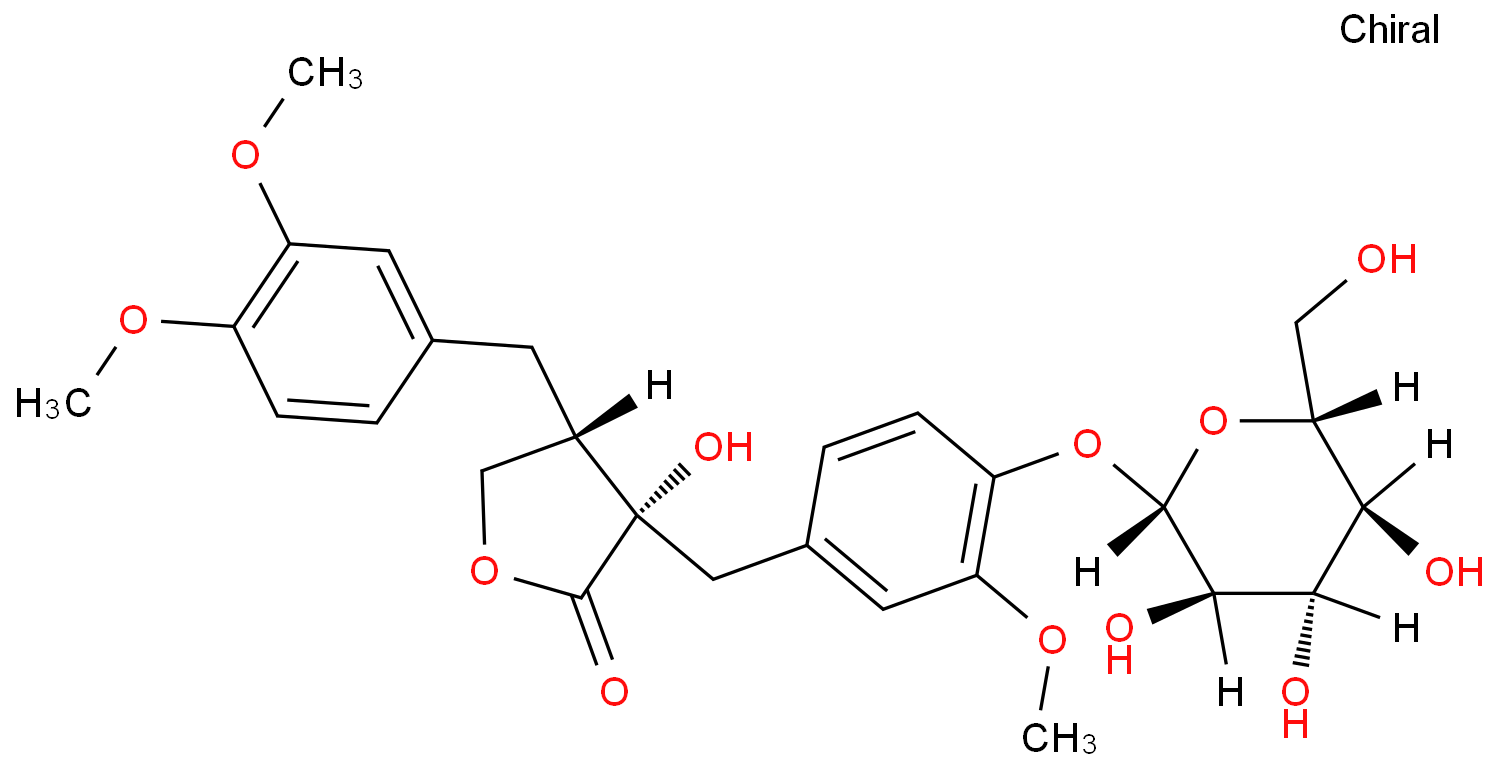
Tracheloside, a lignan with anti-estrogen properties stimulating proliferation of keratinocytes via FFIR1/2, plays a significant role in skincare and medical domains. Its unique anti-aging function has led to widespread application in the development and production of anti-aging and whitening products. Additionally, Tracheloside is utilized in pharmaceuticals for wound healing, demonstrating its significant value in the medical field. This article aims to introduce the mechanism of action and potential future Tracheloside uses.
Tracheloside, also known as dileucin, is a naturally occurring compound with the CAS number 33464-71-0. It is a cyclic tetrahydrofuran glycoside with various biological functions in organisms. Found primarily in lignans, Tracheloside exhibits anti-estrogenic activity by stimulating the ERK1/2 pathway, promoting proliferation of keratinocytes, thus aiding wound healing. It is present in several plants such as Desmodium, Stachytarpheta, Barleria, and Haplophyton. Extraction methods for Tracheloside include solvent extraction, enzymatic hydrolysis, and supercritical fluid extraction.
Tracheloside possesses diverse biological activities including antioxidant, anti-inflammatory, antitumor, and antibacterial properties. Additionally, it has pharmacological effects such as analgesic, antispasmodic, and anticonvulsant activities, indicating its broad application prospects in medicine, food, and cosmetics.

Tracheloside, found in various plants, has garnered attention for its wide-ranging applications across different industries.
(1)Tracheloside has become a crucial ingredient in skincare, offering numerous benefits for achieving healthy and radiant skin. Its potent antioxidant properties play a vital role in neutralizing harmful free radicals that accelerate skin aging and damage. Additionally, its anti-inflammatory characteristics help alleviate irritation and redness, making it particularly beneficial for sensitive or reactive skin. By combating oxidative stress and inflammation, Tracheloside contributes to overall skin resilience and vitality, serving as a cornerstone in skincare formulations aimed at maintaining youthful complexion.
(2)One key mechanism through which Tracheloside promotes skin health is by stimulating collagen production. Collagen, a structural protein, is responsible for maintaining skin firmness and elasticity. Studies demonstrate that Tracheloside can enhance collagen synthesis, thereby improving skin tone and texture. Furthermore, Tracheloside aids in reducing the appearance of fine lines and wrinkles, resulting in smoother, younger-looking skin. These properties of promoting collagen production make Tracheloside an essential ingredient in anti-aging skincare regimens.
(3)The effectiveness of skincare products containing Tracheloside in improving skin appearance and texture is evidenced by their increasing availability. From serums to moisturizers and masks, formulations enriched with Tracheloside offer targeted solutions for various skin concerns. Whether addressing signs of aging, combating environmental stressors, or promoting overall skin health, Tracheloside-rich products earn acclaim for their efficacy in delivering visible results. As consumers increasingly prioritize natural and scientifically supported ingredients in skincare, Tracheloside emerges as a promising ingredient for achieving radiant and resilient skin.
Tracheloside exerts its beneficial effects through complex cellular mechanisms, providing insights into its extensive therapeutic potential. At the core of its action lies the ability to regulate cell signaling pathways involved in oxidative stress and inflammation. The antioxidant activity of Tracheloside, mediated by its scavenging of free radicals, prevents cell damage and alleviates oxidative stress-induced injuries. By neutralizing reactive oxygen species (ROS), Tracheloside helps maintain cellular homeostasis, guarding against oxidative damage implicated in various pathological conditions.
Furthermore, Tracheloside exhibits significant anti-inflammatory properties by inhibiting pro-inflammatory mediators and signaling pathways. It interferes with the production of inflammatory cytokines and enzymes, thereby mitigating inflammatory responses. This dual action against oxidative stress and inflammation not only aids in alleviating various health issues but also underscores its potential in promoting overall well-being. Scientific research supporting the mode of action of Tracheloside continues to expand, revealing its multifunctionality in therapy and paving the way for its applications across diverse fields, from skincare to pharmaceuticals.
Owing to its immense potential in treating a range of health conditions, Tracheloside has garnered attention in the medical and healthcare sectors. Scientific exploration has unveiled its efficacy in alleviating inflammation, scavenging free radicals, and modulating cell signaling pathways, laying the foundation for its therapeutic applications. Clinical trials and preclinical studies have investigated the effectiveness of Tracheloside in treating conditions such as cardiovascular diseases, neurodegenerative disorders, and metabolic syndrome. Furthermore, its role in promoting wound healing and supporting immune function further broadens its therapeutic utility.
Chemotherapy is one of the primary methods for treating malignant lung cancer. However, chemotherapy drugs have severe side effects and are prone to drug resistance. Therefore, multi-drug combination chemotherapy is popular in lung cancer treatment. Research by Shuai Guo et al. found that tracheloside (TCS) is a novel TMEM16A inhibitor highly expressed in lung cancer tissue. TCS inhibits TMEM16A in a concentration-dependent manner, with an IC50 of 3.09 ± 0.21 μM. It inhibits the proliferation and migration of lung cancer cells and induces apoptosis of cells targeting TMEM16A. Furthermore, molecular docking and site-directed mutagenesis confirmed the binding sites of TCS with TMEM16A as S387, E623, and E624. Subsequently, multi-target combination therapy was conducted based on the different drug targets of TCS and doxorubicin (DOX). Both in vitro and in vivo experiments demonstrated satisfactory anticancer effects of low-concentration TCS combined with DOX, counteracting the side effects induced by high-concentration DOX. Therefore, TCS is a safe and effective anticancer lead compound that enhances the efficacy of DOX.
Recent studies have shown a relationship between cancer progression and oxidative mechanisms. Among phenolic compounds, tracheloside (TCS) is a major bioactive compound that can counteract oxidative stress-related chronic diseases and has anticancer activity. Although TCS can inhibit cancer in mammals, its effect on colorectal cancer (CRC) remains unclear. Min-Kyoung Shin et al. investigated the effects of TCS on CRC cell proliferation, CT26 cell migration, and the related molecular mechanisms in vitro and in vivo. Cell viability experiments showed that TCS inhibits the proliferation of colorectal cancer cells. TCS-treated CT26 cells were associated with upregulation of p16 and downregulation of cyclin D1 and CDK4 in cell cycle arrest. Moreover, TCS induces apoptosis of CT26 cells through mitochondria-mediated apoptosis and regulation of the Bcl-2 family. TCS treatment modulates the expression of epithelial-mesenchymal transition (EMT) markers in CT26 cells. In a mouse model, TCS significantly inhibits lung metastasis of CT26 cells. These results suggest that TCS induces cell cycle arrest and apoptosis through its antioxidant properties, making it a novel therapeutic agent to inhibit the metastatic phenotype of mouse CRC cells.
Cell migration and proliferation are essential for proper wound healing after skin injury. Recent studies have shown that compounds from plants can promote cell migration and proliferation. Tracheloside, as a lignan from plants, was found to promote the growth of HaCaT cells by over 40% compared to other compounds tested based on cell proliferation assays. In vitro scratch tests confirmed the wound healing activity of tracheloside (more than doubled the healing activity compared to the control group after 24 hours of treatment), showing its activity was superior to uracil (which increased by 1.2 times after 24 hours). Western blot results showed that tracheloside promotes wound healing by phosphorylating ERK1/2. Therefore, tracheloside is a promising candidate for promoting wound healing and can be developed as a therapeutic agent for wound treatment or as a lead compound with higher activity.
Tracheloside is a multifunctional compound with enormous potential across various industries including pharmaceuticals, cosmetics, and agriculture. Its antioxidant, anti-inflammatory, and collagen-promoting properties make it a valuable asset in skincare formulations, while its therapeutic benefits extend to medicine, offering hopeful avenues for treating various health conditions. As our understanding of Tracheloside and the scientific research behind its mechanisms deepens, it becomes increasingly clear that this natural compound holds significant promise for enhancing human health. I encourage readers to explore products based on Tracheloside and support ongoing research into its potential applications.
[1] Guo S, Bai X, Shi S, et al. Multi-target tracheloside and doxorubicin combined treatment of lung adenocarcinoma[J]. Biomedicine & Pharmacotherapy, 2022, 153: 113392.
[2] Kim J G, Shin Y K, Kim K Y. Promotion of keratinocyte proliferation by tracheloside through ERK1/2 stimulation[J]. Evidence-Based Complementary and Alternative Medicine, 2018, 2018.
[3] Shin M K, Jeon Y D, Hong S H, et al. In vivo and In vitro effects of Tracheloside on colorectal cancer cell proliferation and metastasis[J]. Antioxidants, 2021, 10(4): 513.
[4] https://pubchem.ncbi.nlm.nih.gov/compound/Tracheloside#section=Information-Sources
[5] https://en.wikipedia.org/wiki/Tracheloside
|