Vidarabine, a potent antiviral medication, garners significant attention in the medical realm for its versatile applications. This article delves into the vidarabine uses multifaceted, dissecting its mechanisms of action and efficacy in antiviral therapy from various perspectives. Understanding the diverse applications of vidarabine is paramount to fully leveraging its pharmacological properties. A comprehensive understanding of vidarabine's scope and sources aids in better harnessing the advantages of this medication, enhancing treatment outcomes, and advancing the field of medicine.
Vidarabine (Adenine arabinoside, Ara-A), chemically known as 9-β-D-arabinofuranosyladenine, is a nucleoside antiviral drug with broad-spectrum antiviral activity against DNA viruses. Its widespread use includes treating diseases caused by herpes simplex virus, cytomegalovirus, adenovirus, vaccinia virus, and hepatitis B virus. Notably, it exhibits significant inhibition against herpes simplex and varicella-zoster viruses. Vidarabine can be further synthesized into its monophosphate ester, adenine arabinoside monophosphate (Ara-AMP). Phosphorylated vidarabine demonstrates remarkable inhibitory effects on DNA viruses and stands as an effective and safe antiviral drug for treating chronic hepatitis B virus infections. Its selective inhibition of viral DNA synthesis over human cell DNA synthesis results in relatively low cytotoxicity.
The natural sources of vidarabine include certain types of marine sponges, where traces of vidarabine have been discovered. However, due to limited natural sources, most of the vidarabine used in medications is synthesized artificially.
As early as 1960, Lee et al. transformed xanthosine (9-β-D-xylofuranosyladenine) into Ara-A in the laboratory for potential anticancer purposes. Subsequently, Reist et al. also synthesized Ara-A using this method in 1962. In 1969, the American company Parke Davis produced Ara-A using the Streptomyces antibioticus NRRL3228 strain. In 1972, the Tokyo Institute of Microbial Chemistry utilized the Streptomyces hebacecus 4334 strain fermentation method to produce Ara-A. By 1979, Kranitsky et al. employed solid-phase enzyme methods to convert arabinosyladenine (Ara-U) into Ara-A using uridine phosphorylase and purine nucleoside phosphorylase isolated from Escherichia coli.
The preparation methods for Ara-A are diverse, including chemical synthesis and biological synthesis. Chemical synthesis offers advantages such as short reaction cycles, high production efficiency, wide availability of synthetic materials, and low cost. However, some routes may encounter difficulties, inefficiencies, time consumption, and multiple steps. Biological synthesis, on the other hand, presents advantages such as mild reaction conditions, strong specificity, high conversion rates, and easy product separation. Nonetheless, it involves complex enzyme preparation processes, low catalytic efficiency, and high costs. Both methods are applicable for industrial production, each with its own strengths and weaknesses.
Vidarabine is supplied by manufacturers and pharmaceutical companies worldwide. It is typically available in the form of injectable solutions or topical ointments. Distribution channels encompass pharmacies, hospitals, and healthcare institutions, ensuring accessibility for patients in need of antiviral therapy. Regulatory authorities oversee vidarabine sales, and prescriptions may be required depending on jurisdiction. Despite the availability of new antiviral drugs, vidarabine maintains its position in the pharmaceutical market, especially for treating herpes simplex and varicella-zoster infections, highlighting its enduring relevance in clinical practice.
Vidarabine is an effective antiviral drug with significant therapeutic utility in viral infection management. Its mechanism of action revolves around disrupting the replication cycle of certain viruses, including herpes simplex virus (HSV) types 1 and 2, and varicella-zoster virus (VZV). These viruses cause a range of clinical manifestations, from oral and genital herpes to chickenpox and shingles. By interfering with virus DNA synthesis, vidarabine inhibits viral replication, a crucial step in the virus life cycle. In the pharmaceutical realm, vidarabine plays a crucial role in producing antiviral formulations tailored to diverse clinical needs. Injectable solutions are used for systemic treatment of severe viral infections, ensuring rapid distribution throughout the body to combat widespread viral dissemination. Additionally, topical formulations, such as ointments, provide targeted delivery of vidarabine to viral-infected skin manifestations, offering symptom relief and promoting faster healing. These formulations showcase vidarabine's multifunctionality in addressing various aspects of viral diseases, from systemic spread to localized manifestations.
Despite the emergence of new antiviral drugs, vidarabine remains a cornerstone of antiviral therapy, especially in cases of resistance to alternative medications or intolerance to alternative treatments. Its efficacy and safety, validated through extensive clinical experience, make it a trusted choice for healthcare providers in managing viral infections. Furthermore, ongoing research continues to explore vidarabine's potential applications in other viral diseases and therapeutic settings, underscoring its enduring relevance and importance in modern medicine.
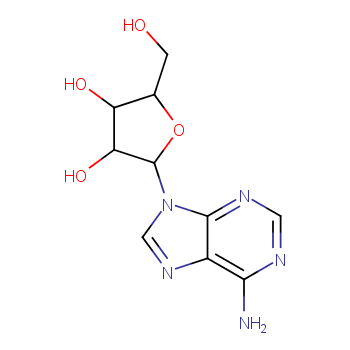
The molecular formula of vidarabine is C10H13N5O4, with a molecular weight of 267.23. Its structure is as follows:
Chemically known as 9-β-D-arabinofuranosyladenine, it is a nucleoside analogue with a unique molecular structure that supports its pharmacological activity. Vidarabine appears as a white crystalline powder or colorless fine needle-like crystals. It is sparingly soluble in water or methanol, almost insoluble in ether, but soluble in strong acid and alkali solutions. Due to its low water solubility, commercial solutions of vidarabine are mostly its monophosphate compound, Ara-AMP. The water solubility of Ara-AMP is more than 400 times higher than that of vidarabine.
The molecular structure of vidarabine has been extensively studied and elucidated using various analytical techniques, including nuclear magnetic resonance (NMR) spectroscopy and X-ray crystallography. Vidarabine consists of two key components: the purine base, adenine, and the sugar portion, arabinose. The adenine base, as a nitrogen-containing component, facilitates its integration into viral DNA during the replication process, imparting vidarabine with its antiviral properties. This binding disrupts the extension of the viral DNA chain, ultimately inhibiting viral replication and proliferation. On the other hand, the arabinose portion provides the necessary structural framework for the stability and bioavailability of vidarabine. The arabinofuranose sugar substitute for natural ribose is crucial for the specificity and selectivity of vidarabine targeting viral nucleic acids while minimizing interference with host cell DNA replication.
Vidarabine serves as a potent antiviral medication widely utilized in clinical practice. By binding to viral DNA polymerase, it inhibits DNA synthesis, thereby treating various diseases. This drug is primarily used to treat herpes simplex virus infections, demonstrating excellent efficacy. Vidarabine also exhibits antiviral effects against different types of viral infections, such as chickenpox, shingles, and cytomegalovirus infections. In infectious disease management, vidarabine plays a crucial role. For instance, in treating patients with HIV/AIDS, vidarabine can be used in combination with other antiviral drugs to enhance treatment efficacy. Additionally, vidarabine can be used to treat respiratory infections, hepatitis, and other diseases.
Vidarabine has minimal side effects. In clinical trials, the efficacy and safety of vidarabine have been extensively studied. Research indicates that vidarabine effectively treats viral infections and reduces the rate of viral replication.
Due to the specific nature of its active ingredient, the use of vidarabine may lead to some potential side effects and adverse reactions. It is essential to closely monitor these side effects and adverse reactions before and during the use of this medication and take appropriate measures to mitigate or avoid them.
The most common adverse reactions involve gastrointestinal symptoms such as nausea, vomiting, and diarrhea, typically occurring early in the course of treatment. These symptoms can usually be managed with antiemetic and antidiarrheal medications. However, more severe adverse reactions, including bone marrow suppression and peripheral neuropathy, may occur with prolonged or high-dose therapy. Therefore, a thorough assessment of the patient's health status is necessary before initiating vidarabine treatment, and appropriate dosage and administration routes should be chosen based on medical advice.
Additionally, the occurrence and severity of vidarabine's side effects and adverse reactions may be influenced by various factors such as the patient's age, gender, weight, health status, drug dosage, and administration route. Therefore, close attention to the patient's health status is essential when using vidarabine, and dosage adjustments and changes in administration routes should be made according to medical advice. Vidarabine should be used with caution in pregnant women, and it should not be mixed with calcium-containing infusions.
Before using vidarabine, a careful assessment of the patient's health status is necessary, and appropriate dosage and administration routes should be chosen based on medical advice. If any side effects or adverse reactions occur, prompt consultation with a doctor is necessary.
Vidarabine uses holds significan in antiviral therapy and infectious disease management. Its versatile uses extend to treating viral infections caused by herpes simplex virus (HSV) types 1 and 2, as well as varicella-zoster virus (VZV), showing efficacy in symptom relief and viral replication inhibition. Vidarabine offers hope for improving clinical outcomes and enhancing the quality of life for patients with these debilitating infections. However, further research and exploration in the field of nucleoside analogues are necessary to unleash their full therapeutic potential. By delving into the molecular mechanisms of action and optimizing pharmacological properties, scientists can pave the way for the development of novel antiviral drugs with higher efficacy, safety, and specificity. Continued research in this area is encouraged to advance our understanding of viral pathogenesis and discover innovative therapeutic strategies against infectious diseases.
[1] Wang, X., Ou, Y., Zhang, S., et al. (2022). Research Progress on Preparation Methods of Vidarabine. Chemical Bulletin, 85(03), 309-316. DOI:10.14159/j.cnki.0441-3776.2022.03.002.
[2] Feng, K. (2012). Research on Microbial Transformation Synthesis of Vidarabine. Dalian University of Technology.
[3] Drugs.com: Vidarabine Information. (https://www.drugs.com/cons/vidarabine.html)
[4] WebMD: Vidarabine Information. (https://www.webmd.com/drugs/2/index)
[5] Wikipedia: Vidarabine. (https://en.wikipedia.org/wiki/Vidarabine)
|
 |



 3YRS
3YRS

