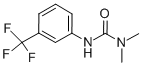
What is fluometuron used for? Fluometuron is a widely used selective herbicide in agriculture, favored for its efficiency and broad-spectrum characteristics. It is primarily used to control various annual broadleaf weeds and grasses, finding application in fields, orchards, vineyards, and non-cropped areas. This article will delve into the specific uses of fluometuron and its effectiveness in different agricultural sectors, aiding readers in understanding comprehensively the value and role of this herbicide.
What is fluometuron used for? Fluometuron herbicide has been used as a weed killer in the United States for several decades. Since the commercialization of the chemical by Ciba-Geigy AG under the trademark "Cotoran" in 1960 (Worthing, 1983), fluometuron has been widely used to control broadleaf weeds and grasses in crops such as cotton and sugarcane. It is estimated that the quantities of fluometuron used in the United States in 1976 and 1978 were 5.3 million pounds and 2.9 million pounds, respectively (IARC Monographs, 1983). By 1995, the annual usage of fluometuron in US agricultural practices ranged from 5 to 9 million pounds (Aspelin, 1997). The EPA has set tolerances for fluometuron residues in raw agricultural commodities, cottonseed, and sugarcane at 0.1 ppm (EPA, 1980). The allowable concentration in bagasse or on bagasse is 0.2 ppm (EPA, 1980b). The maximum occupational exposure concentration of fluometuron in workplace air is 5 mg/m3, according to Soviet regulations (ILO, 1980).
Fluometuron is a colorless crystalline sand-like substance with a melting point of 163–164.5°C and a vapor pressure of 5 × 10?7 mmHg at 20°C. Its solubility at 20°C is approximately 105 mg/L (ppm) in water and 105 g/L (ppt) in acetone. Fluometuron is soluble in most organic solvents.
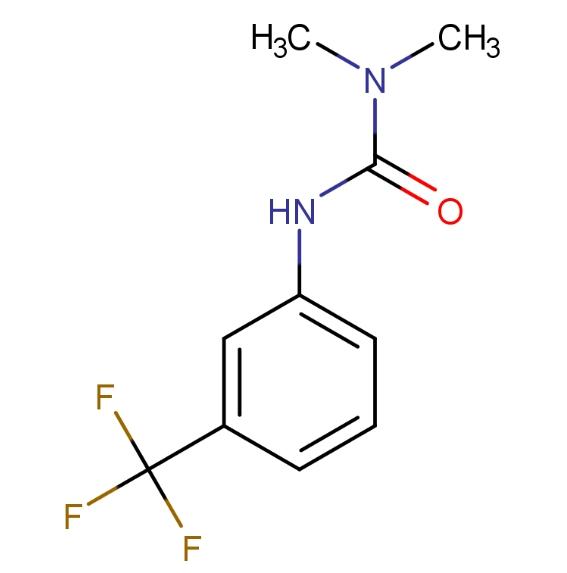
Fluometuron is synthesized by the reaction of 3-trifluoromethylbenzene isocyanate with dimethylamine.
What is fluometuron used for? Chlorine gas is passed into toluene, and while absorbing some of the chlorine gas, a toluene solution of 3-trifluoromethylbenzene isocyanate is gradually added. After completion, the temperature is slowly raised to about 75°C, and chlorine gas is continuously passed until the reaction solution becomes clear. Stir for another 30 minutes, then quickly raise the temperature to about 100°C, pass dry air to remove excess chlorine and hydrogen chloride gas generated by the reaction, and obtain a toluene solution of 3-trifluoromethylbenzene isocyanate.
The above toluene solution of 3-trifluoromethylbenzene isocyanate is added to a synthesis pot, stirred, and the temperature is controlled at about 50°C. Dimethylamine is added dropwise. After the addition is complete, the reaction is maintained for 1 hour. At the end point, the pH of the reaction solution stabilizes at 7.5-8. After standing, filter, dry at 80-90°C, and obtain fluometuron powder with a content of over 95% and a yield of about 92%.
Fluometuron belongs to the substituted urea class of selective herbicides. It is mainly used to control annual monocotyledonous and dicotyledonous weeds in sugarcane and cotton fields. Fluometuron is characterized by high efficiency and low toxicity.
Scope of application: Suitable for the control of annual monocotyledonous and dicotyledonous weeds in crops such as cotton, maize, sugarcane, potatoes, orchards, such as barnyard grass, Echinochloa crus-galli, Setaria glauca, goosegrass, Chenopodium album, Digitaria sanguinalis, Eleusine indica, Acalypha australis, Xanthium strumarium, Conyza canadensis, Amaranthus retroflexus, Chenopodium album, Echinochloa crus-galli, and broadleaf weeds such as Echinochloa crus-galli.
Scientists use fluometuron as a model compound to study the movement and degradation of herbicides in various soil types. This helps assess potential environmental risks associated with herbicide use.
Fluometuron herbicide is an endospermic selective soil treatment herbicide. It is mainly absorbed by weed roots and has low activity in leaves. It is effective against annual monocotyledonous and dicotyledonous weeds. It has a long residual period, and one application in cotton fields can control weeds throughout the growth period. It is used to control annual monocotyledonous weeds and broadleaf weeds in crops such as cotton, maize, sugarcane, and fruit trees, including barnyard grass, Echinochloa crus-galli, Setaria glauca, goosegrass, Chenopodium album, Digitaria sanguinalis, Eleusine indica, Acalypha australis, Xanthium strumarium, Conyza canadensis, Amaranthus retroflexus, Chenopodium album, Echinochloa crus-galli, and others.
Fluometuron is a benzene urea herbicide used for controlling annual grasses and broadleaf weeds in cotton plantations. It was first registered in the United States in 1974 for use on cotton and sugarcane. It is labeled for preplant, preemergence, or postemergence application. Its mode of action involves inhibition of photosynthesis and bleaching, as well as inhibition of carotenoid biosynthesis. Fluometuron may affect non-target organisms. Fluometuron and its metabolites are stable and highly mobile in soil, exhibiting stability against hydrolysis and aqueous photolysis.
Before emergence, 100-125 grams of 80% wettable powder per acre is uniformly sprayed over the soil surface with 50 kilograms of water. For cotton seedbeds, after sowing and covering with soil, 75-100 grams of 80% wettable powder per acre is uniformly sprayed over the soil surface with 35 kilograms of water, followed by covering with plastic film.
Before corn emergence, 100 grams of 50% wettable powder per acre is uniformly sprayed over the soil surface with 50 kilograms of water. Alternatively, during the corn tassel stage, after weeding, 100 grams of 80% wettable powder per acre is uniformly sprayed over the soil surface with 35 kilograms of water, being careful not to spray onto the leaves.
100 grams of 80% wettable powder and 150 grams of 50% oxyfluorfen per acre are uniformly sprayed over the soil surface with 50 kilograms of water. Then, shallow soil mixing or irrigation is carried out to allow the agent to penetrate the soil and enhance its effectiveness.
(1) Avoid using fluometuron after cotton emergence. After corn emergence, when used in orchards, avoid spraying the liquid onto seedlings and leaves to prevent phytotoxicity.
(2) Properly reduce the dosage when using on sandy soils.
(3) Clean spray equipment after use.
Fluometuron, as an efficient selective herbicide, is widely used in various agricultural fields. It effectively controls annual broadleaf weeds and grasses in farmland and plays a crucial role in orchards, vineyards, and non-cropped land management. By using fluometuron correctly, farmers can increase crop yields, reduce weed competition, and promote sustainable agricultural development.
[1] Zhang, L. Research on Immunoassay Methods for Urea Herbicides Fluometuron. (2012). Tianjin University of Science and Technology.
[2] National Center for Biotechnology Information. (2003). PubMed.
[3] ScienceDirect. (n.d.). Chemistry: Fluometuron.
[4] National Toxicology Program. (n.d.). NTP Technical Reports, 100 series, TR 195.
|
 |


 6YRS
6YRS