-
We detected your language preference as English. Would you like to switch to the English version for a better experience?
Switch to English
Stay here


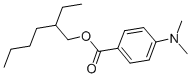
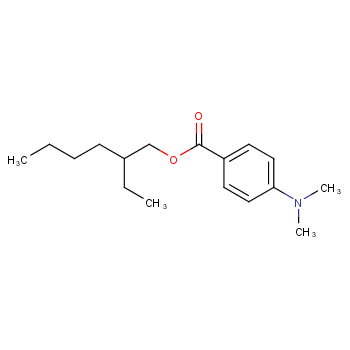
Padimate O (CAS number 21245-02-3) is a water-soluble organic derivative of para-aminobenzoic acid (4-aminobenzoic acid) included in sunscreens and other cosmetics. It is a yellow, water-insoluble oily liquid formed by the condensation of 2-ethylhexanol and dimethylaminobenzoic acid to form an ester bond. Padimate O is also known as octyl dimethyl PABA, OD-PABA, or octyl aminobenzoate (see table below). The Ministry of Food and Drug Safety (MFDS) and the U.S. Food and Drug Administration (FDA) regulate that the concentration of ethylhexyl dimethyl PABA in any cosmetic must not exceed 8%.
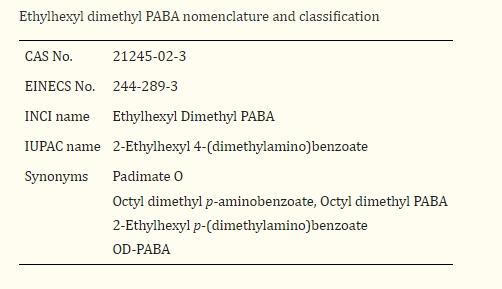
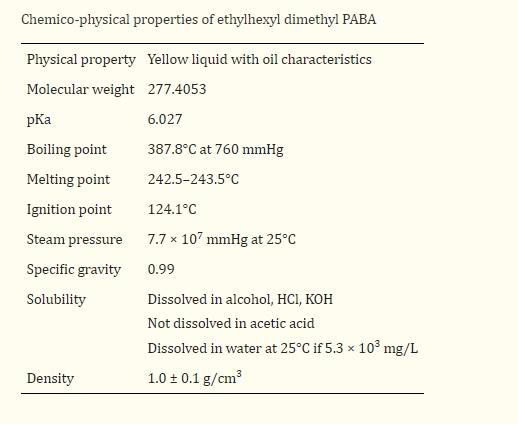
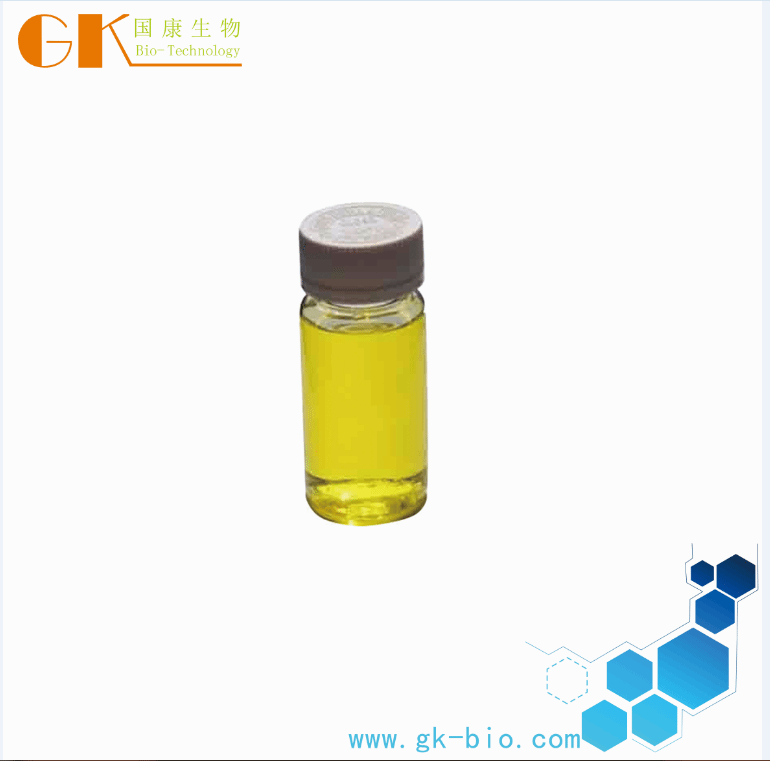
The purity range of Padimate O used as a cosmetic raw material is approximately 98–99.5%. It is an oily yellow liquid with a molecular weight of 277.4053. It is soluble in alcohol, strong acids, and strong alkalis but insoluble in water and acetic acid (as shown in the table below).
Padimate O can be used in coatings, inks and toners, plant protection products, as well as in cosmetics and personal care products.
Padimate O is used in sunscreens and various beauty products. According to the Environmental Working Group (EWG) database, it is used in many products, including lipsticks, conditioners, shampoos, anti-aging agents, hairsprays, and sunscreens. No non-cosmetic use of Padimate O has been reported in South Korea. According to a survey by the Ministry of Food and Drug Safety, the average concentration of Padimate O in cosmetics is 1.25% (ranging from 0.5-2.0%).
Octyl dimethyl PABA (trade name ESCALOL 507) is an excellent UV absorber in the UVB region, with a maximum UV absorption peak of 311 nm (ethanol solution). As an effective anti-UV agent, it is widely used in sunscreen cosmetics abroad and in large quantities. The U.S. FDA lists sunscreens containing this ingredient as a Category I recommended cosmetic.
Padimate O is an active sunscreen agent in cosmetics and over-the-counter sunscreens, with concentrations up to 8% in compliance with FDA regulations. It is a compound related to aminobenzoic acid that absorbs UV-B rays to prevent photodamage. It can penetrate human skin and has been shown to induce non-repairable strand breaks in DNA in vitro and induce mutagenic effects in yeast in vivo.
Research shows that Padimate O can penetrate the skin and cause DNA strand breaks in vitro. Although its effects in various cell lines and organisms have been extensively investigated, the results are complex. Current research continues, with some studies suggesting potential endocrine disruption risks, while other studies have failed to provide clear evidence.
One of its main advantages is its ability to effectively absorb ultraviolet (UV) radiation, particularly UVB rays. Padimate O is the most effective FDA-approved UVB absorber. UVB rays cause sunburn and trigger skin cancer. Unlike some sunscreens that degrade quickly or provide limited UV protection, Padimate O effectively defends against harmful sunlight, helping to prevent sunburn and premature aging (such as wrinkles and rough skin).
Once applied, Padimate O forms a stable sunscreen layer on the skin, continuously blocking UV radiation over an extended period. This long-lasting protection is essential for people who spend prolonged time outdoors or engage in activities involving sweating and water contact.
Extensive research and testing have shown its remarkable effectiveness in preventing UVB-induced skin damage and sun-related premature aging. Adding it to sunscreen products helps enhance overall sunscreen efficacy, ensuring users receive a high level of protection. This efficacy has led to Padimate O's widespread recognition and use in the cosmetics and dermatology industries, highlighting its importance as a key sunscreen ingredient.
Padimate O absorbs UV-B rays, which can induce DNA damage in human keratinocytes. While treating with Padimate O inhibits the formation of UV-endonuclease-sensitive sites, DNA strand breaks in cells also increase.
It is hypothesized that Padimate O, upon contact with keratinocytes, may promote its diffusion within the human epidermis. Under photoexcitation, Padimate O generates singlet oxygen and forms carbon-centered free radicals. While Padimate O can alleviate simple and repairable UV-induced cellular damage, it may also cause more complex chemical damage, making normal cellular repair more challenging.
|
 |
 |
 |
 |
 EN
EN
 Agricultural News
 Food News
 Industrial News
 Cosmetic News
 Pharmaceutical News
 Science News

 3YRS
3YRS

