-
We detected your language preference as English. Would you like to switch to the English version for a better experience?
Switch to English
Stay here


Molecular Geometry & Lewis Structures
Electron-domain analysis, geometry, bond angle and step-by-step construction for XeF2 (CAS 13709-36-9) — with the practical supply context B2B and laboratory buyers need.

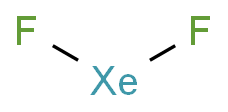
XeF2 has a Linear molecular geometry (AX2E3, trigonal bipyramidal) with a bond angle of 180° (F–Xe–F). The central xenon carries 2 bonding domain(s) and 3 lone pair(s) — 5 electron domains in total. The three equatorial lone pairs cancel each other and leave the two fluorines exactly opposite.
Hybridisation is conventionally described as sp3d (hypervalent description). Polarity: Nonpolar.
| Parameter | Xenon Difluoride (XeF2) |
|---|---|
| CAS Registry Number | 13709-36-9 |
| Molecular formula | XeF2 |
| Molar mass | 169.29 g/mol |
| Total valence electrons | 22 |
| Central atom | Xenon |
| Bonding domains (σ) | 2 |
| Lone pairs on central atom | 3 |
| Electron domains (steric number) | 5 |
| Electron-pair geometry | Trigonal bipyramidal |
| Molecular geometry (shape) | Linear |
| VSEPR notation | AX2E3 |
| Bond angle | 180° (F–Xe–F) |
| Hybridisation (conventional) | sp3d (hypervalent description) |
| Polarity | Nonpolar. |
| Lewis structure guide | XeF2 Lewis structure |
Molar mass is the average value rounded for procurement use. Hybridisation labels are the conventional VSEPR-level description; orbital treatment becomes more nuanced at higher levels of theory.
A worked diagram of this molecule is kept in the companion guide: XeF2 Lewis structure.
VSEPR theory counts electron domains — every σ bond counts once regardless of bond order, and every lone pair counts once. XeF2 has 5 such domains around the xenon: 2 bonding and 3 lone. 5 domains correspond to a trigonal bipyramidal electron-domain arrangement; with 3 lone pairs excluded from the shape the observed molecular shape is linear (AX2E3).
Bond angle: 180° (F–Xe–F) because the three equatorial lone pairs cancel each other and leave the two fluorines exactly opposite.
Polarity: Nonpolar.
Geometry shortcut for recall
Steric number 5 → parent arrangement trigonal bipyramidal; subtract 3 lone positions and the visible shape is linear. Same electron count, different lone-pair bookkeeping, different geometry — always count the domains before naming the shape.
Expecting a bent H2O analogue — the three extra lone pairs force the two bonds into a line.
Xenon carries ten electrons — period-5 expansion.
Mild solid fluorinating agent for organic synthesis and silicon etching; moisture-sensitive and shipped under inert atmosphere.
Structure-level identity is exactly what a purchase order has to fix: the same molecular formula can hide isomers, hydrates or salt forms with different handling profiles. Before ordering, match CAS (13709-36-9), assay, water content and container rating against the datasheet, and request the COA batch that will ship.
Linear. The 5 electron domains around the central xenon adopt a trigonal bipyramidal arrangement, and with 3 lone pairs in place the visible shape is linear.
180° (F–Xe–F), because the three equatorial lone pairs cancel each other and leave the two fluorines exactly opposite.
Nonpolar.
XeF2 carries 3 lone pairs on the central xenon.
Editorial note
This page explains molecular geometry and Lewis-structure construction for education and procurement due-diligence. It is not a safety datasheet; for handling, exposure and transport limits consult the current SDS and local regulations.
 |
 |
 |
|
|
 EN
 Agricultural News
 Food News
 Industrial News
 Cosmetic News
 Pharmaceutical News
 Science News


 5YRS

