-
We detected your language preference as English. Would you like to switch to the English version for a better experience?
Switch to English
Stay here


Nickel ii oxide formula, NiO, is an oxide of nickel where the nickel is in the +2 oxidation state. Known as green nickel oxide due to its green powder appearance at room temperature, it contrasts with black nickel oxide, which mainly consists of Ni2O3. Green nickel oxide is widely used in the ceramics and glass industries, and is also employed in the manufacture of semiconductor films and as a catalyst in organic compound oxidation reactions.
The stable NiO crystals belong to the cubic crystal system and share the same crystal structure as NaCl, which is a face-centered cubic structure. In this structure, each Ni2+ ion (the smaller purple atoms in the image) is surrounded by six nearest O2- ions (the larger green atoms in the image), forming an octahedron with the nickel atoms at the center. Correspondingly, the oxygen atoms are also surrounded by nickel ions in an octahedral arrangement. The overall crystal structure can be viewed as an alternating arrangement of Ni2+ and O2- ions in a face-centered cubic lattice, although the positions of the base units differ slightly between the two lattices.
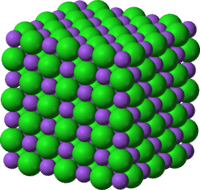
Nickel oxide structure
Ideally, when the nickel-to-oxygen atomic ratio in NiO is strictly maintained at 1:1, it should exhibit insulating properties at room temperature, meaning it does not conduct electricity. However, due to factors such as crystal defects, the actual nickel-to-oxygen ratio in practical nickel(II) oxide often deviates from this ideal value, typically fluctuating around 1:1. The ratio of nickel to oxygen directly affects the color of nickel(II) oxide. When this ratio is close to 1:1, nickel(II) oxide appears as a green powder; deviations from this ratio result in black powder.
Nickel(II) oxide features Ni vacancies in its lattice, giving it the properties of a p-type semiconductor and high electronic migration efficiency. Electrons can transition between the conduction and valence bands, as well as defect energy levels, releasing energy and participating in reactions, making NiO an important photocatalyst material today.
The decomposition reaction of nickel(II) oxide is as follows:
2NiO = 2Ni + O2
Nickel(II) oxide can be reduced to metallic nickel by heating with hydrogen, carbon, or carbon monoxide. The reaction equilibrium equation between solid nickel(II) oxide and carbon monoxide gas, which produces solid nickel and carbon dioxide gas, is:
NiO(s) + CO(g) → Ni(s) + CO2(g)
Nickel(II) oxide can be produced through various methods. By heating nickel and oxygen above 400°C, nickel and oxygen forming nickel ii oxide can be obtained. In some commercial processes, green nickel(II) oxide is often produced by heating a mixture of nickel powder and water at 1000°C, with NiO added to accelerate the reaction. The simplest and most effective method involves pyrolyzing nickel(II) compounds, such as hydroxides, nitrates, or carbonates, to obtain a light green powder. Alternatively, heating metal in oxygen can synthesize powders ranging from gray to black, with the color variation indicating chemical stoichiometry inaccuracies.
Nickel(II) oxide is a typical p-type semiconductor with good thermal and gas-sensing properties. As nanoparticle size decreases, its surface and crystal structure change, exhibiting surface effects, size effects, quantum size effects, and macroscopic quantum tunneling effects, which endow nickel(II) oxide nanoparticles with excellent catalytic and electrical properties. Nickel(II) oxide nanoparticles (NiOx) are cost-effective, have high adaptability in band structure, good photothermal stability, and high visible light transmission. Especially after doping with other metal ions (such as copper, zinc, magnesium, silver, etc.), their charge transport performance is outstanding, making them suitable as hole transport materials in organic or perovskite photovoltaic and light-emitting devices. Due to these remarkable properties, nickel(II) oxide nanoparticles are commonly used as catalysts, sensors, and battery electrode materials. Nickel(II) oxide nanoparticles can be prepared using the following method:
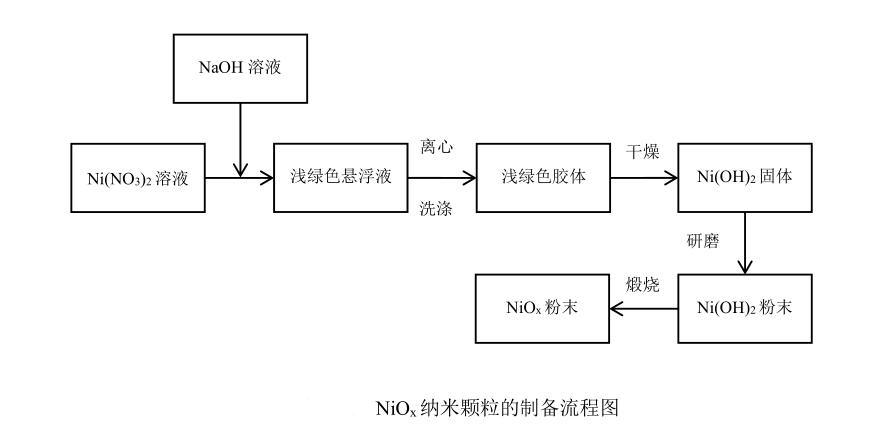
First, weigh a certain amount of Ni(NO3)2·6H2O and dissolve it in deionized water, stirring thoroughly. Prepare a NaOH solution of a certain concentration of the precipitant. Then, under magnetic stirring, rapidly add the NaOH solution to the Ni(NO3)2 solution, adjusting the pH of the reaction system. During this process, a precipitation reaction occurs, forming a light green precipitate. After the addition is complete, continue stirring the reaction mixture for 30 minutes to ensure a thorough reaction. Centrifuge the resulting light green suspension, and wash the product thoroughly with deionized water to remove impurity ions, repeating this step three times. Place the product in an 80°C air-drying oven for 12 hours. Grind the product thoroughly, then calcine it at 270°C for 2 hours to obtain NiOx nanoparticles.
Nickel(II) oxide is a compound with significant industrial applications, playing a key role in catalysts, batteries, ceramics, and more. Its unique structure and properties make it a core component in many high-tech products. Understanding these characteristics and uses may reveal significant potential for nickel(II) oxide in your projects or products. If you are considering using nickel(II) oxide, further explore its specific applications and suppliers. For more information or to purchase nickel(II) oxide, please visit Guidechem, where a wealth of resources and supplier information is available to help you find high-quality products that meet your needs.
[1]Kang Chaoming. Preparation of nickel oxide nanoparticles and their application in perovskite solar cells[D]. Hebei University of Science and Technology, 2023. DOI:10.27107/d.cnki.ghbku.2023.000495.
[2]Dong Yali, MURODBEK KODIROV, Mao Jun, et al. Preparation and application of nickel oxide with different morphologies [J]. Guangzhou Chemical Industry, 2020, 48 (11): 22-24.
[3]Huabi New Energy Technology Research (Suzhou) Co., Ltd. Preparation method and application of nickel oxide nanoparticles: CN202210542451.2[P]. 2022-09-13.
[4]https://zh.wikipedia.org/wiki/%E4%B8%80%E6%B0%A7%E5%8C%96%E9%95%8D
[5]https://baike.baidu.com/item/%E6%B0%A7%E5%8C%96%E9%95%8D
 |
|
 |
 |
 |
 EN
EN
 Agricultural News
 Food News
 Industrial News
 Cosmetic News
 Pharmaceutical News
 Science News

 1YR
1YR


