-
We detected your language preference as English. Would you like to switch to the English version for a better experience?
Switch to English
Stay here


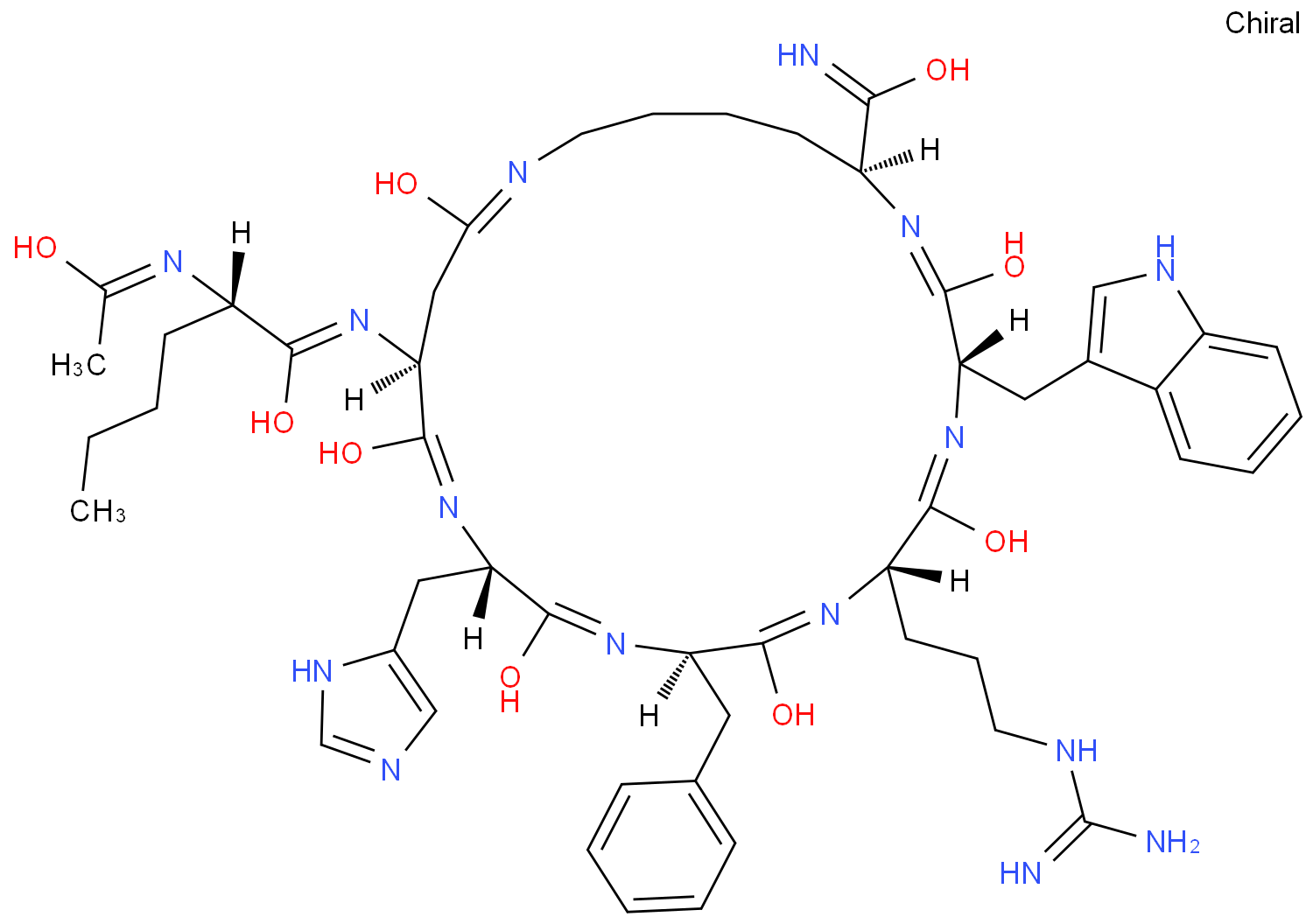
Melanotan II (CAS 121062-08-6) is a synthetic cyclic heptapeptide analogue of alpha-melanocyte stimulating hormone used as a research probe for melanocortin receptor pharmacology. Because it travels to laboratories rather than to patients, its commercial interface is a Contract Development and Manufacturing Organization workflow: custom synthesis and route scouting, process research and development, scale-up, analytical method development and validation, campaign design, containment and technology transfer. This white paper examines the molecule from that CDMO standpoint for 2026, covering how its structure drives synthesis strategy and where the compliance boundary lies between bulk research supply and finished consumer tanning goods.
Structurally the substance is Ac-Nle-cyclo[Asp-His-D-Phe-Arg-Trp-Lys]-NH2, a seven-residue macrocycle closed by a side-chain lactam between the aspartate beta-carboxyl and the lysine epsilon-amine, with norleucine replacing the oxidation-prone methionine of the native hormone and D-phenylalanine replacing L-phenylalanine to slow proteolysis. Those substitutions explain why the compound is considerably more potent and longer acting than alpha-melanocyte stimulating hormone. Route design follows directly: protecting groups must survive chain assembly yet be removable orthogonally for on-resin cyclisation, and the tryptophan indole must be protected during acid cleavage.
Campaigns therefore run on two platforms: a non-cGMP research-grade line delivering RUO peptide for receptor pharmacology, structure-activity work and analytical reference use, and a later ICH Q7 aligned cGMP line when the asset enters toxicology-enabling and first-in-human studies. Documentation, validation, monitoring and stability commitments dominate cost far more than raw protected amino acids do. There is no approved therapeutic indication for Melanotan II in any major jurisdiction and no marketing authorisation exists, so every legitimate B2B transaction is restricted to research use only, evidenced by end-use attestation and supported where required by an open-part DMF documentation package.
Mechanistically, Melanotan II is a potent non-selective agonist across the melanocortin receptor family, and its research value derives precisely from that polypharmacology. With a free-peptide mass near 1024 daltons plus counterion mass depending on isolation conditions, it sits at the economic upper end of routine solid-phase synthesis. Because the compound acts at sub-nanomolar concentrations, small changes in related-substance profile can distort experimental conclusions, so specification design follows receptor biology rather than analytical convenience.
The molecule is built by solid-phase peptide synthesis rather than fermentation or classical solution chemistry, and effectively all commercial routes use Fmoc chemistry on a Rink amide linker so that the C-terminal amide forms on cleavage. Development therefore focuses less on amide bond formation, which is routine and predictable, and more on cyclisation selectivity, purification throughput and control of counterion, residual solvent and scavenger residues.
Demand is negligible in tonnage but intense in specification, tracking the melanocortin pipeline rather than any consumer trend. Sponsors advancing MC4R agonists for monogenic obesity and MC1R-selective agents generate steady requirements for comparators, cold reference standards and custom analogues. A second driver is regulatory, because as unlicensed tanning preparations are intercepted and withdrawn, enquiry increasingly originates from institutions able to evidence end use, and vendors operating without qualification procedures have progressively exited audited supply chains.
Capacity concentrates in peptide-specialist plants rather than general fine chemicals sites, because the asset class requires synthesisers, preparative chromatography suites, lyophilisers and contained handling. North American and European multipurpose suites run cGMP lines alongside RUO lines at tens to hundreds of grams per lot, while expanded synthesiser capacity and cheaper resin supply elsewhere give short quotation cycles for RUO material. Intercontinental movement of cGMP material still favours regional production, making this trade one of samples, documents and technology transfer packages.
The market bifurcates between RUO and cGMP supply, and the price gap reflects paperwork more than chemistry. Material released against an internal specification is quoted at modest gram pricing, whereas the same sequence under ICH Q7 aligned controls with validated methods, reference standards and stability commitments commands a multiple of that figure. Purchasers consequently trade purity bands, accepting ninety to ninety-five percent for screening while specifying above ninety-eight percent for regulatory-enabling work, and volatility follows protected amino acid pricing and chromatography occupancy.
Melanotan II occupies the least forgiving corner of the compliance map: it is not an approved medicine, it is a potent peptide, and it is associated with a consumer misuse channel that regulators have pursued. A CDMO serving this molecule must therefore run a system stronger than its substance classification alone would require, combining chemical inventory duties with documented end-use qualification and awareness of anti-doping rules, since sports authorities treat non-approved pharmacological substances as prohibited at all times.
Peptide manufacturing is solvent-intensive, so ESG performance is measured less through emissions per tonne and more through solvent per gram of purified peptide alongside credible Scope 1-3 Emissions accounting. ISO 14001 certification is now an entry expectation rather than a differentiator, while ISO 9001 underpins the documentation reliability that sponsor audits examine.
Preparative reversed-phase chromatography dominates the burden, because gram-scale isolations consume hundreds of litres of acetonitrile and water per campaign and spent solvent is typically incinerated. Credible programmes account for Scope 1 solvent vapour control and utilities, Scope 2 electricity for lyophilisation and cold storage, and Scope 3 emissions embedded in amino acids, resins and reagents. Practical reductions include steady-state recycling chromatography, lower-odour cleavage scavengers, replacement of dimethylformamide with greener amide alternatives where resin performance permits, and renewable electricity for lyophiliser-heavy operations.
Responsible sourcing here means upstream visibility rather than bulk commodity certification. Every protected amino acid should be traceable to a lot with a declared route, animal-derived-free status and confirmation that no human or animal origin material was used, which becomes mandatory for campaigns later assessed for transmissible spongiform encephalopathy risk. Resins, activators and scavengers require supplier quality agreements and change-control notifications. Batch genealogy from resin lot to filled vial allows reconstruction of any result years later, exactly what a sponsor quality unit requests during due diligence and what supports a DMF-style open-part package.
Although the lyophilised solid is not normally a regulated dangerous good, logistics are governed by potency, hygroscopicity and temperature sensitivity rather than flammability. Shipping discipline resembles high-value biologics more closely than commodity fine chemicals, and resilience planning centres on analytical retest capacity, duplicate retain samples and second-source qualification for critical resins and protected amino acids.
Most RUO consignments travel as non-hazardous goods with a documented classification statement, although intermediate samples containing methanol or trifluoroacetic acid rich solutions may enter United Nations hazard classes and require trained-shipper declarations. Import controls pose a greater practical risk than transport rules, because authorities may detain vaguely described vials; documentation should carry the CAS number, an explicit RUO statement, a consignee end-use declaration and a GHS-aligned safety data sheet. Excursion management should be contractual, defining acceptable ranges, notification timelines and pre-agreed requalification testing.
Organisations positioning around melanocortin peptides should treat compliance capability as a product feature rather than overhead. The priorities below reflect what sophisticated CDMO clients audit for when awarding custom synthesis, analytical development, scale-up and technology transfer packages.
Melanotan II demonstrates how a small, potent research peptide can carry a reputational footprint wholly disproportionate to its tonnage. Its value to legitimate customers lies in cleanly characterised material backed by honest documentation and stated limitations, not in the narrative circulating outside regulated channels. There is no approved therapeutic indication and no authorisation for human use, so the only defensible commercial position is RUO supply to qualified institutions under documented end-use control. CDMOs that internalise this boundary protect their licence to operate and differentiate themselves simultaneously, because qualified sponsors pay for suppliers who will not generate downstream liability.
Across 2026 and beyond the technical agenda is unambiguous: better receptor selectivity through analogue design, cleaner routes with lower solvent intensity, and analytical packages quantifying what single-method purity cannot see. Organisations investing there while maintaining ISO 9001 quality management, ISO 14001 environmental management, transparent Scope 1-3 Emissions reporting and disciplined ESG governance will be positioned to serve whichever melanocortin assets reach clinical development. The prize is not the peptide itself but a durable service relationship with discovery organisations.
Powered by Guidechem
This white paper is exclusively compiled by the Guidechem Intelligence Team based on global customs data, regulatory databases, and industry research. Guidechem is a leading global B2B chemical platform, dedicated to connecting global buyers with verified, high-quality manufacturers.
Relying on Guidechem's extensive global database, we have mapped the core participants in the current global Melanotan II supply chain:
Disclaimer: The content of this white paper is compiled based on public market data and regulatory information available as of 2026. Global chemical regulations are subject to dynamic adjustments. In actual export operations, enterprises must consult professional regulatory advisors or relevant competent authorities to obtain the latest compliance guidance.
 |
 |
 |
 EN
 Agricultural News
 Food News
 Industrial News
 Cosmetic News
 Pharmaceutical News
 Science News


 1YR

