
I. Executive Summary
The record pairs Enclomiphene citrate with CAS 72162-46-0, creating a material identity conflict. That CAS identifies N-[3-(isodecyloxy)propyl]propane-1,3-diamine, or OPDA-10, not a citrate salt of enclomiphene. The Chinese name also identifies the branched ether diamine. This paper therefore evaluates the CAS substance and recommends immediate correction of the assigned English designation.
The CAS-linked product is an amphiphilic specialty amine containing a branched C10 ether tail and primary and secondary amines. Protonation creates cationic surfactant behavior useful in flotation, corrosion inhibition, coatings, pigments, and intermediate chemistry. Value depends on amine distribution, water, color, residual nitrile, and hydrocarbon branching. It must never be represented as a pharmaceutical active or linked to enclomiphene efficacy.
Qualification should reconcile identity across purchase orders, SDSs, certificates, customs records, and inventory searches. Manufacturing control centers on cyanoethylation, hydrogenation, containment of acrylonitrile and hydrogen, and impurity removal. Export readiness requires REACH, CLP, TSCA, GHS, and end-use analysis. Mature suppliers add ISO 9001/14001 governance, traceability, and Scope 1-3 Emissions reporting.
II. Product Deep Dive: Molecular Mechanisms and Production Evolution
2.1 Physicochemical Properties and Mechanisms
N-[3-(isodecyloxy)propyl]propane-1,3-diamine is usually a mixture reflecting the branched isodecyl feedstock, not a pure 8-methylnonyl isomer. Its alkyl ether tail provides hydrophobicity, while two amines provide basicity and salt formation. Acidic media create mono- and diprotonated surface-active species. Performance therefore changes with pH, counter-ion, ionic strength, temperature, and feedstock distribution.
- Interfacial Adsorption and Surface Activity: Protonated molecules adsorb to anionic minerals, oxides, pigments, and dispersed particles while the alkyl tail enters a nonpolar phase. This can change wettability, flotation, emulsification, and pigment wetting, but comparative tests must control pH, ionic strength, and water hardness. Pilot studies should measure adsorption and recovery across representative ore variability.
- Amine Reactivity and Corrosion-Inhibition Logic: Amine sites form salts and support selected curing or derivatization reactions, making the product both additive and intermediate. Adsorbed nitrogen-containing films may inhibit corrosion, but protection requires electrochemical, immersion, and compatibility testing in the actual system. Salt selection and filming persistence should be verified before field deployment.
2.2 Synthesis and Manufacturing Technologies
Manufacture commonly begins with isodecyl alcohol and builds aminoalkyl functionality through nitrile intermediates. Cyanoethylation forms an ether nitrile, hydrogenation gives an ether amine, and another cyanoethylation-hydrogenation sequence forms the diamine. Each stage requires exotherm, catalyst, and residual-acrylonitrile control. Filtration and vacuum finishing then adjust volatiles, water, color, and metal residues.
- Route Scouting and Reaction Control: Development compares cyanoethylation catalysts and nickel or cobalt hydrogenation systems for conversion, selectivity, filtration, and reuse. Gas chromatography tracks alcohol, nitriles, over-alkylated amines, and light ends, while calorimetry and interlocked charging define safe operation. These controls also reduce worker exposure to volatile and reactive intermediates.
- Finishing and Fit-for-Use Release: Finishing uses catalyst separation, vacuum stripping, and polishing filtration rather than costly final-product distillation. Release combines identity with total, primary, and secondary amine values, Karl Fischer water, color, density, residual nitrile, solvent, metals, and application testing. Trend charts should reveal drift before application performance leaves specification.
2.3 Core Application Matrix
- Mineral Processing Collectors and Modifiers: Protonated ether diamines modify mineral wettability in selected phosphate and other ore systems. Qualification needs ore-specific flotation, froth, gangue selectivity, recycle-water tolerance, and tailings assessment rather than extrapolation from another mine. Reagent programs should include representative mineralogy and water chemistry ranges.
- Corrosion, Coatings, and Pigment Systems: The molecule can serve as a corrosion component, wetting aid, dispersant precursor, or adhesion-promoting amine. Buyers test acid compatibility, color stability, foam, metal response, resin interaction, and storage within the intended formulation. Formulation ownership remains with the customer under agreed technical boundaries.
- Chemical Intermediate and Specialty Surfactant Platform: Salt formation, quaternization, alkoxylation, and related reactions tune solubility and interfacial behavior. Intermediate users require stable amine distribution and low residual nitrile because small shifts alter stoichiometry, odor, color, and downstream specifications. Dedicated equipment may be warranted where cross-contamination affects downstream reactivity.
III. Global Market Supply-Demand Landscape and Export Trends
3.1 Demand Drivers and Market Shifts
Demand follows mineral processing, maintenance chemicals, coatings, pigments, and specialty surfactants rather than pharmaceuticals. Buyers increasingly add branch distribution, residual nitrile, color aging, foam, and application performance to amine-value specifications. Consolidated customers also expect stewardship, technical support, and continuity. The name-CAS mismatch is commercially critical because regulated buyers reject inconsistent documentation.
3.2 Capacity Distribution and Export Flows
Asia-Pacific and China supply substantial ether-amine capacity through access to alcohol cuts, acrylonitrile, and hydrogenation assets. European participants emphasize REACH coverage and impurity control, while North American channels add mining and corrosion service. Trade moves in drums, intermediate bulk containers, or bulk tanks after compatibility review. Buyers should dual-source feedstock and finished diamine because composition affects low-temperature and interfacial behavior.
3.3 Market Bifurcation and Pricing Dynamics
Pricing separates documented, consistent specialty grades from material sold mainly by amine value and color. Alcohol, acrylonitrile, hydrogen, catalyst, energy, and waste treatment set the cost structure. Cheap material can create higher dosage, unstable foam, or failed qualification. Contracts should index key inputs, define analytical and performance windows, and require notification of source, catalyst, route, or site changes.
IV. In-depth Analysis of Global Compliance and Regulatory Barriers
Compliance begins by correcting the false equivalence between Enclomiphene citrate and CAS 72162-46-0. The identity profile should state composition, branch distribution, impurities, and analytical fingerprint consistently across documents. This is an industrial chemical, so FDA, DMF, CEP, cGMP, ICH Q7, and ICH Q11 claims are inappropriate under this identity. GHS and sector-specific obligations still apply.
4.1 European Market: REACH, CLP, and Sector-Specific Directives
- REACH Identity, Registration, and Supply-Chain Use: EU entities must verify legal-entity and tonnage coverage under REACH and support only identified uses. Registration identity should represent the isodecyl mixture and impurities rather than an artificial single isomer, with any Only Representative arrangement documented. Dossier ownership and data-access rights should be confirmed before shipment.
- CLP Classification and Sector Controls: CLP classification requires reliable irritation, corrosion, toxicity, and environmental data plus compliant labels and SDSs. Exact categories follow the supplied composition, while biocidal, plant-protection, or consumer uses need separate authorization analysis. Updated classifications must flow rapidly through labels and customer systems.
4.2 North American Market: TSCA, EPA, and FDA Regulations
- TSCA Inventory and Chemical Data Duties: Before US commerce, confirm the exact CAS identity and active TSCA Inventory status plus any significant-use restriction. Import certification, reporting thresholds, records, and downstream communication apply, while an R&D exemption requires all statutory conditions. Annual volume aggregation should include related legal entities where rules require.
- EPA, FDA, and Intended-Use Boundaries: EPA requirements arise when pesticidal claims are made and cannot be avoided by calling such functions technical. FDA applies only to a separately justified regulated use; this diamine is not enclomiphene citrate and cannot support a pharmaceutical DMF or CEP under that identity. Claims review should involve product stewardship before samples enter commerce.
4.3 The Critical Hurdle: Quality Control and Safety Limits
Compliance Warning: Do not release or import material while the assigned name Enclomiphene citrate remains paired with CAS 72162-46-0. The mismatch can invalidate customs declarations, poison-control notifications, REACH or TSCA searches, SDS classifications, and customer risk assessments, and it creates a serious risk that an industrial diamine could enter a pharmaceutical procurement channel. Quarantine the record, obtain an authenticated structural identity package, reconcile the Chinese and English names, and issue controlled corrections to affected customers. For the CAS-linked ether diamine, set limits for residual acrylonitrile, nitriles, catalyst metals, volatile amines, water, and branch distribution, and apply occupational exposure banding where no authoritative limit exists. A certificate showing only assay or total amine value is not sufficient for safe or reproducible use.
V. Green Trade Barriers and ESG in Manufacturing
Environmental performance is shaped by alcohol sourcing, acrylonitrile, pressurized hydrogenation, wastewater, and cationic aquatic effects. Customers request product footprints and evidence that raw-material changes preserve hazard assessments. ISO 14001 governs permits and improvement targets, while ISO 9001 controls changes. ESG claims require auditable inventories rather than generic assertions that surfactants are green.
5.1 Carbon Footprint and Circular Economy
A footprint should separate Scope 1 fuel and treatment emissions, Scope 2 purchased electricity, and Scope 3 Emissions from feedstocks, catalysts, packaging, and freight. Useful projects include heat integration, renewable electricity, catalyst-life extension, solvent recovery, and less rework. Wastewater monitoring should cover oxygen demand, nitrogen, amines, and aquatic toxicity. Results need a stated functional unit and allocation method.
5.2 Sustainable Sourcing and Traceability
Sourcing records should identify the alcohol stream as petrochemical, mass-balanced, or renewable and explain branch control. Supplier review should cover acrylonitrile stewardship, catalyst recovery, process safety, labor, and waste contractors. Batch genealogy must connect raw materials, reactor, catalyst, filtration, filling, and retains. Source changes require analytical bridging and application testing before implementation.
VI. Supply Chain Resilience and Export Logistics
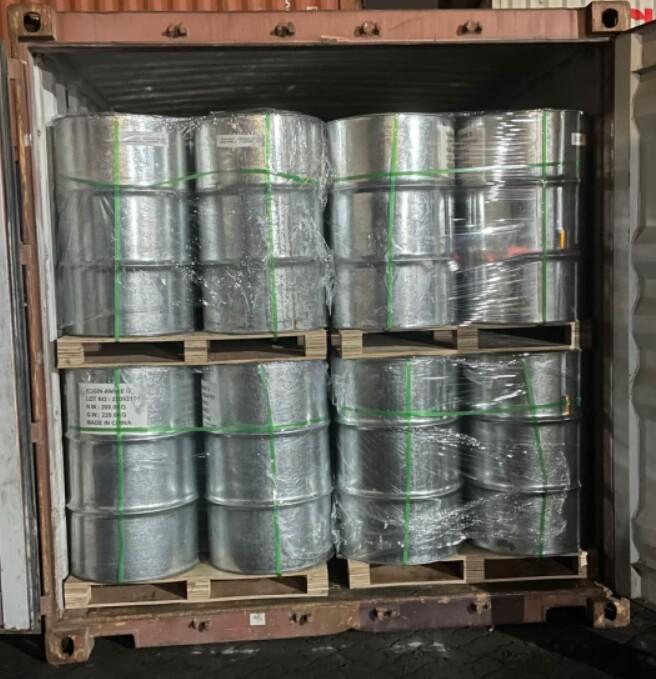
The product is generally shipped as an amine liquid whose low-temperature flow depends on composition. Planning must address corrosivity, odor, moisture, and compatibility with seals, linings, pumps, and hoses. Dedicated or validated-clean equipment prevents contamination by acids, oxidizers, and previous cargoes. Each lane needs current grade-specific ADR, IMDG, IATA, and local review.
6.1 Packaging Standards and Moisture/Contamination Control
- Compatible Closures and Moisture Control: Use compatible lined drums, polymer packs, intermediate bulk containers, or tanks with amine-resistant seals. Keep packs closed and dry, manage oxidation-sensitive headspace, and define temperature limits that preserve flow without unnecessary heating. Package qualification should include drop, vibration, stacking, and closure tests.
- Segregation, Sampling, and Chain of Custody: Segregate from acids, acid chlorides, oxidizers, reactive halogens, food, and pharmaceutical cargoes with secondary containment. Tamper seals, unique package numbers, representative samples, and retained samples preserve custody and support deviation investigations. Receiving inspection should compare seals, labels, appearance, and certificate values.
6.2 Dangerous Goods Identification and Transit Protocols
Dangerous-goods classification must follow the actual grade because amines may be corrosive and environmentally hazardous. Documents should state the assigned shipping name, UN number, packing group, marine status, and emergency contact, while carriers must prevent waterway release. Excursions require controlled appearance and viscosity review, not uncontrolled heating. Customs records must use the corrected industrial identity, and mismatched shipments require quarantine.
VII. Enterprise Global Expansion Strategy Guide
Expansion should be gated by identity integrity, application data, and regional regulatory coverage. Suppliers selling only an amine value compete on price, while those linking composition to performance create durable value. Quality, stewardship, and ESG evidence should be aligned before market entry. This record needs formal remediation before commercial expansion.
- Correct the Master Identity Before Selling: Lock the conflicting record, verify CAS 72162-46-0 structurally, and correct the false designation in controlled systems. Reissue labels, SDSs, declarations, and customer notices through change control, and review historical transactions for safety or regulatory impact. Corrective action should include root cause, effectiveness checks, and governance ownership.
- Build Application-Specific Technical Packages: Build separate qualification packages for flotation, corrosion, coatings, and intermediate use, linking limits to performance. Support them with validated methods, lot trends, ISO 9001 controls, occupational exposure banding, and technical-service protocols. Customer trials should use agreed controls, acceptance criteria, and statistical treatment.
- Regionalize Compliance and Resilience: Secure REACH and CLP support, verify TSCA and EPA implications, and maintain regional inventory and transport matrices. Dual-source inputs, qualify alternate hydrogenation capacity, hold regional safety stock, and report Scope 1-3 Emissions under ISO 14001. Business-continuity exercises should test communications, inventory, and alternate-route readiness.
VIII. Conclusion
CAS 72162-46-0 identifies a branched ether diamine whose value comes from cationic interfacial activity. It is not enclomiphene citrate, and treating the names as synonyms is a major regulatory failure. After correction, the material can serve mineral, corrosion, coating, pigment, and surfactant programs. Feedstock distribution, amine speciation, residual nitrile, metals, water, color, and performance are decisive controls.
Responsible suppliers combine controlled manufacture with GHS, REACH, CLP, TSCA, EPA-use, and transport review. They also document containment, traceability, ISO 9001/14001 systems, and Scope 1-3 Emissions reduction. Buyers should contract against reconciled identity and fit-for-use specifications, not catalogue text. That discipline protects workers, customers, regulators, and supply-chain reputation.
IX. Industry Resource Connection and Supplier Ecosystem
Powered by Guidechem
This white paper is exclusively compiled by the Guidechem Intelligence Team based on global customs data, regulatory databases, and industry research. Guidechem is a leading global B2B chemical platform, dedicated to connecting global buyers with verified, high-quality manufacturers.
Relying on Guidechem's extensive global database, we have mapped the core participants in the current global Enclomiphene citrate supply chain:
- North America: Technical-Service and Formulation Tier: North American supply centers on importers, technical-service channels, and formulators with regional stock. Buyers expect TSCA confirmation, OSHA-GHS documents, dependable delivery, and field data linking lot properties to performance. Distributors should maintain lot traceability and approved end-use records.
- Europe: Compliance-Intensive Specialty Tier: European participants differentiate through REACH access, CLP discipline, application support, and environmental controls. Reviews commonly cover composition, exposure scenarios, wastewater, and ISO 14001 evidence, making the name-CAS conflict an immediate disqualifier. Multilingual documents and poison-centre obligations should be managed centrally.
- Asia-Pacific and China: Integrated Manufacturing Tier: Asia-Pacific and China combine alcohol, acrylonitrile, hydrogenation, and export packaging capacity. Leading producers add residual-nitrile control, branch fingerprints, catalyst traceability, application laboratories, change notification, and globally aligned documents. Audits should verify actual manufacturing sites, laboratories, and waste controls.
Disclaimer: The content of this white paper is compiled based on public market data and regulatory information available as of 2026. Global chemical regulations are subject to dynamic adjustments. In actual export operations, enterprises must consult professional regulatory advisors or relevant competent authorities to obtain the latest compliance guidance.


 EN
 Agricultural News
 Food News
 Industrial News
 Cosmetic News
 Pharmaceutical News
 Science News


 4YRS


