-
We detected your language preference as English. Would you like to switch to the English version for a better experience?
Switch to English
Stay here


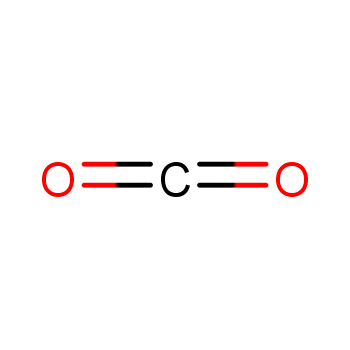
To determine whether carbon dioxide (CO2) is polar or nonpolar, the decisive factor is not the polarity of an individual C=O bond but the vector sum of both bond dipoles. As illustrated in the CO2 Lewis Structure Guide, the central carbon is bonded to two oxygen atoms by double bonds and has no lone pair on the central atom.
The molecule has a linear O=C=O geometry with a bond angle of 180°. The carbon atom is conventionally described as sp-hybridized in the Lewis/VSEPR framework, with the two π bonds formed from two mutually perpendicular p-orbital sets. Each C=O bond carries a bond dipole directed toward oxygen. Because the two bonds have equal magnitude and point in exactly opposite directions, their dipole vectors cancel: μnet = 0 D.
A useful industrial distinction is that zero dipole does not mean zero intermolecular interaction. CO2 possesses a strong quadrupole moment arising from its symmetric charge distribution. Consequently, CO2 can participate in dipole–quadrupole interactions and exhibit specific interactions with polar solutes, water, stationary phases, and functional groups. Reviews of supercritical-fluid chromatography specifically describe CO2 as a non-protic, effectively nonpolar solvent with zero molecular dipole but significant quadrupolar interactions.
CO2 should not be treated as a conventional room-temperature organic solvent. Its industrial solvent value comes primarily from its use as a compressed or supercritical fluid. Above its critical temperature of approximately 31.1°C and critical pressure of approximately 7.38 MPa, CO2 becomes a tunable dense fluid whose density, solvating power, and transport properties can be modified substantially through pressure and temperature.
This distinction matters for solvent-selection databases. Snyder's P′ scale was developed for common chromatographic liquids and therefore does not provide a scientifically robust single-number P′ value for CO2. Instead, SFC practitioners evaluate CO2 through pressure-dependent density, modifier percentage, stationary-phase chemistry, analyte solubility, and retention behavior. The low dielectric constant and zero permanent dipole contribute to weak solvation of many strongly polar and ionic compounds, while the quadrupole moment provides useful interactions with selected functional groups.
The dielectric constant illustrates why phase and operating conditions must be specified. Gaseous CO2 at approximately atmospheric pressure has a relative permittivity very close to unity, around 1.0009, whereas the dielectric response rises with density in compressed and supercritical states. Measurements at approximately 323 K show a pronounced increase in dielectric constant near the critical-pressure region.
In preparative and analytical SFC, CO2 is commonly combined with modifiers such as methanol, ethanol or acetonitrile. Increasing modifier content changes the effective polarity and elution strength of the mobile phase, making it possible to move from predominantly nonpolar CO2 behavior toward stronger interactions with polar analytes. This tunability is one reason CO2 is valuable in pharmaceutical, natural-product and fine-chemical separations.
CO2 also has favorable transport characteristics for extraction and processing because depressurization can remove the solvent without leaving a conventional organic-solvent residue. Its industrial applications include supercritical extraction, fractionation, precision cleaning, particle formation, chromatography, and selected reaction-media applications. PubChem also lists uses including food freezing, fire extinguishing and chemical-process applications.
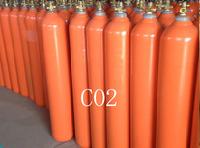
For procurement, the analytical certificate should therefore state the grade and intended application—food, beverage, laboratory, semiconductor, pharmaceutical, welding, extraction or SFC—rather than relying on a generic “high purity” designation.
Comparing CO2 with structurally related or process-relevant gases clarifies why a zero dipole does not automatically translate into identical solvent performance. The values below should be treated as condition-dependent engineering descriptors, not as a universal polarity ranking.
| Compound | Dipole Moment | Approx. Gas εr | log P / XlogP | Water Solubility Behavior | Industrial Sourcing |
|---|---|---|---|---|---|
| CO2 | 0 D | ≈1.0009 | XlogP ≈0.9 | Moderately soluble; strongly pressure dependent | Very high availability; multiple purity grades |
| N2 | 0 D | ≈1.0006 | Not meaningfully comparable as an organic logP descriptor | Low | Very high |
| O2 | 0 D | ≈1.0005 | Not meaningfully comparable as an organic logP descriptor | Low | Very high |
| CH4 | 0 D | ≈1.0009 | Not meaningfully comparable as an organic logP descriptor | Very low | High, subject to fuel-gas specifications |
| SF6 | 0 D | ≈1.002 under typical gas conditions | Not meaningfully comparable as an organic logP descriptor | Very low | Specialty-gas sourcing |
For CO2 specifically, water solubility is substantially affected by pressure and temperature. NIST data give a calculated mole fraction of approximately 0.622 × 10⁻³ for CO2 in water at 25°C and a CO2 partial pressure of 101.325 kPa, illustrating why pressure and phase conditions should accompany any quoted solubility number.
“The useful electronic description of CO 2 is not simply ‘nonpolar’: its zero permanent dipole coexists with a substantial quadrupole field. In supercritical processing, this produces weak bulk dielectric screening but measurable, directional interactions with polar analytes and stationary phases; pressure and modifier composition therefore become practical tools for controlling solvation and chromatographic retention.”
Carbon dioxide has a dual regulatory profile: it is an extensively used industrial gas with established occupational exposure controls, while its atmospheric release is also regulated or monitored in greenhouse-gas programs in many jurisdictions. In the European Union, ECHA identifies CAS 124-38-9 / EC 204-696-9 as a REACH-registered substance and provides associated regulatory and classification information.
In the United States, OSHA lists a permissible exposure limit of 5,000 ppm as an 8-hour TWA and a 30,000 ppm STEL in the referenced occupational-exposure framework; NIOSH lists an IDLH value of 40,000 ppm. These limits are particularly relevant to enclosed extraction, dry-ice handling, beverage production, fermentation, refrigeration and compressed-gas systems where CO2 can accumulate and displace oxygen.
The U.S. greenhouse-gas regulatory position has also changed. EPA finalized a February 2026 rule rescinding the 2009 greenhouse-gas Endangerment Finding and associated federal motor-vehicle greenhouse-gas standards. This action concerns the statutory framework for regulating greenhouse-gas emissions from new highway vehicles; it should not be interpreted as eliminating all federal or state requirements relevant to CO2 emissions, reporting or occupational exposure.
From a green-chemistry perspective, CO2 can be attractive as a process medium because it is nonflammable, readily recoverable in closed systems and can reduce reliance on conventional volatile organic solvents in appropriately designed processes. However, compressed and supercritical CO2 requires pressure-rated equipment, and its climate impact means that “CO2-based” does not automatically mean low-impact. Recovered or captured CO2, high recycle rates and process-energy accounting are important when comparing it with conventional solvents or fluorinated alternatives.
Buyers should specify more than CAS number and nominal purity. For industrial and R&D applications, the appropriate procurement specification can include purity grade, moisture limit, oxygen and nitrogen limits, carbon monoxide, hydrocarbons, sulfur compounds, particulate control, cylinder or bulk-tank configuration, pressure, valve standard, certificate of analysis and intended regulatory/food/pharmaceutical status.
For SFC and high-pressure extraction, also specify the acceptable concentration of non-condensable impurities and moisture because these can affect pump behavior, modifier composition, stationary-phase performance and reproducibility. For semiconductor or highly sensitive analytical applications, trace-metal and ultra-low hydrocarbon specifications may be more important than conventional industrial-gas specifications.
Looking for commercial bulk supplies or technical documentation for Carbon Dioxide (CAS 124-38-9)?
Carbon dioxide is nonpolar overall. Its two C=O bonds are individually polar, but the molecule is linear and symmetrical, so the two bond dipoles cancel and the net dipole moment is 0 D.
CO2 has no permanent dipole, but its quadrupole moment permits specific interactions with water. In addition, dissolved CO2 participates in the CO2/carbonic-acid equilibrium. Solubility increases with CO2 partial pressure and generally decreases as temperature rises under comparable conditions.
Not in the conventional sense. Snyder P′ is primarily a scale for chromatographic liquid solvents. For supercritical CO2, pressure, density, temperature and modifier concentration provide more useful engineering descriptors than assigning an artificial P′ number.
CO2 is not a conventional HPLC liquid mobile phase. It is widely used as the primary mobile phase in supercritical fluid chromatography (SFC), where it is often combined with an organic modifier. This provides low-viscosity, tunable chromatographic conditions for many analytes.
Typical specification concerns include water, N2, O2, CO and hydrocarbons. Depending on the source, sulfur-containing compounds and other trace process contaminants can also matter. The correct impurity panel should be matched to the application and grade.
CO2 is nonflammable, but elevated concentrations can cause oxygen displacement and serious asphyxiation hazards. Enclosed areas, cylinder-storage rooms, dry-ice facilities and extraction systems should therefore use appropriate ventilation, gas monitoring and pressure-system controls. OSHA provides occupational exposure limits for workplace planning.
No under ordinary gaseous conditions. Its relative permittivity is close to unity, approximately 1.0009 near atmospheric pressure. The effective dielectric response changes substantially as CO2 is compressed and approaches or exceeds its critical region, which is important for supercritical processing.
|
 |
 |
 EN
EN
 Agricultural News
 Food News
 Industrial News
 Cosmetic News
 Pharmaceutical News
 Science News


 4YRS
4YRS