-
We detected your language preference as English. Would you like to switch to the English version for a better experience?
Switch to English
Stay here


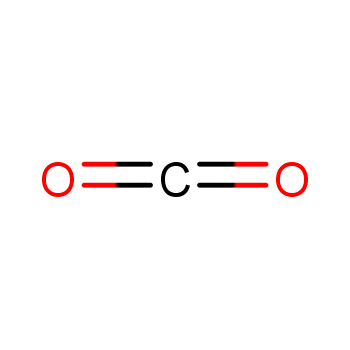
The carbon dioxide Lewis structure is O=C=O, with carbon at the center double-bonded to two oxygens; the molecule is linear, the central carbon carries no lone pairs, the C=O bond angle is 180°, carbon is best described as sp-hybridized, and because the two equal bond dipoles cancel, CO2 is nonpolar.
 Figure 1: Lewis Structure of Carbon dioxide (CO2)
| Chemical Formula | CO2 |
| CAS Number | 124-38-9 |
| Total Valence Electrons | 16 |
| Lewis Structure | O=C=O, two C=O double bonds |
| Electron-Domain Geometry | Linear |
| Molecular Geometry | Linear |
| Hybridization Model | sp (central carbon) |
| O=C=O Bond Angle | 180° |
| Polarity | Nonpolar molecule |
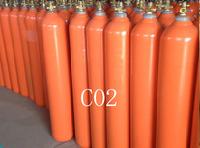
Carbon dioxide is far more than a classroom example of a linear molecule. Industrially, CO2 is produced at scale as a by-product of ammonia synthesis, fermentation, and fossil-fuel combustion, and it is captured, purified and sold in multiple grades. Its chemical inertness in the absence of strong nucleophiles or reducing agents, together with its low toxicity relative to many industrial gases, makes it valuable across food, energy and materials sectors.
In the chemical industry, CO2 is a feedstock for urea (via reaction with ammonia), for salicylic acid, and increasingly for polycarbonates and other CO2-derived polymers. In the food and beverage sector it provides carbonation and inert modified-atmosphere packaging. Supercritical CO2 is a widely used green solvent for decaffeination, hop extraction and specialty extractions, while solid CO2 (dry ice) is a common refrigerant and shipping coolant.
The first step in drawing the CO2 Lewis structure is to sum all valence electrons. Carbon is in Group 14 and contributes 4 valence electrons. Each oxygen is in Group 16 and contributes 6 valence electrons.
Total valence electrons = 4 from C + 6 from O + 6 from O = 16 electrons.
Place carbon in the center with the two oxygens on either side: O – C – O. A single bond to each oxygen consumes 4 of the 16 electrons, leaving 12. Distributing those as lone pairs gives each oxygen three lone pairs, but that leaves carbon with only 4 electrons (an incomplete octet) and yields high formal charges.
To satisfy the octet rule and minimize formal charge, convert each single bond into a double bond: O=C=O. Each double bond uses 4 electrons, so two double bonds consume 8 electrons, and the remaining 8 electrons become two lone pairs on each oxygen. Every atom now has a complete octet, and formal charges are zero.
The Lewis structure of CO2 shows two electron domains around the central carbon, both bonding (the two C=O double bonds). Under VSEPR, two electron domains adopt a linear arrangement to maximize their separation, at 180°.
Because there are no lone pairs on the central carbon, the electron-domain geometry and the molecular geometry are identical: both are linear. The absence of lone-pair repulsion on carbon means the bond angle stays at the ideal 180° rather than being compressed.
With only two bonding domains and no lone pairs, the only significant repulsion is bonding-pair–bonding-pair repulsion between the two C=O domains. These are placed 180° apart, the farthest possible separation, giving a perfectly linear molecule.
In the localized-bond model, the central carbon in CO2 is described as sp-hybridized: two electron domains correspond to two linear hybrid orbitals that form the σ framework of the two C=O bonds. The remaining two unhybridized p orbitals on carbon form the two π components of the double bonds (one π bond with each oxygen).
Each oxygen is typically described as sp2-hybridized in a localized picture, using two sp2 lone pairs and one sp2 orbital for the σ bond, with the remaining p orbital contributing the π bond.
Formal charge = valence electrons − nonbonding electrons − ½ × bonding electrons. For carbon in O=C=O: 4 − 0 − ½ × 8 = 0. For each oxygen: 6 − 4 − ½ × 4 = 0. Every atom therefore has zero formal charge, confirming the O=C=O representation is the dominant contributing structure.
Carbon dioxide is nonpolar. Each C=O bond is individually polar because oxygen is more electronegative than carbon, so each bond has a bond dipole pointing toward oxygen. However, the molecule is linear, so the two equal bond dipoles point in exactly opposite directions and cancel by vector addition.
The net molecular dipole moment of an isolated CO2 molecule is therefore zero (or immeasurably small). This symmetry-driven cancellation is the key reason CO2, despite containing polar bonds, is classified as a nonpolar molecule.
"The decisive point is not that the C=O bonds are polar, but that the linear geometry makes their dipoles antisymmetric. With two identical bond dipoles separated by 180°, vector cancellation is exact; the molecule's symmetry, not the absence of polar bonds, is what makes CO2 nonpolar."
Interpretation consistent with standard molecular-symmetry and VSEPR treatments of linear triatomic molecules.This nonpolarity explains many of CO2’s macroscopic behaviors: it is only weakly soluble in water (reacting slowly to form carbonic acid) and mixes readily with other nonpolar or weakly polar gases. In contrast, the polar bonds are what allow CO2 to interact with nucleophiles in chemical reactions such as urea or salicylate formation.
| Species | Formula | Central Atom | Electron Domains | Molecular Geometry | Polarity |
|---|---|---|---|---|---|
| Carbon dioxide | CO2 | C | 2 | Linear | Nonpolar |
| Carbon monoxide | CO | C | 2 | Linear (diatomic) | Polar |
| Sulfur dioxide | SO2 | S | 3 | Bent | Polar |
| Carbon suboxide | C3O2 | central C | 2 | Linear | Nonpolar |
| Ozone | O3 | central O | 3 | Bent | Polar |
O=C=O with two lone pairs on each oxygen. This satisfies the octet rule on every atom and gives zero formal charge throughout.
CO2 is nonpolar. The two polar C=O bonds are equal and opposite in the linear geometry, so their dipoles cancel.
The O=C=O angle is 180°. Two electron domains around carbon give a linear arrangement with no lone-pair compression.
Carbon is sp-hybridized. Two linear electron domains correspond to two sp hybrids for the σ bonds and two p orbitals for the π bonds.
The CAS number is 124-38-9. PubChem (CID 280) and NIST both identify this CAS number with CO2.
Technical scope: Lewis structures, VSEPR and hybridization are model-based descriptions used for chemical communication and structure prediction; actual electronic structure is better represented by molecular-orbital and quantum-chemical methods. Commercial CO2 specifications vary by grade (beverage, food, welding, industrial, pharmaceutical), and CAS 124-38-9 identifies the substance rather than a single purity specification.
 |
|
 |
 EN
EN
 Agricultural News
 Food News
 Industrial News
 Cosmetic News
 Pharmaceutical News
 Science News

 4YRS
4YRS