-
We detected your language preference as English. Would you like to switch to the English version for a better experience?
Switch to English
Stay here


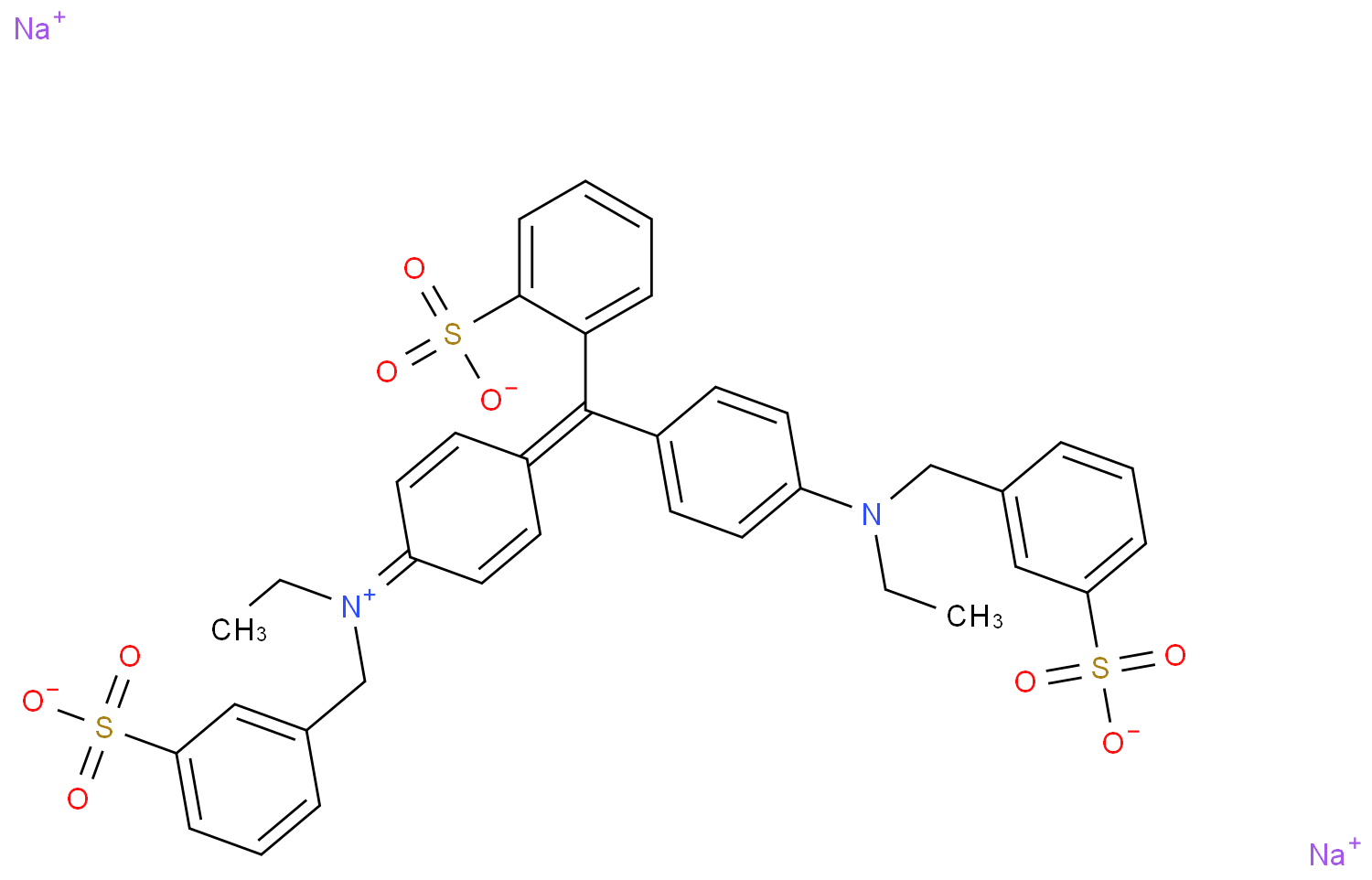
To determine whether Brilliant Blue FCF (C37H34N2Na2O9S3) is polar or nonpolar, the decisive question is whether the bond dipoles of the molecule cancel once its three-dimensional shape is taken into account. Brilliant Blue FCF is a sulfonate salt, built from 3 × sulfonate anion (–SO₃⁻). As set out in the C37H34N2Na2O9S3 Lewis Structure Guide, C37H34N2Na2O9S3 has 51 heavy atoms, 5 ring systems and 12 rotatable bonds. For FD&C Blue No..
The bond polarities follow from electronegativity. The largest differences in the structure are O–S (ΔEN ≈ 0.86), C–N (ΔEN ≈ 0.49) and C–S (ΔEN ≈ 0.03), so electron density is pulled toward oxygen. In three dimensions, the sulfur centre is tetrahedral with sp3 hybridization with angles close to tetrahedral. Because the substance separates into ions, the molecule is polar but the magnitude of its dipole is not quoted here, because the species is ionic or carries a net charge, so the dipole depends on the choice of origin and is not a molecular constant.
For formulation and process work, the useful consequences are these: the calculated topological polar surface area is 177.8 Ų, 0 hydrogen-bond donors and 10 hydrogen-bond acceptors and the Crippen partition coefficient is not quoted, because the parameter set does not cover every element in the molecule. PubChem’s curated experimental record adds: Brilliant Blue FCF is In water, 30 mg/mL (3.0X10+4 mg/L).
PubChem’s use and manufacturing record describes Brilliant Blue FCF as follows: For FD&C Blue No. These applications are what make the polarity question practical — solvent choice, extraction recovery, cleaning and formulation all turn on how strongly the molecule interacts with polar phases.
The measured physical behaviour recorded for this substance is consistent with that picture. Solubility: In water, 30 mg/mL (3.0X10+4 mg/L). Physical Description: Other Solid;. Melting Point: 283 °C (decomposes). LogP: log Kow = -4.94 (estimated). These are database values and should be read with the conditions (temperature, purity, pressure) that the source states.
No dilute-gas permittivity is reported here: the Debye estimate would have to inherit a dipole moment that this method does not deliver reliably for this class of compound (the species is ionic or carries a net charge, so the dipole depends on the choice of origin and is not a molecular constant), and for an ionic substance the equation does not apply at all.
Structurally the reactivity sits in 3 × sulfonate anion (–SO₃⁻). That functional inventory, together with the unresolved dipole, is what predicts the solubility and adsorption behaviour: polar groups give the molecule a handle on polar solvents and on polar surfaces, while the hydrocarbon portion resists them.
No GHS hazard statements were retrieved for this substance from the public record used here, so no classification is asserted. The applicable classification must be taken from the supplier’s safety data sheet and from the ECHA or OSHA/NIOSH tables for CAS 3844-45-9.
In short, specify Brilliant Blue FCF by assay, water content, impurity profile, packaging and transport class, and state the intended application on the enquiry. The polarity analysis above explains behaviour in use; it does not replace a specification.
The comparison below places C37H34N2Na2O9S3 next to structurally related substances from the same catalogue. Dipole moments come from one consistent protocol (GFN2-xTB//MMFF94, gas phase, single conformer) and are quoted only where that protocol has been validated; where it has not, the cell says so instead of giving a number. Permittivities are dilute-gas estimates from the Debye equation, logP values are Crippen calculations, and the solubility column is a qualitative inference from the calculated descriptors rather than a measurement.
| Compound | Dipole Moment | Approx. Gas εr | log P / XlogP | Water Solubility Behavior | Industrial Sourcing |
|---|---|---|---|---|---|
| C37H34N2Na2O9S3 | non-zero, not quoted | — | — | In water, 30 mg/mL (3.0X10+4 mg/L) | See supply listing |
| C55H72MgN4O5 | non-zero, not quoted | — | — | Dissolves by dissociation; ionic hydration dominates | See supply listing |
| C55H70MgN4O6 | non-zero, not quoted | — | — | Dissolves by dissociation; ionic hydration dominates | See supply listing |
| C40H56O2 | ≈1.02 D (calc.) | ≈1.0262 | logP ≈ 10.40 | Low; hydrophobic (inferred from logP > 4) | See supply listing |
| C40H56 | ≈0.18 D (calc.) | ≈1.0224 | logP ≈ 12.61 | Low; hydrophobic (inferred from logP > 4) | See supply listing |
The spread across this table is the point: composition alone does not set the polarity verdict. C37H34N2Na2O9S3 sits where it does because of the balance between its polar functional groups and the asymmetry of its shape, and any of the neighbouring entries can be the better choice once the temperature, the phase and the required polarity window are fixed.
“C 37H 34N 2Na 2O 9S 3 is an ionic substance, so the useful question is not "polar or nonpolar" but how the charge is distributed and how strongly the ions are hydrated. No calculated partition coefficient is quoted, because the Crippen parameter set does not cover every element in the molecule. The curated experimental record is consistent: In water, 30 mg/mL (3.0X10+4 mg/L).”
Regulatory status is specific to the substance and to the jurisdiction, and it changes. For CAS 3844-45-9 the authoritative public sources are the ECHA registered-substance database for the EU, and the OSHA and NIOSH tables for occupational exposure in the United States.
No GHS hazard statements for this substance were retrieved from the public database used to build this article, so none are asserted here. Treat the absence of a quoted classification as an instruction to check the supplier’s safety data sheet, not as evidence that the substance is harmless.
No occupational exposure limit for this substance is quoted in this article, because none was present in the database record used here. Publishing a limit that is not on the record would be worse than publishing none: obtain the applicable value from the OSHA Z-table, the NIOSH pocket guide or the equivalent national instrument before designing the ventilation or monitoring programme.
From a compliance and sustainability standpoint, the polarity of C37H34N2Na2O9S3 is a means rather than an end. It determines which solvent can replace another, how completely the substance can be recovered from a stream, and how much energy the separation will cost — so it belongs in the process justification, while the hazard classification and the exposure limits belong in the safety case.
A purchase enquiry for Brilliant Blue FCF (CAS 3844-45-9) should state the grade, assay basis, permitted impurity limits, water content, packaging, and the transport and regulatory status required for the destination market. Where the substance is used as a reagent or intermediate, the impurity profile usually matters more than the nominal percentage.
Because polarity governs phase behaviour, it also governs recovery: a polar molecule is easier to strip from a non-polar stream and harder to dry than a non-polar one, and vice versa. Confirm the Guidechem supply listing for current availability and compare lots on the certificate of analysis rather than on the label alone.
Looking for commercial bulk supplies or technical documentation for Brilliant Blue FCF (CAS 3844-45-9)?
Brilliant Blue FCF is polar. The bond dipoles do not cancel, so the molecule is polar, but no magnitude is quoted because the species is ionic or carries a net charge, so the dipole depends on the choice of origin and is not a molecular constant.
The species is ionic or carries a net charge, so the dipole depends on the choice of origin and is not a molecular constant. Rather than publish a number that would be misleading, the article argues the polarity from structure and symmetry; the literature value can be looked up in the NIST or CRC tables if a number is required.
The sulfur centre is tetrahedral with sp3 hybridization with angles close to tetrahedral. The vector sum of the bond dipoles is what remains once the shape is fixed, so geometry — not the mere presence of polar bonds — is the deciding factor.
No permittivity is quoted: the Debye dilute-gas equation does not apply to a charged species.
Not in routine tabulations. Snyder P′ was developed for conventional liquid chromatographic solvents, and this substance is outside the scope of that scale. Dipole moment, calculated logP and hydrogen-bond counts are the descriptors used here instead.
The curated database record states: In water, 30 mg/mL (3.0X10+4 mg/L). No calculated partition coefficient is quoted, because the Crippen parameter set does not cover every element in the molecule.
Grade, assay basis, water content, the declared impurity profile, packaging and the transport classification, plus the regulatory status required for the destination market. Confirm the hazard classification from the supplier’s safety data sheet, since none is asserted here.
|
 |
 EN
EN
 Agricultural News
 Food News
 Industrial News
 Cosmetic News
 Pharmaceutical News
 Science News



 13YRS
13YRS


