-
We detected your language preference as English. Would you like to switch to the English version for a better experience?
Switch to English
Stay here


Diethyl butylmalonate (DEBM) is an important organic compound with a wide range of applications in industry and science. Its unique chemical properties endow it with various possibilities for application. This article aims to introduce the basic overview of DEBM and its applications in various industries to provide insights into the functionality and potential value of this compound. Through the study of Diethyl butylmalonate, we can better understand and utilize its characteristics, providing references and insights to promote development and innovation in relevant fields.
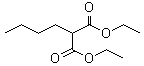
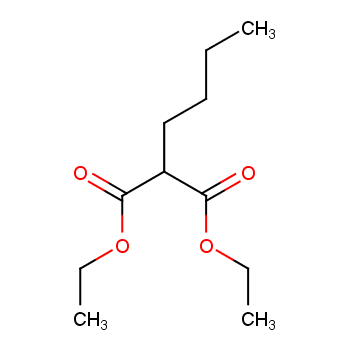
To understand the chemical properties of Diethyl butylmalonate, we must first look at its molecular formula, C11H20O4.

The structural formula of Diethyl butylmalonate features a central methylene group (CH2) and two ester groups (C=O-O-CH2-CH3). These ester groups contribute to the chemical properties of Diethyl butylmalonate by making the adjacent methylene slightly acidic and electron-rich. This combination enables Diethyl butylmalonate to act as both a nucleophilic reagent, attracted by electron-deficient centers, and as a weak acid capable of losing a proton. This unique functionality allows Diethyl butylmalonate to participate in various organic reactions, making it a valuable tool in organic synthesis.
Diethyl butylmalonate is a valuable reagent in organic chemistry, particularly in forming carbon-carbon bonds. Understanding its mechanism of action is crucial for unleashing its potential in various synthetic schemes. There are two main aspects to consider:
(1) Synthesis of Diethyl Butylmalonate: Diethyl butylmalonate itself is synthesized by alkylation of diethyl malonate (DEM). This process typically involves a strong base such as sodium ethoxide (NaOEt) and an alkylating agent like n-butyl bromide (BuBr).
The mechanism involves: A. Deprotonation by base: NaOEt extracts a proton from the acidic α-carbon of DEM, forming a resonance-stabilized carbanion. B. Nucleophilic attack: The carbanion acts as a nucleophilic reagent, attacking the electrophilic carbon of BuBr in an SN2 reaction. C. Product formation: Bromide ion (Br-) leaves, yielding Diethyl butylmalonate.
(2) Reactions involving Diethyl Butylmalonate: The key functionality of Diethyl butylmalonate lies in its ability to undergo further reactions, facilitated by the presence of two ester groups and the active methylene (CH2) group between them: A. C-C bond formation: DEBM acts as a nucleophilic reagent in conjugate addition reactions. Electron-withdrawing ester groups deactivate the central carbon, making the adjacent methylene (CH2) more nucleophilic. This allows the addition of various electrophiles, forming new C-C bonds, such as reacting with aldehydes or ketones to produce β-keto ester products. B. Decarboxylation: Under specific conditions (heat, strong base), DEBM can undergo decarboxylation. This results in the loss of a carbon dioxide molecule and the formation of a monoester with a more reactive alkyl group.
Diethyl butylmalonate is an important organic chemical widely used in industries such as dyes, fragrances, pesticides, and pharmaceuticals. Particularly in pharmaceutical synthesis, it serves as a crucial intermediate for the synthesis of the antipyretic and analgesic drug ibuprofen.
Due to its reactivity as a precursor molecule, Diethyl butylmalonate finds application in various industries. In the pharmaceutical industry, it serves as a cornerstone for synthesizing complex molecules with therapeutic applications. By manipulating its chemical structure, scientists can manufacture new drugs targeting specific diseases. For example, Diethyl butylmalonate can serve as a starting material for antiviral drugs or drugs for neurological disorders.
The cosmetics and personal care products industry also utilizes Diethyl butylmalonate. It plays an intermediate role in the production of certain fragrances and sunscreen ingredients. Its versatility allows for the creation of various esters, contributing to pleasant fragrances and UV protective properties in many cosmetics.
The flavor and fragrance industry utilizes Diethyl butylmalonate as a precursor to fragrance molecules. Through specific chemical transformations, it can be converted into aroma molecules that mimic natural flavors or create entirely new fragrances. This aids in the development of new perfumes, food flavorings, and other fragranced products.
Diethyl butylmalonate is a colorless liquid used as an intermediate in organic synthesis. It is a flammable liquid and can irritate the eyes, skin, and respiratory system. According to the 2012 OSHA Hazard Communication Standard (29 CFR 1910.1200), this chemical is considered hazardous. Specific hazards of Diethyl butylmalonate include:
The melting point of Diethyl butylmalonate is a common question, but it is a misconception. Diethyl butylmalonate exists as a liquid at room temperature and does not have a melting point. Scientific resources typically focus on physical properties associated with the state of matter under standard conditions. Therefore, information about the boiling point and density of Diethyl butylmalonate is readily available, but the melting point is not reported. Experimental data confirms this, with Diethyl butylmalonate boiling at around 235-240°C without solidifying.
Due to its unique ability to participate in carbon-carbon bond formation reactions, Diethyl butylmalonate finds application in various product formulations. This versatility allows chemists to introduce new functional groups into molecules, creating complex structures with desired properties. For example, Diethyl butylmalonate can be used in the synthesis of drugs, polymers, and specialty chemicals.
The ester groups of Diethyl butylmalonate can also be manipulated to control the solubility and reactivity of the final product. This fine-tuning ability is particularly valuable when designing materials for specific applications. For instance, by adjusting the ester groups in Diethyl butylmalonate, chemists can create biodegradable polymers or lubricants with enhanced performance characteristics.
In conclusion, Diethyl butylmalonate plays an indispensable role as an important organic compound in various industries. Through this introduction, we have gained insights into the characteristics, mechanisms, and wide-ranging applications of Diethyl butylmalonate in pharmaceuticals and other fields. With continuous advancements in science and technology, the potential and application areas of Diethyl butylmalonate are yet to be fully explored and expanded. It is believed that further research into Diethyl butylmalonate will bring more opportunities and possibilities for development and innovation in related industries, promoting progress and sustainable development.
[1] CN105646217A
[2] PubChem: Diethyl butylmalonate
[3] Safety Data Sheet: Diethyl N-butylmalonate
[4] PubChem: Diethyl butylmalonate (CID: 67244)
[5] Xie Wenlin, Cheng Bencheng. Study on Synthesis of Diethyl butylmalonate by Phase Transfer Catalysis. Fine Petrochemicals, 2000, (03):30-32.
[6] Fisher Scientific: Material Safety Data Sheet (MSDS) for Diethyl butylmalonate
|
 |
 |
 |
 EN
EN
 Agricultural News
 Food News
 Industrial News
 Cosmetic News
 Pharmaceutical News
 Science News

 3YRS
3YRS

