-
We detected your language preference as English. Would you like to switch to the English version for a better experience?
Switch to English
Stay here


Ethylene thiourea (ETU) is an important organic sulfur compound with wide-ranging applications and significant chemical properties. It plays a crucial role in industries such as rubber and chemicals, serving as a rubber accelerator and fungicide. However, ethylene thiourea also poses certain toxicological and safety risks, making understanding its structure, properties, and toxicity essential. This article aims to delve into the uses, structure, toxicity, and safety practices concerning ethylene thiourea, providing reference and guidance for research and applications in relevant fields. Comprehensive understanding of ethylene thiourea enables better utilization of its potential across various domains while also facilitating better control of its potential safety risks.
Ethylene thiourea (ETU) is an organic sulfur compound with the molecular formula C3H6N2S. It is a white solid synthesized by treating ethylenediamine with carbon disulfide. Ethylene thiourea serves as an excellent vulcanization accelerator for chloroprene rubber in commercial use, also known as N,N'-ethylene thiourea. Due to its reproductive toxicity, carcinogenicity, and mutagenicity, alternatives to ethylene thiourea are being sought. One such candidate alternative is N-methyl-2-thiazolidinethione.
Additionally, ethylene thiourea can serve as a biomarker for exposure to ethylene bisdithiocarbamate (EBDC), commonly used as a fungicide in agriculture, primarily on fruits, vegetables, and ornamental plants.
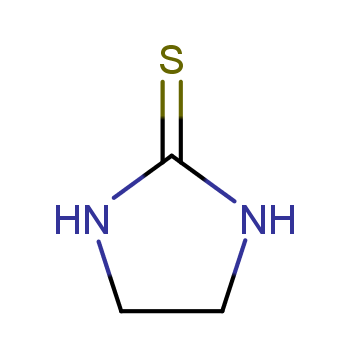
Ethylene thiourea is an organic molecule with the chemical formula C3H6N2S. Ethylene thiourea structure be depicted as follows:

What is ethylene thiourea used for? Ethylene thiourea has been used in various industrial applications but is gradually being phased out due to safety concerns. Its historical uses include being a vulcanization accelerator for polychloroprene (neoprene) and polyacrylate rubbers. Polychloroprene rubber is primarily used in industrial applications (e.g., mechanical and automotive products), wire and cable production, construction, and adhesives. Polyacrylate rubbers are used in automotive and aerospace applications for seals, O-rings, and gaskets, among other products. Ethylene thiourea is also used in the manufacture of ethylene bisdithiocarbamate pesticides, such as amobam, maneb, mancozeb, metiram, nabam, and zineb. It is also used in electroplating solutions, as an intermediate in antioxidant production, dyes, pharmaceuticals, and synthetic resins.
Ethylene thiourea is used in the rubber industry and in the production of certain fungicides. There are no reports of acute (short-term) or chronic (long-term) effects of ethylene thiourea on humans. Effects on the thyroid gland have been observed in rodents exposed to ethylene thiourea in their diet for extended periods. Ethylene thiourea has been shown to be a potent teratogen (causing birth defects) in rats through oral or dermal exposure. A study of female workers occupationally exposed to ethylene thiourea did not report an increased incidence of thyroid cancer. An increase in thyroid tumors in rats and tumors in the thyroid, liver, and pituitary gland in mice exposed to ethylene thiourea has been observed in a National Toxicology Program (NTP) study. The United States Environmental Protection Agency (EPA) has categorized ethylene thiourea as a B2 carcinogen, possibly carcinogenic to humans.
The National Institute for Occupational Safety and Health (NIOSH) recommends cautious handling of ethylene thiourea in the workplace as if it were a human carcinogen and teratogen. Exposure to ethylene thiourea should be limited to as few employees as possible, with exposure levels in the workplace minimized. Its use should be restricted to employees crucial to the process or operation. Specific practices include:
Using alternative materials with lower potential health and safety risks is one approach. However, great caution must be taken when selecting possible substitutes. The potential impacts on human health of alternatives to ethylene thiourea must be thoroughly assessed. A seemingly safe substitute may only reveal serious health effects after years of use.
Where feasible, the most effective control of ethylene thiourea is through closed operations and/or local exhaust ventilation to control the pollution source. If feasible, processes or operations should be enclosed under slight vacuum so that any leaks result in air being drawn into the enclosure. The next most effective control measure is a well-designed local exhaust ventilation system that physically encloses the process as much as possible and has sufficient capture velocity to prevent pollutants from entering the workplace atmosphere. To ensure the effectiveness of ventilation equipment, the effectiveness of ventilation equipment should be checked at least every three months (e.g., air velocity, static pressure, or airflow). The effectiveness of the system should be checked immediately after any changes in production processes or controls that may result in a significant increase in ethylene thiourea exposure in the air.
A third option is to isolate employees. This often involves the use of automated equipment observed by personnel from enclosed control rooms or rooms. The control room is maintained at a higher pressure than the process equipment to ensure that airflow is out of the room rather than into it. This type of control does not protect employees who must perform process checks, adjustments, maintenance, and related operations.
The least favored method is the use of personal protective equipment. This equipment may include respirators, goggles, gloves, and related items and should not be the sole means of preventing or reducing contact during routine operations. Respirators should not be used to control exposure to ethylene thiourea except during installation or implementation of engineering or work practice controls; or in situations where engineering and work practice controls are technically infeasible; or maintenance; or work requiring entry into tanks or confined spaces; or in emergencies.
The melting point of ethylene thiourea is 203°C (397°F). Other physical properties of ethylene thiourea include:
Through this article, we have gained deeper insights into the uses, structure, and toxicity of ethylene thiourea. Ethylene thiourea, as an important organic sulfur compound, plays a significant role in various fields. However, it is crucial to be aware of its toxicity and safety hazards and to exercise caution and control during its usage. Future research should further explore the performance and reaction mechanisms of ethylene thiourea, exploring its potential applications in more domains while also enhancing the assessment and management of its toxicity and safety.
[1] https://pubchem.ncbi.nlm.nih.gov/compound/2723650
[2] https://en.wikipedia.org/wiki/Ethylene_thiourea
[3] https://meridian.allenpress.com/rct/article-abstract/95/4/550/488235/QUEST-FOR-SUSTAINABLE-CURATIVES-FOR-CHLOROPRENE?redirectedFrom=fulltext
[4] https://www.cdc.gov/niosh/docs/78-144/default.html
[5] https://www.epa.gov/sites/default/files/2016-09/documents/ethylene-thiourea.pdf
|
 |
 |
 |
 EN
EN
 Agricultural News
 Food News
 Industrial News
 Cosmetic News
 Pharmaceutical News
 Science News

 1YR
1YR


