-
We detected your language preference as English. Would you like to switch to the English version for a better experience?
Switch to English
Stay here


Glyoxylic acid monohydrate is a chemical compound with a specific chemical structure and properties. This article will introduce the structural characteristics of glyoxylic acid monohydrate and its applications in the chemical and industrial fields.

Glyoxylic acid monohydrate, CAS: 563-96-2, molecular formula: C2H4O4. Glyoxylic acid monohydrate is found naturally in immature fruits and young green leaves, as well as in young sugar beets. It has wide applications in flavors, medicine, paints, papermaking, fine chemicals, and more. It is used in cosmetics as a fragrance agent and fixative, in daily chemical product fragrances, and food flavoring. It is also a raw material for vanillin, ethyl vanillin, oral penicillin, allantoin, p-hydroxyphenylglycine, p-hydroxyphenylacetic acid, and can be used as an intermediate for pharmaceuticals, dyes, plastics, and pesticides.
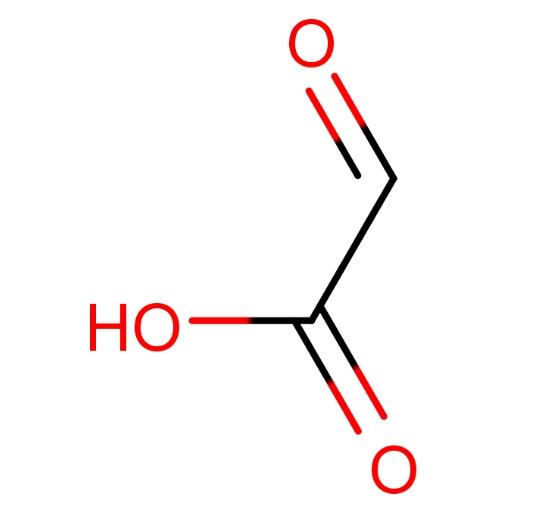
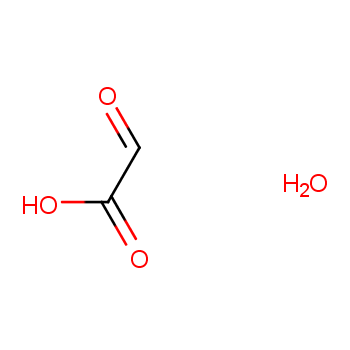
Glyoxylic acid is an important organic synthesis intermediate and pharmaceutical intermediate. The molecular formula is C2H2O3, consisting of an aldehyde group (-CHO) and a carboxyl group (-COOH), with properties of both an aldehyde and a carboxylic acid. Its structural formula is HOC-COOH, with glyoxylic acid monohydrate molecular weight of 74.04. Glyoxylic acid monohydrate is a white crystalline substance with an unpleasant odor; its aqueous solution is a colorless or pale yellow transparent liquid. It is easily soluble in water, poorly soluble in ether, ethanol, and benzene, and is corrosive. Glyoxylic acid monohydrate has a molecular formula of C2H4O4, a molecular weight of 92.05, glyoxylic acid monohydrate melting point of 49-52°C (lit.), a boiling point of 100°C (lit.), and glyoxylic acid monohydrate density of 1.33 g/mL at 20°C. The structure of glyoxylic acid monohydrate is as follows:

There are three main methods for producing glyoxylic acid: nitric acid oxidation of glycol, electrolysis of oxalic acid, and ozonolysis of maleic anhydride. Most Chinese glyoxylic acid manufacturers adopt the nitric acid oxidation method of glycol, producing 40-50% glyoxylic acid aqueous solutions. Glyoxylic acid monohydrate, as a high-purity glyoxylic acid product, can be used in fine chemical products and other high-end markets. Glyoxylic acid monohydrate is generally synthesized using the ozonolysis method of maleic anhydride or ozonolysis with a catalyst, producing high-purity products with advanced technology and minimal environmental pollution.
A reported production method involves heating 40-50% crude glyoxylic acid, adding a precipitant, stirring, cooling, filtering, adding activated carbon, cooling, filtering again, concentrating the filtrate to 55-67wt%, cooling, adding glyoxylic acid monohydrate crystals, maintaining temperature, cooling to -10 to -5°C, and filtering the crystallized liquid to obtain a filter cake. After drying, glyoxylic acid monohydrate is obtained.
Glyoxylic acid monohydrate is an important intermediate in organic synthesis and pharmaceutical chemistry. Due to the presence of aldehyde and carboxyl groups in its structure, it exhibits high reactivity and can be used to construct various biologically active molecules and drug molecules with cyclic lactone structures.
The unique feature of this molecule lies in its two functional groups: aldehyde and carboxyl. The aldehyde group can undergo nucleophilic addition reactions and redox reactions, while the carboxyl group can participate in amidation and esterification reactions. These reactions provide rich chemical means to construct complex organic molecules.
Notably, glyoxylic acid monohydrate can form lactone compounds through its functional group reactions, and lactone structures are widespread in natural products, conferring important biological activities. For example, artemisinin with anticancer activity and paclitaxel with antibacterial activity both contain lactone structures.
Thus, glyoxylic acid monohydrate is not only a crucial raw material for synthesizing various biologically active molecules but also has potential biological activity itself, making it a research focus in organic synthesis and pharmaceutical chemistry.
Glyoxylic acid monohydrate shares some characteristics with other carboxylic acids (e.g., acetic acid, oxalic acid). However, it contains an aldehyde group (CHO) and a carboxylic acid group (COOH) connected by a single carbon atom, making it a bifunctional molecule capable of participating in reactions involving both aldehyde and carboxylic acid functional groups. This distinction affects its reactivity and makes it a valuable intermediate in various organic syntheses.
Glyoxylic acid monohydrate has several advantages. It is readily available and relatively inexpensive. Additionally, its inherent water content can play a role in specific reactions. However, its corrosiveness and instability at higher temperatures require careful handling and control of reaction conditions.
Despite these limitations, glyoxylic acid monohydrate has specific applications. Notably, it plays a crucial role in the synthesis of pharmaceuticals and pesticides. Its structural characteristics make it a versatile component for manufacturing complex organic molecules. Furthermore, its ability to participate in condensation reactions has proven valuable in the production of resins and polymers.
Glyoxylic acid monohydrate, as a chemical substance with unique structure and properties, holds significant importance in the chemical and industrial fields. By deeply understanding its characteristics and applications, we can better utilize glyoxylic acid monohydrate's properties to promote development and progress in related fields. Future research on glyoxylic acid monohydrate is expected to bring more innovations and breakthroughs to science and industry.
[1] Qingdao Ozone Oxidation Method for Preparation of Crystalline Glyoxylic Acid Monohydrate Project[J]. Acetaldehyde Acetic Acid Chemical Industry, 2014(6):49.
[2] Xinjiang Guolin New Materials Co., Ltd. A Crystallization Method for Glyoxylic Acid Monohydrate. 2023-10-13.
[3] Xinjiang Guolin New Materials Co., Ltd. A Method for Preparation of Glyoxylic Acid Monohydrate by Ozone Oxidation. 2023-10-13.
[4]https://pubchem.ncbi.nlm.nih.gov/
[5]https://www.emdmillipore.com/US/en/product/Glyoxylic-acid-monohydrate,MDA_CHEM-804107
[6]Dhawa U, Connon R, Oliveira J C A, et al. Enantioselective Ruthenium-Catalyzed C–H Alkylations by a Chiral Carboxylic Acid with Attractive Dispersive Interactions[J]. Organic Letters, 2021, 23(7): 2760-2765.
 |
|
 |
 |
 |
 EN
EN
 Agricultural News
 Food News
 Industrial News
 Cosmetic News
 Pharmaceutical News
 Science News

 1YR
1YR

