-
We detected your language preference as English. Would you like to switch to the English version for a better experience?
Switch to English
Stay here


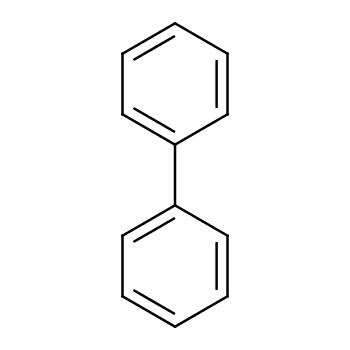
Biphenyl (C12H10) is a compound that consists of two phenyl rings joined together through a single bond. This structure gives biphenyl a unique set of properties, making it useful in various industries. Biphenyl is a non-polar molecule, which means that it does not have a significant separation of positive and negative charges. This characteristic influences its behavior in different chemical reactions and its applications. Let's explore the concept of polarity, understand why biphenyl is non-polar, and delve into its uses in various fields.
Polarity refers to the uneven distribution of electrical charges within a molecule, resulting in regions with positive and negative charges. This phenomenon occurs when electrons are not shared equally among atoms in a molecule. Polarity plays a crucial role in determining a molecule's chemical and physical properties, including its solubility, reactivity, and interactions with other substances.
To determine if biphenyl is polar or non-polar, we need to consider its molecular structure and properties. Biphenyl is composed of two phenyl rings, each containing six carbon atoms and five hydrogen atoms, connected by a single bond. This structure is symmetrical and does not create a significant separation of positive and negative charges.
The two phenyl rings in biphenyl are identical, and since they are connected by a single bond, the molecule does not exhibit any asymmetry. This symmetry leads to an even distribution of electrons, resulting in no net dipole moment. A molecule with a zero dipole moment is considered non-polar.

Each phenyl ring in biphenyl is composed of alternating single and double bonds between carbon atoms. Carbon is sp2-hybridized, which means that each carbon atom forms three sigma bonds and one pi bond. This hybridization results in a planar structure with a trigonal planar arrangement of atoms around each carbon atom. Within each phenyl ring, the carbon atoms are bonded to hydrogen atoms, which do not contribute to the polarity of the molecule. The remaining electrons are delocalized over the entire ring, contributing to the molecule's stability but not creating a significant separation of charges.

The dipole moment of a molecule is a measure of the separation of positive and negative charges. Since biphenyl has a symmetrical structure and the electron distribution is evenly spread across both phenyl rings, the molecule does not have a net dipole moment. Therefore, biphenyl is classified as a non-polar molecule.
The non-polar nature of biphenyl makes it suitable for various applications where polarity is not a significant factor. Some common uses of biphenyl include:
 |
|
 |
 |
 |
|
 EN
EN
 Agricultural News
 Food News
 Industrial News
 Cosmetic News
 Pharmaceutical News
 Science News

 3YRS
3YRS

