-
We detected your language preference as English. Would you like to switch to the English version for a better experience?
Switch to English
Stay here


The Lewis structure, developed by Gilbert N. Lewis, provides a visual representation of electron distribution within a molecule. It depicts valence electrons as dots and bonds as lines, enabling predictions about a molecule's structure and properties based on the octet rule. This principle asserts that atoms aim for stability by having eight electrons in their outer shell.
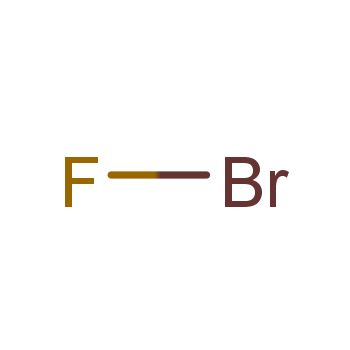
Bromine Monofluoride (BrF) is a chemical compound composed of one bromine atom bonded to one fluorine atom. This inorganic substance is colorless and exhibits properties influenced by the halogen family characteristics.

Let’s delve into the process of creating the Lewis structure for BrF:
Step 1: Identify the Central Atom: Bromine (Br) serves as the central atom since it is less electronegative than fluorine.
Step 2: Calculate Total Valence Electrons: Bromine contributes 7 valence electrons, and fluorine contributes 7, summing up to 14 valence electrons.
Step 3: Arrange Electrons Around Atoms: Connect the bromine atom to the fluorine atom with a single bond and distribute any remaining electrons as lone pairs around the atoms.
Step 4: Fulfill the Octet Rule: Ensure each atom has a full outer shell by allocating electrons appropriately.
Step 5: Check for Formal Charges: Formal charges might not be necessary if both atoms have satisfied the octet rule.
The molecular geometry of Bromine Monofluoride is determined by the Lewis structure, indicating a linear arrangement due to the single bond between the bromine and fluorine atoms. This geometry ensures minimal electron repulsion.

Molecular orbital theory explains electron repulsion and the pursuit of stable molecular configurations. For BrF, a single sigma bond forms between bromine and fluorine, with no lone pairs. The theory suggests that while bromine has only three valence orbitals, the Lewis structure implies a single bond pair, implying the use of additional orbitals in this hypervalent complex. However, advanced calculations reveal that the electronic structure primarily consists of two delocalized bonds across the two atoms, rather than a single bond involving additional orbitals.
The orbitals involved and the bonds produced during the interaction of bromine and fluorine will be examined to determine the hybridization of bromine monofluoride (BrF). The 4s, 4p, and 4d orbitals are involved. The bromine atom, which is the central atom in its ground state, will have the 4s²4p⁵ configuration.In the excited state, one of the paired electrons from the 4p orbital is promoted to an empty 4d orbital, allowing for bonding. The resulting hybridization involves the mixing of one 4s, three 4p, and one 4d orbital, leading to the formation of five sp³d hybrid orbitals, which facilitates the formation of the Br-F bond.
In Bromine Monofluoride, the bond angle is approximately 180 degrees due to the linear geometry of the molecule. The bond length is around 0.171 nm, reflecting the distance between the bromine and fluorine atoms in this compound.
Here’s a concise summary of key details for Bromine Monofluoride (BrF):
| Bromine Monofluoride (BrF) | |
| Molecular formula | BrF |
| Molecular shape | Linear |
| Polarity | Polar |
| Hybridization | sp3d hybridization |
| Bond Angle | 180 degrees |
| Bond length | 0.171 nm |
A Lewis structure is considered polar when there is an asymmetrical distribution of electron density due to differences in electronegativity between atoms. For Bromine Monofluoride, since bromine is less electronegative than fluorine, the molecule exhibits a polar bond between the atoms, resulting in a polar molecule overall.
Calculating bond energy from a Lewis structure involves consulting reference data for the specific bond strength. For Bromine Monofluoride, the bond energy can be estimated based on the energy required to break the Br-F bond, typically derived from thermodynamic or spectroscopic measurements.
Bond order is determined by counting the number of shared electron pairs between atoms in a Lewis structure. In Bromine Monofluoride, the bond order is 1, reflecting the single bond between bromine and fluorine.
Electron groups in a Lewis structure encompass both bonding pairs (shared electrons) and lone pairs (unshared electrons). In Bromine Monofluoride, bromine has one electron group (the single bond with fluorine), while fluorine has one bonding pair and one lone pair.
In a Lewis dot structure, dots represent valence electrons, illustrating the electron configuration of atoms in a molecule. For Bromine Monofluoride, the dots around bromine indicate its seven valence electrons, while the dot around fluorine represents its seven valence electrons.
 |
|
 |
 EN
EN
 Agricultural News
 Food News
 Industrial News
 Cosmetic News
 Pharmaceutical News
 Science News