Guideview >  Articles >  Property  > What is the Lewis Structure of Salicylic acid?

What is the Lewis Structure of Salicylic acid?

Discover the Lewis Structure of Salicylic acid, its molecular geometry, hybridization, and polarity. Unravel the secrets of this compound's bonding and properties. Sanchez1 MIN READMay 8, 2024

Welcome to the world of molecular structures! Today, we'll delve into the Lewis structure of Salicylic acid (C7H6O3), a compound with significant biological and medicinal relevance. Understanding its Lewis structure provides insights into its bonding, geometry, and properties.


What is the Lewis Structure of Salicylic acid?


What is the Lewis Structures?

Lewis structures are graphical representations of molecular bonding patterns, proposed by Gilbert N. Lewis. They depict the arrangement of valence electrons as dots around atoms and lines representing bonds between atoms. By following the octet rule, Lewis structures help predict molecular geometry and properties.


What is Salicylic acid?

Salicylic acid is a monohydroxybenzoic acid with the chemical formula C7H6O3. It is known for its use in skincare products due to its ability to exfoliate skin and treat acne. Additionally, it serves as a precursor for the synthesis of aspirin and other pharmaceuticals.


How to draw Lewis structures for Salicylic acid?

Let's explore the Lewis structure of Salicylic acid:

Step 1: Identify the Central Atom: In Salicylic acid, the central atom is carbon (C) bonded to the carboxylic acid group.

Step 2: Calculate Total Valence Electrons: Carbon contributes 4 valence electrons, hydrogen contributes 1 each, and oxygen contributes 6 each. Thus, total valence electrons = 4 + (6 x 1) + (6 x 2) = 22.

Step 3: Arrange Electrons Around Atoms: Form single bonds between carbon and each hydrogen atom and between carbon and one oxygen atom in the carboxylic acid group. Distribute remaining electrons as lone pairs around oxygen atoms.

Step 4: Fulfill the Octet Rule: Ensure each atom (except hydrogen) has 8 electrons (2 lone pairs and 2 bonding pairs).

Step 5: Check for Formal Charges: Adjust bonds to minimize formal charges while maintaining the octet rule.


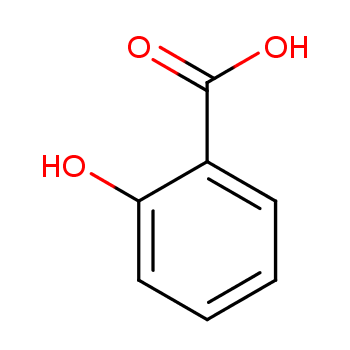
Molecular Structure of Salicylic acid

(Image Source: Wikipedia)


Molecular geometry of Salicylic acid

The Lewis structure suggests that Salicylic acid adopts a planar geometry around the carboxylic acid group, with the carbon atom at the center. The benzene ring maintains a trigonal planar geometry due to resonance structures.


Molecular Structure of Salicylic acid

(Image Source: Wikipedia)


Hybridization in Salicylic acid

In Salicylic acid, the carbon atom in the carboxylic acid group undergoes sp2 hybridization. One s orbital and two p orbitals combine to form three sp2 hybrid orbitals. These orbitals then overlap with the p orbitals of oxygen and carbon atoms, forming sigma bonds.


Is Salicylic acid polar or nonpolar?

Salicylic acid is polar due to the presence of the carboxylic acid group. The electronegativity difference between carbon, oxygen, and hydrogen atoms leads to polar covalent bonds, creating an overall polar molecule.


What are approximate bond angles and Bond length in Salicylic acid?

The bond angles in Salicylic acid vary, but in the carboxylic acid group, they are approximately 120 degrees due to the trigonal planar geometry. The bond length of carbon-oxygen double bonds is around 1.20 angstroms, and carbon-carbon bonds in the benzene ring are approximately 1.39 angstroms.

Note: Actual bond angles and lengths may vary slightly due to resonance effects and molecular interactions.


Highlight of Salicylic acid

Salicylic acid Cas 69-72-7
Molecular formula C7H6O3
Molecular shape -
Polarity polar
Hybridization sp2 hybridization
Bond Angle 120 degrees
Bond length C-O: 120 pm C-C: 139 pm


Related News
  • Salicylic Acid vs Ketoconazole
    Salicylic Acid vs Ketoconazole Salicylic Acid Ketoconazole Comparison Salicylic acid vs ketoconazole differ in their uses: salicylic acid is a keratolytic agent commonly used for acne and psoriasis, while ketoconazole is an antifungal treatment used for conditions like dandruff and fungal infections. Both target different skin issues effectively.
  • Adapalene vs Salicylic Acid
    Adapalene vs Salicylic Acid Adapalene Salicylic Acid Comparison Adapalene vs Salicylic Acid are both popular acne treatments, but they work differently. Adapalene, a retinoid, promotes skin cell turnover to prevent clogged pores, while salicylic acid exfoliates and helps unclog pores. Both are effective but target acne in different ways.
  • Glycolic Acid vs Salicylic Acid
    Glycolic Acid vs Salicylic Acid Glycolic Acid Salicylic Acid Comparison Glycolic acid vs salicylic acid both exfoliate the skin, but glycolic acid is an alpha hydroxy acid (AHA) that targets surface skin, while salicylic acid is a beta hydroxy acid (BHA) that penetrates pores, making it more effective for acne treatment.