-
We detected your language preference as English. Would you like to switch to the English version for a better experience?
Switch to English
Stay here


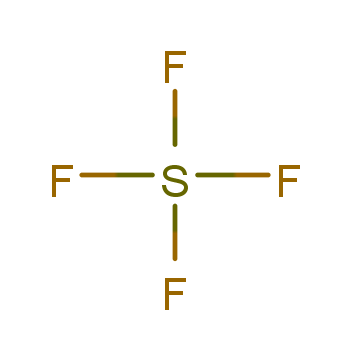
Sulfur tetrafluoride (SF4) is a chemical compound with a sulfur atom bonded to four fluorine atoms. The Lewis structure for SF4 depicts the arrangement of valence electrons in the molecule, following the octet rule, which states that atoms tend to achieve stability by having eight electrons in their outer shell. This structure helps predict the molecule's shape, properties, and bonding.
Sulfur tetrafluoride (SF4) is a colorless, toxic gas with a pungent odor. It is composed of one sulfur atom covalently bonded to four fluorine atoms. SF4 finds applications in semiconductor manufacturing, as a source of fluorine in various reactions, and as a reagent in organic synthesis.

Drawing the Lewis structure for SF4 involves understanding the valence electrons and the bonding pattern between sulfur and fluorine. Here’s how to proceed:
The Lewis structure for SF₄ indicates that the molecule has a seesaw molecular geometry. This geometry arises from the presence of one lone pair on the sulfur atom and four bonding pairs with fluorine atoms, leading to a trigonal bipyramidal electron pair geometry. The lone pair occupies an equatorial position, which minimizes repulsion and results in the characteristic seesaw shape of the molecule.
In SF4, the molecular orbital theory explains the electronic structure of the molecule. The bonding and antibonding molecular orbitals involve the combination of atomic orbitals from sulfur and fluorine. The exact details of the molecular orbitals and their energies depend on quantum mechanical calculations.
As mentioned earlier, the molecular geometry of SF4 is a seesaw shape. This results from the trigonal bipyramidal electron pair geometry, with sulfur at the center and fluorine atoms at the vertices of the bipyramid, along with one lone pair on sulfur.
The hybridization of sulfur in SF4 can be determined by considering the number of electron domains around the sulfur atom. With one lone pair and four bonding pairs, sulfur undergoes sp3d hybridization, forming five hybrid orbitals that participate in bonding.
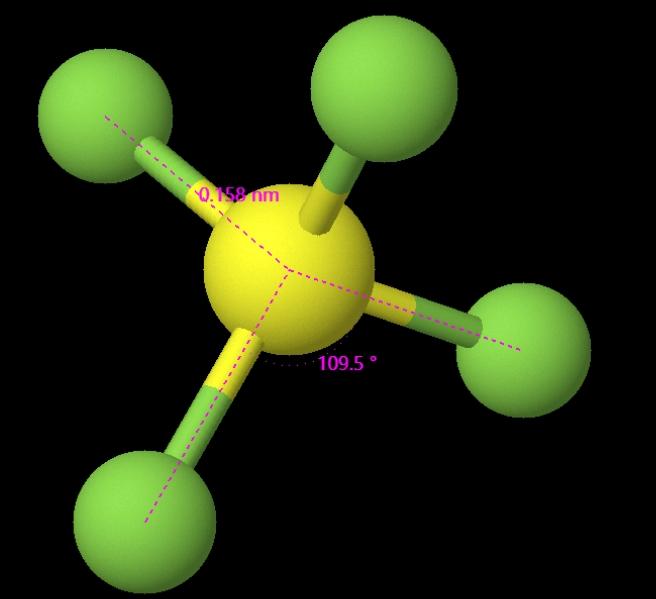
In SF₄, the F-S-F bond Angle is about 109.5 degrees. The bond lengths in SF₄ are approximately 0.158 nm for the S-F bonds, reflecting the strong covalent interactions between sulfur and fluorine.
| Sulfur Tetrafluoride (CAS Number: 7783-60-0) | |
| Molecular Formula | SF4 |
| Molecular Shape | Seesaw |
| Polarity | polar |
| Hybridization | sp3d hybridization |
| Bond Angle | 109.5 degrees |
| Bond Length | 0.158 nm |
To determine if a Lewis structure is polar, examine the molecular geometry and bond polarity. In the case of sulfur tetrafluoride (SF₄), the Lewis structure shows a sulfur atom bonded to four fluorine atoms. The molecular geometry is see-saw due to the presence of one lone pair on the sulfur atom, which leads to an asymmetrical distribution of charge. Each S-F bond is polar because fluorine is more electronegative than sulfur, creating dipole moments in each bond. The overall asymmetry from the lone pair and the arrangement of the fluorine atoms results in a net dipole moment, making SF₄ a polar molecule.
Bond energy can be estimated by summing the bond dissociation energies of all bonds in the molecule. For SF4, the bond dissociation energy of one S-F bond is approximately 275 kJ/mol. Since there are four S-F bonds, the total bond energy is about 1100 kJ/mol.
Bond order is calculated as the number of bonds between two atoms divided by two. In SF4, each sulfur-fluorine bond is a single bond, so the bond order for each S-F bond is 0.5. However, the concept of bond order is more commonly applied to double (1) and triple (2) bonds.
Electron groups in a Lewis structure refer to the total number of valence electrons associated with an atom, including both bonding pairs and lone pairs. In SF4, each sulfur atom has five electron groups: four bonding pairs with fluorine atoms and one lone pair.
In a Lewis dot structure, the dots represent valence electrons. Each dot corresponds to one valence electron of an atom, illustrating how electrons are shared or paired between atoms to form bonds.
 |
|
 |
 |
 |
 |
 EN
EN
 Agricultural News
 Food News
 Industrial News
 Cosmetic News
 Pharmaceutical News
 Science News