-
We detected your language preference as English. Would you like to switch to the English version for a better experience?
Switch to English
Stay here


The Lewis structure of a molecule provides a visual representation of the arrangement of electrons in that molecule. It helps us understand the bonding and electron distribution within the molecule. For tellurium hexafluoride (TeF6), the Lewis structure shows how tellurium (Te), a main group 16 elements, is bonded to six fluorine (F) atoms. The structure adheres to the octet rule, suggesting that each atom seeks to have eight electrons in its outer shell for stability.
Tellurium hexafluoride (TeF6) is a colorless, highly reactive, and volatile gas composed of one tellurium atom and six fluorine atoms. It is a compound known for its role in semiconductor manufacturing, particularly in the etching process of silicon wafers. TeF6 is also used in various industrial applications such as the production of other chemicals and as a reagent in organic synthesis.
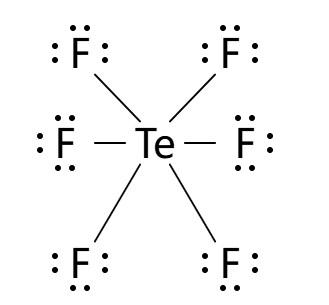
Let’s explore the steps to construct the Lewis structure of tellurium hexafluoride (TeF6):

The molecular geometry of tellurium hexafluoride (TeF6) is octahedral. This means the tellurium atom is at the center, surrounded by six fluorine atoms, which form a symmetrical octahedron around it. The bond angles between the F-Te-F bonds are approximately 90 degrees.
The molecular orbital theory explains electron repulsion and the need for compounds to adopt stable configurations. In TeF6, six sigma bonds form between tellurium and fluorine, with three lone pairs on each fluorine atom. Contrary to the initial Lewis structure suggesting six bond pairs, TeF6's actual electronic structure consists of four delocalized bonds across all seven atoms, rather than six distinct bonds involving d-orbitals.
The hybridization of the tellurium atom in TeF6 involves the mixing of atomic orbitals to form molecular orbitals. The involved orbitals include 3s, 3pz, 3py, 3pz, 3dx2–y2, and 3dz2. Initially, tellurium has a 3s23p4 configuration. During the interaction with fluorine, one electron from the 3s and 3pz orbitals is promoted to the unoccupied 3dz2 and 3dx2-y2 orbitals. As a result, all six half-filled orbitals hybridize to form six sp3d2 hybrid orbitals, facilitating the formation of the octahedral structure.
The bond angle in TeF6 is approximately 90 degrees, consistent with its octahedral geometry. This arrangement ensures minimal electron-electron repulsion among the six fluorine atoms. The bond length in TeF6 is approximately 155 pm.
| Tellurium Hexafluoride (TeF6) | |
| Molecular formula | TeF6 |
| Molecular shape | Octahedral |
| Polarity | Nonpolar |
| Hybridization | sp3d2 hybridization |
| Bond Angle | 90 degrees |
| Bond length | 155 pm |
To determine if a Lewis structure is polar, consider the molecular geometry and bond polarity. In the case of tellurium hexafluoride (TeF6), the octahedral geometry and symmetric arrangement of the six fluorine atoms around the tellurium atom ensure that any dipole moments cancel out, making TeF6 a nonpolar molecule.
To calculate the total bond energy of TeF6, look up the bond energy for a single tellurium-fluorine (Te-F) bond, typically around 250 kJ/mol. Since TeF6 has six Te-F bonds, multiply the bond energy by six to get the total bond energy, which is approximately 1500 kJ/mol.
Bond order refers to the number of chemical bonds between a pair of atoms. In the Lewis structure of TeF6, each Te-F bond is a single bond, so the bond order for each Te-F bond is 1.
|
 |
 |
|
|
 EN
EN
 Agricultural News
 Food News
 Industrial News
 Cosmetic News
 Pharmaceutical News
 Science News


