-
We detected your language preference as English. Would you like to switch to the English version for a better experience?
Switch to English
Stay here


Lewis structures, devised by Gilbert N. Lewis, visually represent electron arrangements in molecules. By depicting valence electrons as dots and bonds as lines, Lewis structures predict a molecule's shape and properties based on the octet rule. This rule states that atoms tend to achieve stability by having eight electrons in their outer shell. Lewis structures adhere to this rule, offering a clear picture of chemical bonding.
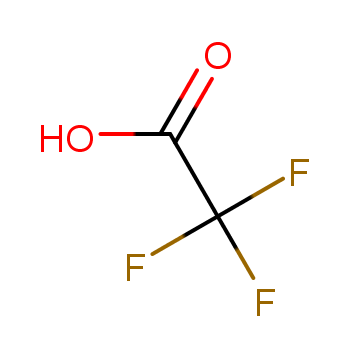
Trifluoroacetic acid (TFA), with the chemical formula CF3COOH, is a colorless liquid with a pungent odor. It is a strong acid and a useful solvent in organic synthesis. TFA is widely used in peptide synthesis and in the purification of proteins due to its ability to stabilize peptide chains and prevent racemization. Its molecular weight is 98.01 g/mol, and it is highly soluble in water and organic solvents.

Let's dive into drawing the Lewis structure of CF3COOH:
Step 1: Identify the Central Atoms: Carbon (C) and Fluorine (F) are the primary atoms in CF3COOH. Carbon is the central atom in the carboxyl group (COOH).
Step 2: Calculate Total Valence Electrons: Carbon contributes 4 valence electrons, oxygen contributes 6 valence electrons, and each fluorine contributes 7, and each hydrogen contributes 1 valence electron giving a total of 4*2 + 2*6+ 3*7+1= 42 valence electrons.
Step 3: Arrange Electrons Around Atoms: Connect each fluorine atom to the central carbon atom with a single bond (line) and distribute remaining electrons as lone pairs around each fluorine atom. For the carboxyl group, place a double bond between carbon and one oxygen atom, and a single bond between carbon and another oxygen atom.
Step 4: Fulfill the Octet Rule: Ensure each atom has 8 electrons (2 lone pairs and 1 or 2 bonding pairs). The carboxyl group should have two oxygen atoms, one with a double bond and one with a single bond to the carbon atom, and a hydroxyl group (OH).
Step 5: Check for Formal Charges: Formal charges may not be necessary as all atoms have achieved the octet rule.
The structure of trifluoroacetic acid consists of a central carbon atom that is part of a carboxyl group (COOH), flanked by three fluorine atoms. The molecular geometry of CF3COOH can be described as tetrahedral due to the arrangement of the substituents around the central carbon atom. The bond angles around the carbon atom are influenced by the presence of electronegative fluorine atoms and the carboxyl group.

Molecular orbital theory helps to explain the electron distribution and bonding characteristics in trifluoroacetic acid. In CF3COOH, the central carbon atom forms four sigma bonds: three with the fluorine atoms and one with the oxygen atom of the carboxyl group. The presence of these highly electronegative fluorine atoms leads to a polarization of the electron cloud, affecting the bond angles. The resulting bond angles—F-C-F at 106.9°, F-C-C at 122.3°, and O-C-O at 123.7°—reflect the interplay of sigma bonds and the steric effects of the substituents.
The Lewis structure indicates that trifluoroacetic acid adopts a tetrahedral geometry around the central carbon atom. The three fluorine atoms and the hydroxyl group are positioned around this central carbon, creating a spatial arrangement that minimizes electron pair repulsions. The bond angles are as follows: the F-C-F angle measures approximately 106.9°, while the F-C-C angle is about 122.3°. The O-C-O bond angle is slightly larger at 123.7°, indicating the influence of the carboxyl group.
To understand the bonding in CF3COOH, we examine the hybridization of the carbon atom. The ground state configuration of carbon is 1s²2s²2p². In trifluoroacetic acid, the carbon undergoes hybridization to form four equivalent sp³ hybrid orbitals. These orbitals participate in forming sigma bonds with the three fluorine atoms and the hydroxyl group, resulting in a tetrahedral arrangement that accommodates the bond angles and lengths effectively.
In trifluoroacetic acid, the bond angles are approximately as follows: F-C-F is about 106.9°, F-C-C is around 122.3°, and O-C-O is approximately 123.7°. The bond lengths are also significant: the C-F bond length is approximately 0.136 nm (136 pm), and the C-O bond length is similarly about 0.136 nm (136 pm). These values reflect the varying strengths and character of the bonds within the molecule, influenced by the presence of highly electronegative fluorine atoms and the carboxyl group.
| Trifluoroacetic Acid Cas 76-05-1 | |
| Molecular formula | CF3COOH |
| Molecular shape | Tetrahedral structure |
| Polarity | Polar |
| Hybridization | sp3 hybridization |
| Bond Angle | F-C-F is about 106.9°, F-C-C is around 122.3°, and O-C-O is approximately 123.7° |
| Bond length | C-F: 136 pm, C-O: 136 pm |
To determine if a Lewis structure is polar, examine the molecular geometry and bond polarity. In the case of trifluoroacetic acid (CF3COOH), the Lewis structure shows carbon at the center bonded to three fluorine atoms and a carboxyl group. CF3COOH has a bent structure around the oxygen atoms, leading to an overall polar molecule due to the asymmetry in the distribution of charge.
To calculate the total bond energy of CF3COOH, first, look up the bond energy for a single carbon-fluorine (C-F) bond and carbon-oxygen (C-O) bond, which are approximately 48 kcal/mol and 80 kcal/mol, respectively. CF3COOH has three C-F bonds and two C-O bonds, so you multiply the bond energies of these bonds by the number of bonds. This gives a total bond energy of 144 kcal/mol for the C-F bonds and 160 kcal/mol for the C-O bonds.
Bond order is the number of chemical bonds between a pair of atoms. In the Lewis structure of CF3COOH, each carbon-fluorine bond is a single bond, so the bond order for each C-F bond is 1. The carbon-oxygen bond in the carboxyl group includes a double bond, so the bond order for the C=O bond is 2.
Electron groups in a Lewis structure include both bonding pairs (shared electrons) and lone pairs (non-bonded electrons) around an atom. In CF3COOH, each carbon atom has four electron groups around it, corresponding to the three C-F bonds and one C-O bond (three bonding pairs and one lone pair on oxygen).
In a Lewis dot structure, the dots represent valence electrons. Each dot corresponds to one valence electron of an atom. In CF3COOH, carbon is surrounded by three bonding pairs (represented by lines in the Lewis structure) and each fluorine atom is represented by three pairs of dots (lone pairs) and one bonding pair with carbon. The dots help visualize how electrons are shared or paired between atoms.
|
 |
|
|
 EN
EN
 Agricultural News
 Food News
 Industrial News
 Cosmetic News
 Pharmaceutical News
 Science News

 3YRS
3YRS

