-
We detected your language preference as English. Would you like to switch to the English version for a better experience?
Switch to English
Stay here


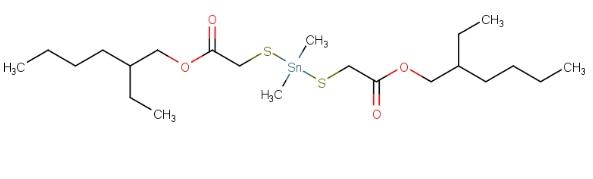
Methyltin mercaptide (a mixture of isooctyl tin tristhioacetate and isooctyl dimethyltin dithioacetate) is a widely used PVC heat stabilizer with excellent performance. Isooctyl dimethyltin dithioacetate, English name: Methyltin mercaptide, chemical formula [Sn(CH3)2(SC2H4O2COOC8H17)2], is an organic tin compound, and its structure is shown in the figure below:
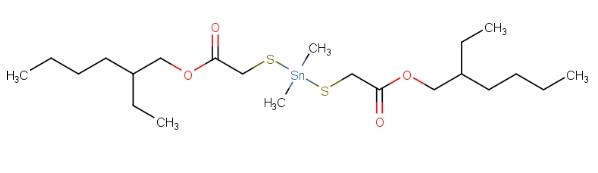
Methyltin mercaptide is one of the three major organic tin varieties. It is a transparent, clear and viscous liquid with good compatibility with PVC and C8-C12 fatty alcohols, C8-C12 fatty acids, phosphite fatty alcohol esters, oils and other weak polar oils. It is non-flammable and has a low freezing point. It is still a viscous liquid even at -20°C. Industrial products usually contain a mixture of dimethyltin mercaptide and monomethyltin mercaptide, among which the common ratio is a weight ratio of monomethyltin mercaptide to dimethyltin mercaptide of 20:80. Methyltin mercaptan has excellent initial stability, while dimethyltin mercaptan provides even better late stability. Methyltin mercaptan is also widely used in food and pharmaceutical packaging, as well as in non-toxic and harmless PVC products, and is widely used in the processing of plastic sheets, profiles, pipes, fittings and other blow-molded products.
In material science, methyl tin mercaptide can act as a metal preservative by forming a protective film, thereby extending the lifespan of metals. Its application in coatings and inks significantly enhances the adhesion and durability of the coatings.
As a highly effective heat stabilizer and catalyst, methyl tin mercaptide reacts with polymer chains to significantly improve the thermal stability, oxidation resistance, and weather resistance of materials. It is also used as a heat stabilizer for polymers such as PVC and polystyrene, enhancing the performance and quality of these materials.
Methyl tin mercaptide uses in food
Methyl tin mercaptide uses in food packaging: Certified by the US FDA (21 CFR 178.2010) and Germany's BGA (IIA, 4C), it is suitable for food packaging materials and drinking water pipes due to its high safety. Its excellent performance makes it widely used in the processing of food-grade hard transparent products. Furthermore, methyl tin mercaptide heat stabilizer (181) is one of the most effective heat stabilizers for PVC plastic processing, its high safety and good transparency make it especially suitable for food packaging and high-clarity hard PVC products, as well as for transparent films, PVC pipes, and plastic windows. Methyl tin mercaptide uses in food include its widespread application in food packaging and processing due to its effective properties.
In agriculture, methyl tin mercaptide, as a novel biopesticide, features broad-spectrum efficacy, high efficiency, low toxicity, and low residue. It effectively controls various crop pests and diseases, meeting the needs of modern green agriculture.
Methyl tin mercaptide stands out as an unrivaled PVC stabilizer in terms of heat stability. It offers superior high-temperature color stability and long-term dynamic stability, making it the preferred PVC stabilizer for all PVC homopolymers, including emulsions, suspensions, and bulk PVC, as well as copolymers, grafted polymers, and co-polymers.
Organic tin PVC stabilizers are known for their excellent transparency. Formulations using organic tin, especially methyl tin mercaptide heat stabilizers, yield crystal-clear products without whitening. Therefore, SS-218A/TM-181-FS can be used for bottles, containers, corrugated pipes, various types of rigid packaging containers, hoses, profiles, films, and more.
Methyl tin mercaptide is a non-toxic, environmentally friendly stabilizer. It migrates minimally in PVC and is approved for use in food and medical packaging PVC products and drinking water pipes in countries such as the US, Europe, and Japan. It is recognized by Germany’s Federal Health Bureau, the US FDA, BPF in the UK, and JHPA in Japan.
Methyl tin mercaptide exhibits excellent compatibility as a PVC stabilizer, ensuring uniform dispersion in PVC compounds. It does not cause precipitation in processed products, thus not affecting the surface properties and electrical performance of the products. Compared to butyl tin and octyl tin, methyl tin has better compatibility with PVC.
Methyl tin mercaptide improves the melt processing of PVC, enhancing its flowability during processing. Compared to mixed metal or lead salt stabilizers, it produces a lower melt viscosity, making it the best heat stabilizer for rigid PVC mixtures.
Using methyl tin mercaptide avoids scaling, reducing the frequency of equipment cleaning, increasing production efficiency, lowering production costs, and expanding profits.
Methyl tin mercaptide is a hazardous substance and must be handled with strict safety procedures. Always work in a well-ventilated fume hood and wear appropriate personal protective equipment, including gloves, lab coats, and safety goggles. Avoid contact with skin, eyes, and inhalation. Wash thoroughly after handling. Do not eat, drink, or smoke in the work area. If accidental contact occurs, rinse the affected area with water immediately and seek medical attention.
Proper storage and handling of methyl tin mercaptide are crucial for safety. Store it in a cool, dry, well-ventilated area, away from incompatible substances. Keep containers sealed. Dispose of the compound and its containers according to local, state, and federal regulations. Do not pour it down the drain or into water bodies. Consult hazardous waste disposal services for proper disposal.
|
 |
 |
 |
 |
 EN
EN
 Agricultural News
 Food News
 Industrial News
 Cosmetic News
 Pharmaceutical News
 Science News

 1YR
1YR

