-
We detected your language preference as English. Would you like to switch to the English version for a better experience?
Switch to English
Stay here


Dimethyltin bis(2-ethylhexyl thioglycolate), also known as Methyltin mercaptide, has the CAS number 57583-35-4 and the molecular formula C22H44O4S2Sn. The chemical structure of Methyltin mercaptide is [Sn(CH3)2(SC2H4O2COOC8H17)2], making it an organotin compound.
Methyltin mercaptide, a mixture of mono-methyltin tris(thioglycolate) and dimethyltin bis(thioglycolate), is a widely used and high-performing PVC heat stabilizer. It is generally recognized as one of the most versatile and best stabilizers used in the processing of rigid PVC plastics, offering unmatched thermal stability and transparency. Methyltin mercaptide provides excellent heat and oxidative stability while enhancing processing performance, such as reducing melt viscosity and promoting good fusion. It is highly compatible with PVC and almost entirely miscible with major plasticizers.
LogP: 4.74-8.5 at 20°C
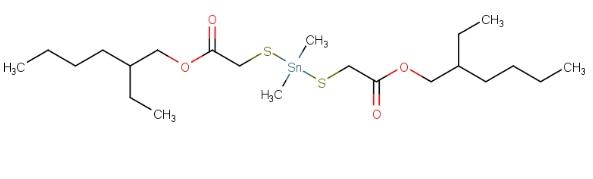
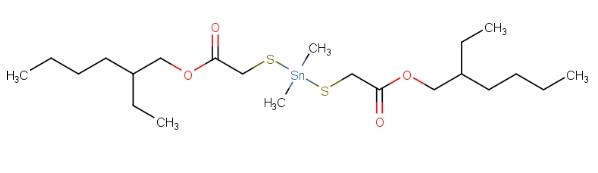
Methyl tin mercaptide structure
This formula indicates the composition of the compound, including carbon, hydrogen, oxygen, sulfur, and tin elements.
Molecular Weight: 555.4 g/mol
Purity: Typically 95%
The purity indicates the cleanliness of the compound, which is crucial for the reliability of experimental results.
14-carbon chain: This chain provides a certain degree of hydrophobicity, which may affect the solubility and biocompatibility of the compound.
Tin atom: The tin is bonded to the chain, potentially forming a five-membered ring. The formation of this ring can have a significant impact on the stability and reactivity of the compound.
Ester group: The ester group attached to the chain may influence the compound’s chemical behavior, including its solubility and reactivity with other chemicals.
The uses of this compound may involve catalysis, material science, or other fields of chemical research. Its complex structure and configuration of functional groups provide it with certain application potential in these fields.
The production technology of Methyltin mercaptide generally adopts the "one-step" synthesis process to prepare methyltin chloride. Methyltin chloride is composed of mono-methyltin trichloride and dimethyltin dichloride, with the ratio adjustable by the addition of tin tetrachloride. However, due to the special nature of the reaction, not every batch will yield the required ratio of mono-methyltin trichloride and dimethyltin dichloride.
Wang Aihong et al. achieved separation by adding sodium hydroxide to the mixture of mono-methyltin trichloride and dimethyltin dichloride, utilizing the differing compatibility of the resulting products with water. Methyl thioglycolate was then added to the separated mono-methyltin trichloride and dimethyltin dichloride to synthesize the corresponding high-purity mono-methyltin tris(thioglycolate) and dimethyltin bis(thioglycolate) monomers. These can be mixed in different proportions to produce various products, meeting different processing needs. The specific steps are as follows:
Add the calculated amount of 20% sodium hydroxide aqueous solution into a 500 mL three-necked flask, add a measured amount of methyltin chloride aqueous solution dropwise, start stirring, and after the dropwise addition, add 100 mL of water, stir, and filter. The filtrate is the hydroxyl group-bearing methyltin chloride aqueous solution. Hydrochloric acid is added to adjust the pH, followed by the addition of methyl thioglycolate, reacting at a certain temperature, maintaining temperature, separating layers, washing with water, filtering, and drying to obtain mono-methyltin tris(thioglycolate). The solid phase is dimethyltin oxide, which, after washing with water, is reacted with methyl thioglycolate at a certain temperature, maintaining temperature, separating layers, washing with water, filtering, and drying to obtain dimethyltin bis(thioglycolate).
Methyl tin mercaptide hs code
HS Code 38123090 is commonly used for Methyltin mercaptide. The breakdown of the methyl tin mercaptide hs code is as follows:
38: Chemical Products
12: Organic Compounds with Oxygen Function
30: Antioxidant Preparations and Other Compound Stabilizers for Rubber or Plastics90: Others
Important note: Although HS Code 38123090 is commonly used, it is essential to verify this with your local customs authorities. Factors such as the exact composition of Methyltin mercaptide, its specific use, and regional customs regulations can influence the correct HS code. For accurate and clear classification, please consult a customs broker or import/export expert in your country or region.
Hazards
Organotin compounds, especially those containing trivalent tin (Sn(III)), may have toxic properties. However, the specific toxicity of tetravalent tin (Sn(IV)) compounds is not yet fully documented and requires further research. According to the GHS hazard classification by the United Nations, this compound is marked as an irritant with health hazards, with the GHS signal word "Danger." Storage conditions are unclear, so please follow label instructions upon receipt. To ensure safe experimental operations, it is recommended to work in a well-ventilated laboratory and wear appropriate personal protective equipment.
General Advice: Consult a physician. Show the safety data sheet to the doctor in attendance.
If Inhaled: If breathed in, move the person into fresh air. If not breathing, give artificial respiration. Consult a physician.
In Case of Skin Contact: Wash off with soap and plenty of water. Consult a physician.
In Case of Eye Contact: Rinse thoroughly with plenty of water for at least 15 minutes and consult a physician.
If Swallowed: Never give anything by mouth to an unconscious person. Rinse mouth with water. Consult a physician.
Precautions for Safe Handling: Avoid contact with skin and eyes. Avoid the formation of dust and aerosols. Provide appropriate exhaust ventilation at places where dust is formed.
Conditions for Safe Storage, Including Any Incompatibilities: Store in a cool place. Keep the container tightly closed in a dry and well-ventilated place.
[1] Wang Aihong, Han Yonghe, Li Jian, et al. Study on the synthesis method of methyl tin mercaptan[J]. Plastic Additives, 2013(4):24-26. DOI:10.3969/j.issn.1672-6294.2013.04.006.
[2] Zhejiang Hepton Chemical Technology Co., Ltd. A method for preparing methyl tin mercaptan. 2011-11-23.
[3]https://pubchem.ncbi.nlm.nih.gov/compound/Methyltin mercaptide
[4]https://www.guidechem.com/msds/57583-35-4.html
 |
|
 EN
EN
 Agricultural News
 Food News
 Industrial News
 Cosmetic News
 Pharmaceutical News
 Science News


 1YR
1YR


