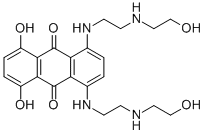
Mitoxantrone (MIT) is a non-cell cycle-specific broad-spectrum anticancer drug. Its chemical structure is similar to that of doxorubicin, except it lacks the amino sugar part at the 9th carbon atom. Its anticancer activity is also comparable to doxorubicin. Due to the absence of the amino sugar structure, it does not produce free radicals and has an inhibitory effect on lipid peroxidation, resulting in lower cardiotoxicity. Mitoxantrone inserts into DNA through hydrogen bonding, causing crosslinking and breaks in the DNA structure. It also inhibits RNA polymerase, thereby interfering with RNA synthesis. Mitoxantrone is an effective inhibitor of topoisomerase, an enzyme that unzips and repairs damaged DNA. Mitoxantrone is mainly used to treat acute non-lymphocytic leukemia and prostate cancer.
Mitoxantrone, also known as Mitozantrone, Dihydroxyanthracenedione, and several other names, is primarily classified as an antineoplastic drug and secondarily as an antineoplastic antibiotic. As an anthraquinone derivative of anthracycline antibiotics, Mitoxantrone’s structure and anticancer activity are similar to doxorubicin. Due to the absence of the amino sugar structure, it does not produce free radicals and has lower cardiotoxicity.
Mitoxantrone’s planar aromatic ring easily intercalates into the base pairs of the DNA double helix, forcing the two base pairs to separate and the DNA chain to elongate, resulting in structural denaturation and tumor cell death. Biochemical studies have shown that Mitoxantrone has little tendency to activate free radicals and does not increase the rate of microsomal NADPH oxidation or superoxide ion production, which are considered causes of myocardial damage by doxorubicin. Mitoxantrone is a non-cell cycle-specific cytotoxic drug that binds to DNA regardless of whether the cells are undergoing chromosomal replication. It also inhibits topoisomerase II and RNA polymerase activity, thereby interfering with DNA replication and inhibiting tumor proliferation.

Mitoxantrone is a synthetic anthracenedione derivative and a recognized cytotoxic antineoplastic agent. Its mechanism of action in multiple sclerosis (MS) is hypothesized to be immunosuppressive. In antineoplastic studies, this drug exhibits various immunomodulatory effects, inducing inhibition of macrophage-mediated B cell, T-helper cell, and cytotoxic T cell functions.
Mitoxantrone is a synthetic anthracenedione developed in the 1980s as a doxorubicin analog to find a cytotoxic agent with reduced cardiotoxicity compared to doxorubicin. It was approved by the FDA in 1987 for treating adult acute myeloid leukemia and in 1996 for symptomatic hormone-refractory prostate cancer. In 2000, Mitoxantrone was approved by the FDA for treating worsening relapsing-remitting multiple sclerosis (MS), secondary progressive MS, and progressive-relapsing MS. The drug’s highest concentrations are typically found in the thyroid, liver, and heart, and it persists in the body for up to 272 days. Mitoxantrone effectively reduces disease progression through various mechanisms, including inhibiting T cell, B cell, and macrophage proliferation. It impairs antigen presentation and reduces the secretion of pro-inflammatory cytokines. Mitoxantrone enhances T cell suppressor function and inhibits B cell function and antibody production. Finally, it inhibits macrophage-mediated myelin degradation. Compared to interferon beta, Mitoxantrone has a broader effect on various types of immune cells.
Mitoxantrone is a synthetic anthracenedione derivative and an antineoplastic immunomodulator. Its mechanism of action in multiple sclerosis (MS) patients is hypothesized to involve immunomodulatory mechanisms, although these mechanisms remain to be fully elucidated. Mitoxantrone hydrochloride was the first drug approved by the FDA for treating secondary progressive MS and progressive-relapsing MS. It is also used to treat worsening relapsing-remitting MS.
When you have multiple sclerosis (MS), your immune system attacks the normal brain and spinal cord and their protective myelin, leading to various MS symptoms. Mitoxantrone helps control these symptoms by suppressing the immune system, specifically reducing the number of T cells, B cells, and macrophages in the blood, thereby reducing inflammation in the brain and spinal cord. Although Mitoxantrone effectively controls MS symptoms, it does not cure the disease. Due to the potential for various side effects and the increased risk of certain complications, doctors usually consider using Mitoxantrone only in severe cases of MS.
Mitoxantrone is a drug used to treat certain types of cancer, particularly those related to leukemia and lymphoma. As a chemotherapy drug, Mitoxantrone works by interfering with cancer cells' DNA synthesis, inhibiting their growth and reproduction. However, due to its potential side effects and individualized impact on each patient, it must be used cautiously. Always consult a professional doctor when deciding whether to use Mitoxantrone and its specific dosage to ensure safety and optimal effectiveness. The doctor will provide professional advice based on your specific condition and health status and develop a personalized treatment plan.
[1]https://www.webmd.com/
[2]Liu Lili. Acute toxicity of mitoxantrone on zebrafish embryos and its molecular mechanism[D]. Chinese Academy of Agricultural Sciences, 2017.
[3]Tian Wei. Study on long-circulating thermosensitive liposomes of mitoxantrone[D]. Hebei Medical University, 2014.
[4]Fox E J. Mechanism of action of mitoxantrone[J]. Neurology, 2004, 63(12_suppl_6): S15-S18.
[5]Scott L J, Figgitt D P. Mitoxantrone: a review of its use in multiple sclerosis[J]. CNS drugs, 2004, 18: 379-396.
[6]https://www.sciencedirect.com/topics/medicine-and-dentistry/mitoxantrone
 |
|



 15YRS
15YRS


