-
We detected your language preference as English. Would you like to switch to the English version for a better experience?
Switch to English
Stay here


Murexide, as a special indicator, plays a key role in the Murexide test. By observing the color change that occurs after a sample reacts with Murexide reagent, the concentration of the target substance in the sample can be accurately determined, providing a reliable basis for further research on the properties and content of substances.
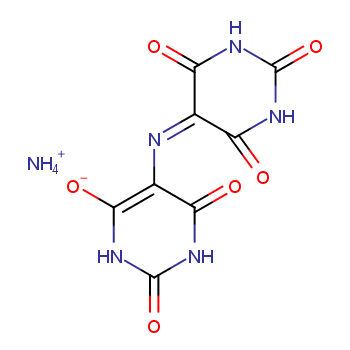
Murexide (NH4C8H4N5O6 or C8H5N5O6·NH3), also known as ammonium purpurate or MX, is the ammonium salt of purpuric acid; its English name is Murexide. The Murexide test is an analytical technique used to detect the presence of caffeine and other purine derivatives in a sample. These compounds do not react to common alkaloid identification tests, such as the Dragendorff reagent. In this test, the drug (to be identified) is mixed with a trace of potassium chlorate and a drop of hydrochloric acid. The sample is then evaporated to dryness, and the resulting residue is exposed to ammonia vapor. Purine alkaloids produce a pink-purple color in this test due to the formation of Murexide (ammonium purpurate, purple in pure form), which gives the test its name.
In its pure form, Murexide is purple, but when it is produced by the reaction of purines with acidified ammonia, it generates various shades of purple and pink.

Direct titration: Ca, Co, Cu, Ni
Back titration: Ca, Cr, Ga
Displacement titration: Ag, Au, Pd
Murexide is a valuable acid-base indicator, exhibiting different color changes at different pH levels.Murexide color change from yellow in acidic conditions (pH below 4.5) to bright purple in alkaline conditions (pH above 7.5), with a transition occurring between pH 5.5 and 6.5. This color change provides researchers with a clear visual cue to accurately determine the endpoint during titration, helping to determine the concentration of an unknown solution.
Murexide reacts with specific compounds to form colored complexes, which is particularly important for detecting and identifying specific compounds such as calcium and magnesium in biological samples.
The Murexide test is a color test for uric acid and some other purines. (Solid) samples are first treated with a small volume of concentrated acid (such as hydrochloric or nitric acid) and slowly evaporated; if uric acid is present, the subsequent addition of ammonia (NH3) will turn it purple due to the formation of Murexide. If xanthine or its derivatives are present, they will turn yellow when heated.
The Murexide test is a colorimetric method used to identify purine derivatives, particularly the presence of uric acid. The test involves two steps:
Oxidation
Treat the sample containing purine derivatives with concentrated nitric acid and heat it. This process oxidizes the purine compounds to form a product known as a denatured toxin.
Color Formation
Add ammonia to the oxidized product. If uric acid or other purine derivatives are present, they will react with ammonia to form Murexide, a purple compound. The intensity of the purple color is proportional to the concentration of purine compounds in the sample.
The Murexide test is a colorimetric test used to detect uric acid and some other purines. Here are the detailed steps:
Ensure the sample is dry and finely powdered.
Place a small amount of the sample in a porcelain dish. Add a few drops of concentrated nitric acid to the sample. Gently evaporate the mixture to dryness over a water bath. This step oxidizes uric acid to form a denatured toxin.
Allow the residue to cool completely. Add a drop of dilute ammonia to the residue. The presence of uric acid is indicated by a purple color, forming the purple compound Murexide.
Positive result: Purple indicates the presence of uric acid. Negative result: No color change or different color indicates the absence of uric acid.
|
 EN
EN
 Agricultural News
 Food News
 Industrial News
 Cosmetic News
 Pharmaceutical News
 Science News

 4YRS
4YRS

